
Charter Yacht Brands: The 5 Kings of the Caribbean
Five catamaran brands dominate Caribbean charters. Here’s what sets each builder apart.
Last Updated: September 7, 2026
The badge on a charter catamaran moves the price of a crewed week further than most people expect. The median Leopard lists at $26,000 and the median Sunreef at $73,000, and both are catamarans that sleep eight (Vital Charters rate analysis, September 2026).
If you’ve ever scrolled through Caribbean charter listings, you’ve noticed the same names appearing over and over: Lagoon, Bali, Fountaine Pajot, Leopard and Sunreef. Five builders, five price points, and the fifth is not the brand most guides name. We go deeper on two of them in our guides to Lagoon catamarans and Fountaine Pajot catamarans.
The global yacht charter market reached $9.30 billion in 2025 and is projected to hit $12.69 billion by 2031 (Mordor Intelligence, 2025). The Caribbean sits at the center of that growth. With steady trade winds, warm water year-round, and over 700 islands to explore, it’s no accident that Caribbean catamaran charters climbed 15% year-on-year in 2024 (Mordor Intelligence, 2025).
So which charter yacht brands actually dominate the Caribbean, and what does each one cost once a crew is aboard? That’s what this guide breaks down, from our own rate analysis rather than from brochures.
Why Is the Caribbean the World’s Best Cruising Ground for Catamarans?
Catamarans make up 64% of the crewed yachts holding a bookable 2026-27 Caribbean or Bahamas rate, 353 of 550, against 174 motor yachts and 23 sailing monohulls (Vital Charters rate analysis, September 2026). That isn’t just marketing. The region offers a combination of conditions that no other sailing destination can match, and catamarans are uniquely built to take advantage of every one of them.
Trade winds are the engine. The northeast trades blow a steady 15 to 25 knots from December through April, creating predictable sailing conditions that catamarans handle beautifully, and the pattern every winter itinerary is planned around. Unlike monohulls, cats sail flat. No heeling, no grabbing for handholds. You’re sipping a drink on a stable platform while doing 8 knots.
The water is absurdly warm. Sea temperatures range from 77°F to 84.5°F year-round, averaging about 80°F (SeaTemperature.org, 2026). That means swimming, snorkeling, and diving off the back of your charter catamaran every single day, no wetsuit required.
Island-hopping was made for multihulls. The Caribbean comprises more than 700 islands and over 5,000 cays and reefs (Encyclopaedia Britannica). Many of the best anchorages sit in shallow, reef-protected bays that monohulls can’t access. A catamaran’s shallow draft, typically 3.5 to 4.5 feet, opens up dozens of hidden spots that deeper-keeled boats have to skip. If you’re weighing your Caribbean charter destination options, the catamaran advantage becomes obvious quickly.
Short hops, big variety. Sail 15 to 30 nautical miles between islands and you’ll experience completely different cultures, cuisines, and marine environments. The BVI alone packs world-class sailing into an area you can cross in a few hours. For a closer look at what makes the BVI special, our BVI crewed charter guide covers it in depth.
Our experience: On a recent BVI charter aboard a Lagoon 46, we sailed from Norman Island to Anegada, roughly 25 nautical miles, in steady 18-knot trades with flat seas behind the reef line. First-time guests who’d been nervous about sailing were snorkeling at Loblolly Bay by lunch. That’s the Caribbean advantage: protected waters and predictable conditions that turn cautious newcomers into repeat charterers.
How Big Is the Caribbean Yacht Charter Industry in 2026?
The numbers tell a clear story: charter demand in the Caribbean isn’t just recovering from the pandemic era. It’s accelerating. The global yacht charter market hit $9.30 billion in 2025 and is on track to reach $12.69 billion by 2031, growing at a 5.32% compound annual rate (Mordor Intelligence, 2025).
The Caribbean captures a disproportionate share of that market. Europe still holds the largest single share of global charter revenue at 45.05%, but the Caribbean owns the November-to-April window outright (Mordor Intelligence, 2025). Tourism numbers reinforce the trend: the Caribbean recorded 33.7 million cruise visits in 2024, a 10.3% jump over 2023, with overnight visitor arrivals projected to reach roughly 35 million in 2025 (Caribbean Tourism Organization, 2025).
What’s driving this? A few factors. The rise of remote work has made week-long charters more accessible to younger professionals. The all-inclusive charter model has removed the complexity barrier for first-timers. And social media, particularly Instagram and TikTok, has turned Caribbean sailing into an aspirational lifestyle that drives booking inquiries.
For charterers wondering whether a yacht vacation makes financial sense compared to a traditional resort trip, the comparison between crewed charters and luxury resorts often surprises people.
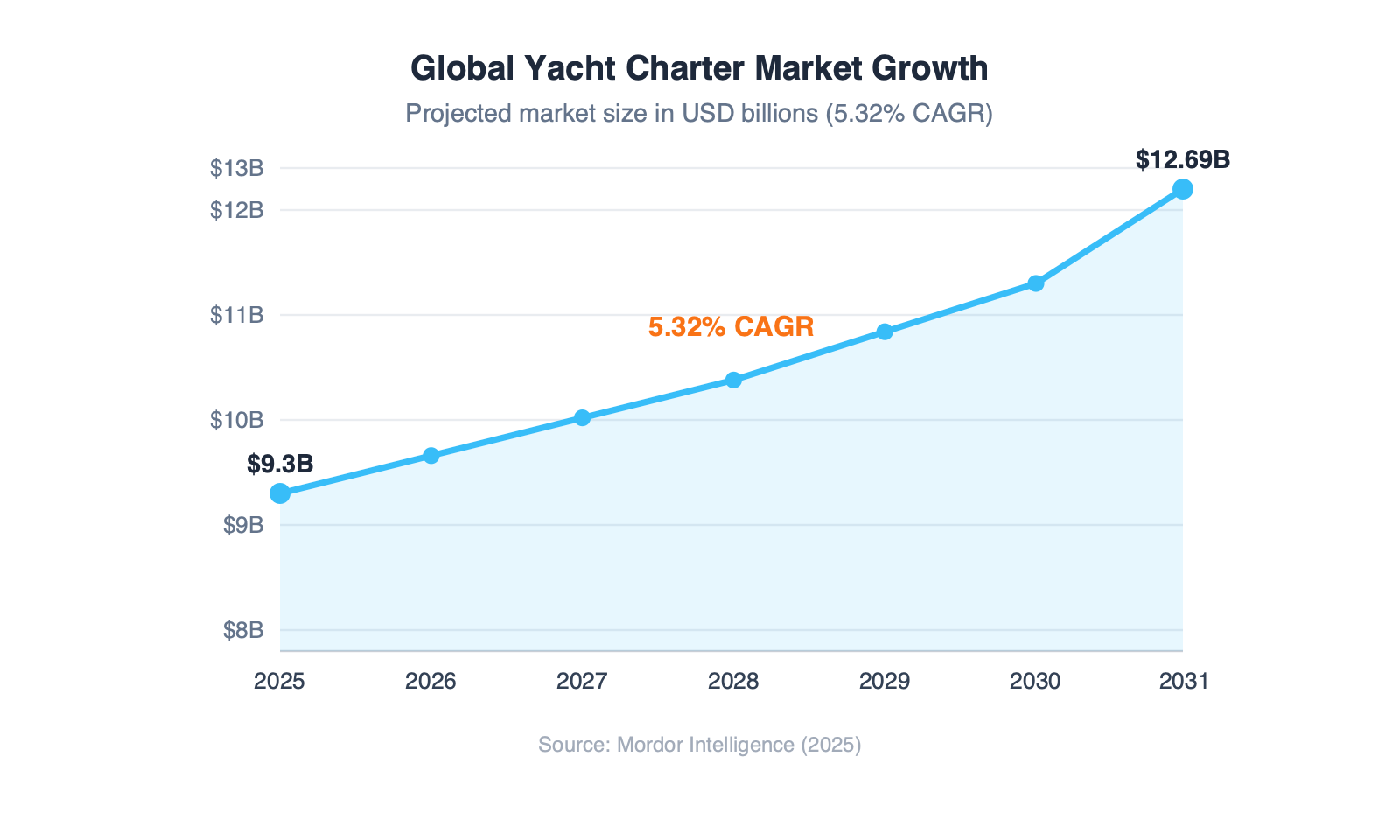
View data table
| Year | Market Size (USD) |
|---|---|
| 2025 | $9.30B |
| 2026 | $9.79B |
| 2027 | $10.31B |
| 2028 | $10.86B |
| 2029 | $11.44B |
| 2030 | $12.05B |
| 2031 | $12.69B |
Source: Mordor Intelligence (2025). 5.32% CAGR.
What Makes Caribbean Charter Logistics So Reliable?
Europe accounts for 45.05% of global charter revenue, but the Caribbean dominates the winter season (Mordor Intelligence, 2025). That kind of demand only works because the region’s infrastructure can handle it. Unlike remote sailing destinations where provisioning means “whatever the local market has,” the Caribbean offers a fully developed support ecosystem that keeps charter operations running smoothly.
Charter bases are everywhere. The major fleet operators maintain fully staffed bases across the BVI, USVI, St. Martin, Antigua, Grenada, and St. Lucia. That means professional check-ins, well-maintained fleets, and on-call support if something goes wrong mid-charter.
Provisioning is turnkey. Most charter companies offer pre-stocked provisioning packages. Your yacht arrives loaded with groceries, beverages, and supplies based on your preferences. On crewed charters, the chef handles everything: from sourcing fresh Caribbean lobster dockside to preparing multi-course meals onboard.
Marinas and boatyards are well-established. Yacht maintenance facilities across the Caribbean handle everything from routine haul-outs to major refits. This keeps charter fleets in excellent condition and gives owners confidence that their investment is being maintained to high standards.
Crew availability runs deep. The Caribbean has a long tradition of professional yacht crew (captains, chefs, stewardesses, and engineers) who know these waters intimately. That depth of talent is why crewed charter experiences in the region consistently rate higher than other destinations, and it is the part of a week you cannot buy by picking a different builder. Our guide to planning a Caribbean yacht charter covers how the pieces fit together. Understanding how charter rates, APA, and crew fees break down helps you see where that infrastructure investment goes.
Are you comparing destinations? Our BVI, Bahamas, and St. Martin comparison breaks down the logistical differences between the top Caribbean charter grounds.
Which Charter Yacht Brands Dominate the Caribbean?
Five builders supply 299 of the 353 crewed catamarans with a bookable Caribbean or Bahamas rate, and they land at five different price points. The rates below are what a crewed week actually lists at, measured from those 299 boats rather than taken from a brochure. Every figure covers the captain, the chef and the rest of the crew (Vital Charters rate analysis, September 2026).
Charter Catamaran Brand Comparison
| Brand | Founded | HQ | Yachts here | 25th pct | Median crewed week | 75th pct | Median length | What it is |
|---|---|---|---|---|---|---|---|---|
| Lagoon | 1984 | Bordeaux, France | 98 | $24,500 | $35,663 | $45,281 | 56 ft | The widest range on the water, 38 ft to 78 ft |
| Bali | 2014 | Canet-en-Roussillon, France | 72 | $25,000 | $31,000 | $32,000 | 54 ft | The most predictable price of any brand here |
| Fountaine Pajot | 1976 | La Rochelle, France | 57 | $28,000 | $42,500 | $55,000 | 59 ft | Sailing performance, and a step up in size |
| Leopard | 1991 | Cape Town, South Africa | 37 | $22,000 | $26,000 | $30,000 | 51 ft | The value entry to a crewed week |
| Sunreef | 2002 | Gdansk, Poland | 35 | $49,500 | $73,000 | $94,000 | 75 ft | Crewed luxury, and a different market entirely |
Two things in that table are worth pausing on. Bali is the most predictable brand to shop: half of them list between $25,000 and $32,000, a $7,000 spread, because the range runs only 42 to 58 ft. Lagoon is the least predictable: the same middle half spans $24,500 to $45,281, because Lagoon builds everything from a 38 ft to a 78 ft and all of it charters here. If you are comparing quotes, “it’s a Lagoon” tells you much less about the price than “it’s a Bali” does.

View data table
| Brand | Yachts | 25th pct | Median | 75th pct | Landed per guest, per night |
|---|---|---|---|---|---|
| Leopard | 37 | $22,000 | $26,000 | $30,000 | $602 |
| Bali | 72 | $25,000 | $31,000 | $32,000 | $637 |
| Lagoon | 98 | $24,500 | $35,663 | $45,281 | $686 |
| Fountaine Pajot | 57 | $28,000 | $42,500 | $55,000 | $841 |
| Sunreef | 35 | $49,500 | $73,000 | $94,000 | $1,479 |
Source: Vital Charters rate analysis, September 2026. High-season listed week. Landed cost adds APA and a 15% gratuity, then divides by guests and 7 nights.
Per guest per night the order barely changes, which is the useful part: the brands are not trading price against capacity, they are simply different boats. A Leopard week works out near $602 a head a night, a Bali $637, a Lagoon $686, a Fountaine Pajot $841 and a Sunreef $1,479.
Here’s what sets each builder apart.
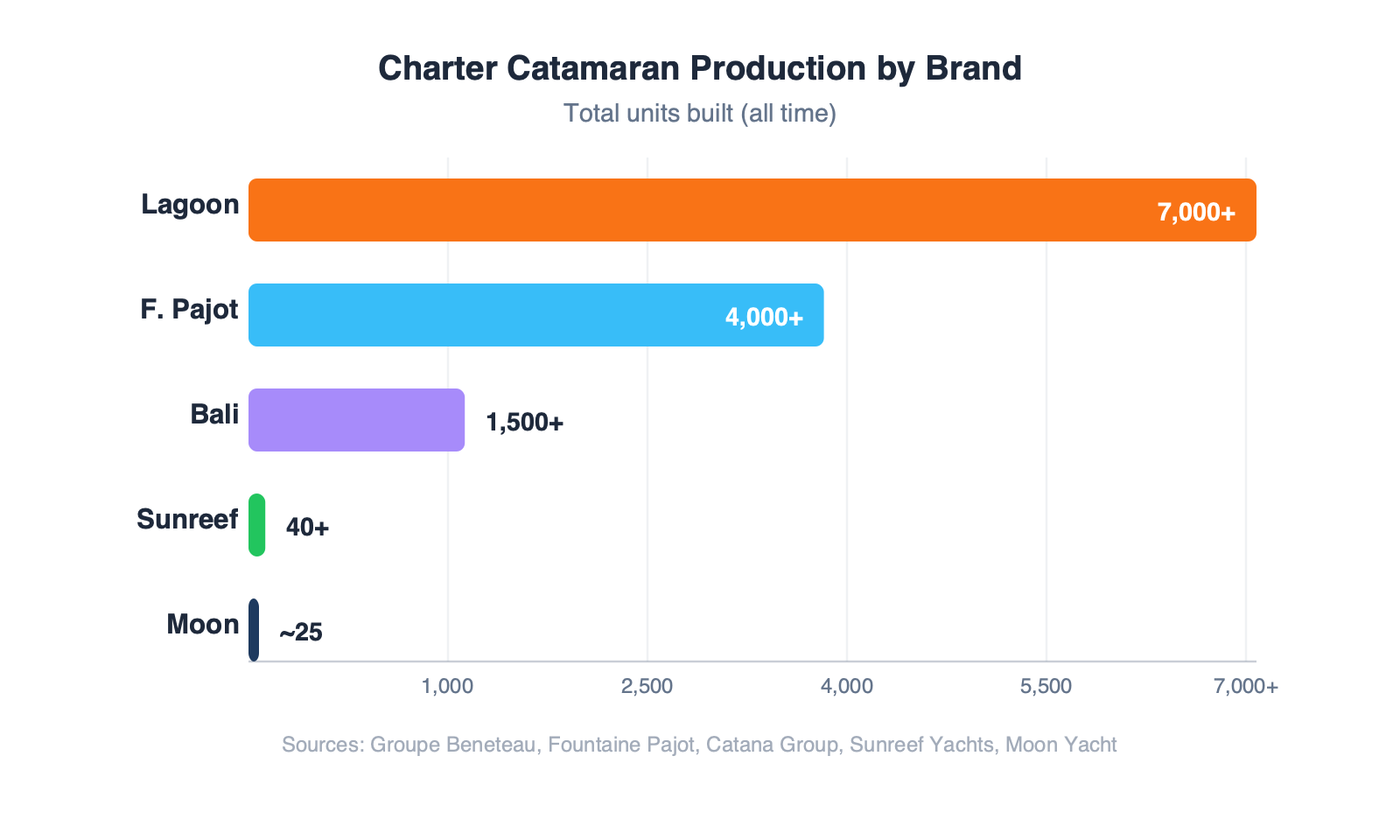
View data table
| Brand | Total Catamarans Built | Since |
|---|---|---|
| Lagoon | 7,000+ | 1984 |
| Fountaine Pajot | 4,000+ | 1976 |
| Bali | 1,500+ | 2014 |
| Sunreef | 40+ | 2002 |
| Moon | ~25 | 2021 |
Sources: Groupe Beneteau, Fountaine Pajot, Catana Group, Sunreef Yachts, Moon Yacht
Lagoon Catamarans: The Undisputed Volume Leader
With over 7,000 catamarans built since 1984 and an annual production rate of roughly 400 boats per year, Lagoon isn’t just the biggest charter yacht brand. It’s the biggest catamaran manufacturer in the world (Groupe Beneteau, 2024).
Lagoon at a Glance
Founded: 1984 (as JTA) · HQ: Bordeaux, France · Parent: Groupe Beneteau
Total built: 7,000+ · Annual output: ~400 boats/year
Crewed charters in this analysis: 98 · Size range: 38–80 ft
A brief history. Lagoon started as JTA (Jeanneau Techniques Avancees), a specialist multihull division within the Jeanneau shipyard. When Groupe Beneteau acquired Jeanneau in 1995, Lagoon came with it. Today, the brand operates out of Bordeaux, France, with dedicated production facilities purpose-built for catamaran construction.
What makes Lagoon dominant in charter? Volume and reliability. Charter companies need boats they can order in quantity, maintain affordably, and turn over predictably. Lagoon delivers all three. The Lagoon 42 and Lagoon 46 are charter workhorses: spacious enough for guests, simple enough for a fleet to keep running, and built in sufficient numbers that spare parts are available at any Caribbean boatyard.
Key charter models:
- Lagoon 40: compact 4-cabin layout, ideal for couples or small families
- Lagoon 42: the fleet workhorse, one of the most common hulls in Caribbean waters
- Lagoon 46: larger crewed charter option with owner’s suite
- Lagoon 51: flagship for premium crewed experiences
- Lagoon 38 (new, 2025): entry-level option for budget-conscious charterers
- Lagoon 47 (coming 2026): mid-range refresh
The iconic Lagoon 380 (with nearly 1,000 hulls produced over a 20-year run) remains one of the most chartered catamarans in Caribbean history (Katamarans.com, 2024).
Bali Catamarans: The Fastest-Growing Challenger
Bali has built approximately 1,500 catamarans since launching in 2014, a remarkable pace of roughly 350 boats per year for a brand barely a decade old (Catana Group, 2024). The parent company, Catana Group, recently unveiled a EUR 130 million strategic plan through 2030 to further scale production (Katamarans.com, 2025).
Bali at a Glance
Founded: 2014 · HQ: Canet-en-Roussillon, France · Parent: Catana Group (est. 1984)
Total built: 1,500+ · Annual output: ~350 boats/year
Crewed charters in this analysis: 72 · Size range: 42–58 ft
A brief history. Catana Group was founded in 1984 in Cogolin, France, building performance-oriented catamarans. The Bali sub-brand launched in 2014 with a radically different design philosophy aimed squarely at the cruising and charter market. Headquarters are now in Canet-en-Roussillon in southern France.
What makes Bali stand out? Innovation. Bali replaced the traditional trampoline net between the hulls with a solid foredeck platform, creating a massive forward cockpit that doubles as lounge space. The pivoting aft saloon door erases the boundary between indoor and outdoor living. These design choices feel purpose-built for charter guests who want open-air living without sacrificing comfort.
Key charter models:
- Bali 4.2: solid foredeck pioneer, the model that made the layout famous
- Bali 4.6: mid-range with expansive cockpit and saloon
- Bali 5.4: crewed luxury segment with owner’s suite
- Bali 5.8: flagship, competing with Lagoon 55 and FP Aura 51
- Bali 5.2 (new, 2025): versatile mid-range unveiled at Cannes
Fountaine Pajot: Five Decades of Catamaran Craft
Fountaine Pajot has produced more than 4,000 yachts since 1976, backed by a workforce of 800 employees across four production centers (Fountaine Pajot, 2026). Half a century of continuous catamaran building gives them a depth of engineering experience that few competitors can match.
Fountaine Pajot at a Glance
Founded: 1976 · HQ: La Rochelle, France · Founders: Jean-François Fountaine & Yves Pajot
Total built: 4,000+ · Employees: 800
Crewed charters in this analysis: 57 · Size range: 40–67 ft
A brief history. Jean-François Fountaine, an Olympic sailor, and Yves Pajot founded the company near La Rochelle, France, in 1976. They produced their first cruising catamaran, the Louisiane 37, in 1983, establishing the template for a livable, performance-capable multihull that the company has refined ever since.
What makes Fountaine Pajot a charter favorite? Build quality and balance. FP catamarans are known for sailing performance that doesn’t compromise living space. They tend to point higher and move faster than comparable Lagoons or Balis, which appeals to charterers who actually want to sail rather than just motor between anchorages.
Key charter models:
- Isla 40: the nimblest in the range and the best sailor of them
- Elba 45: mid-range workhorse, balanced layout for families
- Aura 51 / FP51: crewed charter flagship, evolving into the new FP51
- FP48, FP55, FPY70s (coming spring 2026): next-generation lineup
Leopard Catamarans: The Charter Workhorse
Leopard is the brand most likely to be under you on a first crewed week, and the cheapest of the five: 37 in the Caribbean and Bahamas crewed fleet, a median $26,000 for the high-season week, and 35 of the 37 chartering all-inclusive (Vital Charters rate analysis, September 2026). It is also the only one of the five whose median boat sleeps six rather than eight, at a median 51 ft, which is why it lands where it does.
Leopard at a Glance
Builder: Robertson & Caine, founded 1991 · HQ: Cape Town, South Africa
Brand launched: 1997 · Delivered: 3,000+ to charter fleets worldwide
In this analysis: 37 yachts · median 51 ft · median 2019 build
A brief history. John Robertson and Jerry Caine founded the yard in Cape Town in 1991 and launched the Leopard brand in 1997 (Leopard Catamarans, 2025). It now runs five production facilities and turns out more than 200 catamarans a year (Robertson and Caine, 2025).
What makes Leopard different? It is the only one of these five designed around charter service first and private ownership second. That shows up in details a guest never thinks about and a crew notices every week: sealed edges on laminated cabinetry, hardware sized for turnover rather than for a season, and layouts that put the galley where a chef can work in it. Over 3,000 hulls have gone to charter fleets worldwide (Yacht Style, 2025).
Key charter models:
- Leopard 45: the volume model, 379 hulls since 2017
- Leopard 46: forward cockpit, the layout the brand is known for
- Leopard 50: the crewed step up, four cabins and a flybridge
- Leopard 52: the current flagship
Our guide to Leopard catamarans goes through the model line boat by boat.
Sunreef Yachts: Where Luxury Meets Sustainability
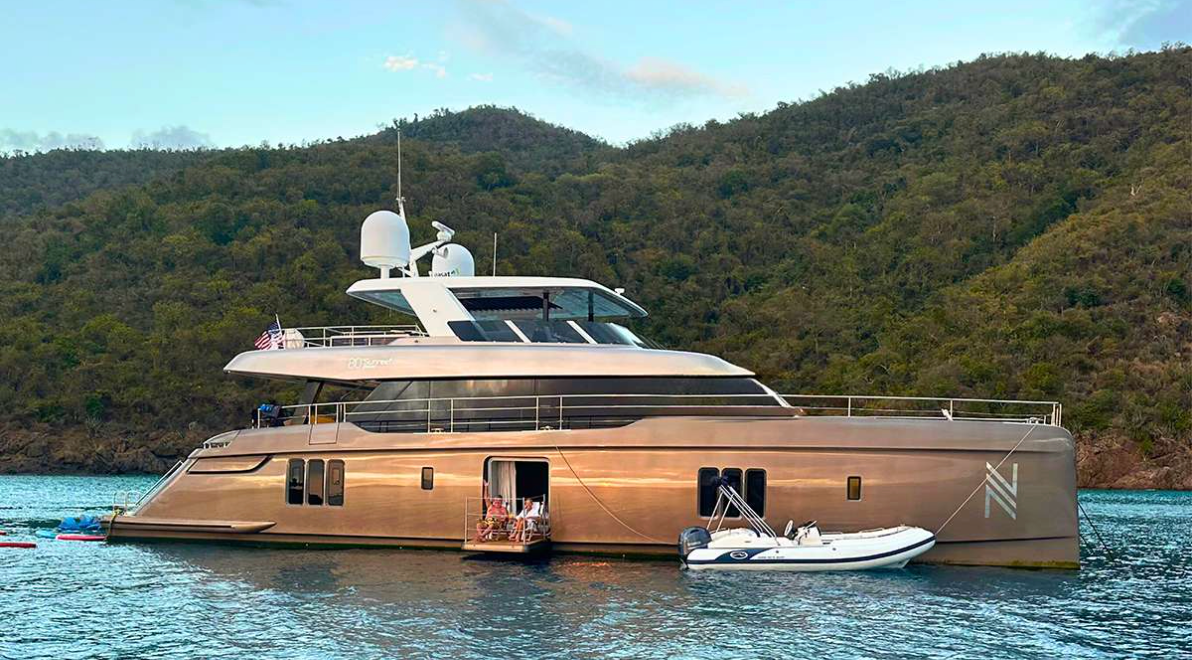
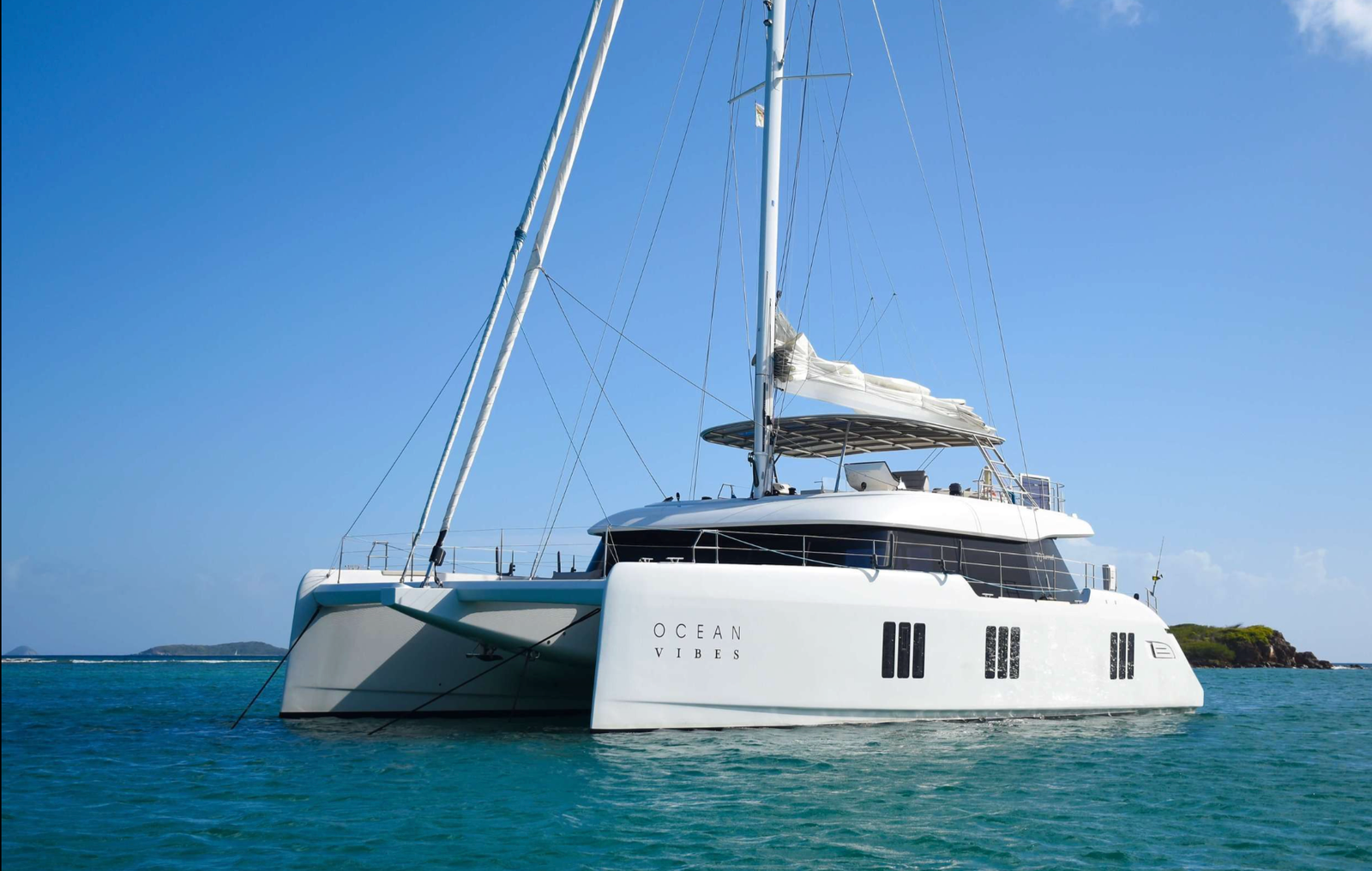
Sunreef doesn’t compete on volume, and its rates say so plainly: 35 in this analysis, a median $73,000 for the high-season week against $26,000 for a Leopard (Vital Charters rate analysis, September 2026). With 40-plus luxury catamarans built since 2002, it is playing an entirely different game. But the brand ranked 6th in BOAT International’s Global Order Book for 2026, putting them among the world’s most in-demand yacht builders (Sunreef Yachts, 2025).
Sunreef at a Glance
Founded: 2002 · HQ: Gdansk, Poland · Founder: Francis Lapp
Total built: 40+ · Build type: Semi-custom luxury
Charter segment: Crewed luxury · Size range: 50–100+ ft
A brief history. Francis Lapp founded Sunreef Yachts in 2002 in Gdansk, Poland, within the historic Gdansk Shipyard. The company launched with the world’s first 74-foot luxury catamaran with a flybridge in 2003, immediately staking out the premium end of the market. A second facility in Ras Al-Khaimah, UAE, expanded production capacity.
What makes Sunreef unique? Two things: luxury and eco-technology. Every Sunreef is semi-custom, built to the owner’s specifications with materials and finishes that rival superyachts. The Eco range integrates solar panels directly into the hull and superstructure, Sunreef manufactures its own photovoltaic cells in-house, enabling silent electric cruising. Their 60 Sunreef Power Eco won both Multihull of the Year and Catamaran of the Year for 2025 (Sunreef Yachts, 2025).
Key charter models:
- Sunreef 60: the most commonly chartered, fully crewed luxury experience
- Sunreef 80: flagship charter option with superyacht-level finishes
- Sunreef Eco range: solar-integrated electric propulsion for silent cruising
Sunreef is also the one brand here where the rate is often not the whole number: 14 of the 35 charter plus expenses, against 3 of 72 Balis and 2 of 37 Leopards, so on a Sunreef you should expect an APA on top (Vital Charters rate analysis, September 2026).
These are floating five-star hotels. For a sense of what’s included at this level, see our breakdown of what a charter fee covers under a MYBA contract.
Worth noting: Sunreef’s “Double Happiness”, a 100-foot solar electric supercat, represents a new frontier. As eco-conscious travelers increasingly ask about sustainable charter options, brands with proven electric propulsion technology will have a significant competitive advantage in the Caribbean market.
Moon Yachts: The One to Watch, Not Yet a King
Moon is the newest name here and by far the smallest presence: four Moon hulls are active in the Caribbean and Bahamas against 98 Lagoons, and three of them carried a bookable 2026-27 rate when we ran this (Vital Charters rate analysis, September 2026). That is not a criticism of the boats, it is the point of them. The brand launched its first yacht in March 2021 and debuted at the Cannes Yachting Festival that same year (Moon Yacht). If you charter one, it will be Moon Shadow, Perfect Moon, Tryst or the newest Moon 60 hull.
Moon at a Glance
Founded: 2021 · HQ: Gdansk, Poland · Ownership: Family-owned
Total built: ~25 · Build type: Small-batch semi-custom
Charter segment: Crewed luxury · Size range: 45–100 ft
A brief history. Moon Yachts is a family-owned operation based in Gdansk, Poland. Every vessel is assembled entirely in-house: a rarity in modern boatbuilding where outsourcing is standard. The company emphasizes traditional craftsmanship paired with contemporary design, producing semi-custom catamarans in small batches rather than at production-line scale.
What makes Moon different? Exclusivity. When you charter a Moon 60, you’re on one of perhaps two dozen boats in the world. The interiors are bespoke, the build quality is hands-on, and the attention to detail reflects a boutique mindset. In a Caribbean charter market flooded with identical Lagoons and Balis, a Moon catamaran stands out at the dock and on the water.
Key models:
- Moon Sail 60: the core charter model, multiple units in BVI/USVI service
- Moon Power 60: power catamaran variant for motor yacht enthusiasts
- Moon Sail 100 / Moon Power 100: superyacht segment
- M.O. 45: performance-oriented sports line
What Does the Future Look Like for Charter Catamarans?
The electric boat market was valued at $6.78 billion in 2024 and is forecast to reach $14.09 billion by 2030, a 13.5% compound annual growth rate (Grand View Research, 2025). Hybrid propulsion is following the same curve a step behind.
What does this mean for Caribbean charters? Expect to see more hybrid and electric catamarans entering fleets over the next five years. Sunreef is already there with the Eco range. Lagoon and Bali are both exploring hybrid propulsion options. Fountaine Pajot has signaled interest in electric-assisted sailing systems.
For charter guests, the benefits are tangible: quieter anchorages, reduced fuel costs (which can lower your APA), and a smaller environmental footprint. If understanding hidden charter costs are on your mind, fuel savings from hybrid propulsion could meaningfully reduce trip expenses.
Worth watching: several Caribbean marine parks already restrict what may run inside them, and the direction of travel is toward tighter limits rather than looser ones. We would not book a charter on the assumption that an electric hull opens anchorages a diesel one cannot reach today, but it is a reasonable thing to ask your broker about for a 2028 booking.
Which Charter Catamaran Brand Is Right for You?
Take the price first and the badge second, because the badge moves the price more than most people expect. Here is the short version of the table above.
- Leopard, median $26,000. The cheapest way onto a crewed catamaran, and the one built for charter turnover. Median boat sleeps six.
- Bali, median $31,000. The most predictable quote of the five, and the newest fleet: median build year 2023. Solid foredeck, open-air living.
- Lagoon, median $35,663. The widest choice by far, 98 boats from 38 ft to 78 ft, so the name alone tells you very little about the price.
- Fountaine Pajot, median $42,500. A step up in length and in sailing manners, at a step up in rate.
- Sunreef, median $73,000. A different market. Semi-custom, mostly 70 ft and up, and the one brand where you should budget an APA on top.
Planning a crewed celebration with a private chef and a flybridge jacuzzi? That is the Sunreef end of the table (Vital Charters rate analysis, September 2026).
Whatever you choose, the Caribbean itself is the constant. Warm water, steady wind, and 700 islands waiting for you to drop anchor. Find a crewed yacht in the brand that suits you.
Frequently Asked Questions
What is the most popular catamaran brand for Caribbean charters?
Lagoon, and not narrowly. Of the 353 crewed catamarans with a bookable Caribbean or Bahamas rate, 98 are Lagoons, against 72 Balis and 57 Fountaine Pajots (Vital Charters rate analysis, September 2026). Globally the yard has built over 7,000 catamarans since 1984 (Groupe Beneteau, 2024). That scale means parts availability and crew familiarity are unmatched, and it also means the widest price range of any brand: half of Lagoon charters list between $24,500 and $45,281. Choosing between islands as well as boats? Our BVI versus USVI catamaran charter comparison covers that side.
How much does it cost to charter a catamaran in the Caribbean?
A crewed catamaran in the Caribbean lists at a median $32,000 for the high-season week, and the brand moves that a long way: Leopard sits at a $26,000 median, Bali at $31,000, Lagoon at $35,663, Fountaine Pajot at $42,500 and Sunreef at $73,000 (Vital Charters rate analysis, September 2026). Most of them charter all-inclusive, so the listed rate is close to your real spend. Our breakdown of yacht charter cost by size shows the same fleet cut by length instead of badge, and our charter costs guide covers APA and the add-ons.
Are catamarans better than monohulls for Caribbean sailing?
Catamarans outsail monohulls in the Caribbean for most charter guests. Their shallow draft (3.5 to 4.5 feet) accesses anchorages monohulls can’t reach, and the stable twin-hull design eliminates heeling. The accommodation gap is measurable: a catamaran reaches a 4-cabin, 8-berth layout at a median 56 ft, where a monohull or motor yacht needs 94 ft, and catamarans carry 1.38 guests per 10 ft of length against 0.85 (Vital Charters rate analysis, September 2026).
What should I tip the crew on a crewed catamaran charter?
Crew gratuity in the Caribbean typically runs 15-20% of the base charter fee. On the $32,000 median crewed catamaran week, that’s $4,800 to $6,400 split among the crew. Our guide to tipping yacht crew covers MYBA guidelines, regional customs, and how to handle gratuity with grace.
When is the best time to charter a catamaran in the Caribbean?
Peak season runs December through April, when northeast trade winds blow a steady 15 to 25 knots and rainfall is minimal. Water temperatures stay between 77°F and 84.5°F year-round. Shoulder season is about availability rather than price: 70% of catamarans publish the same rate in low season as in high, and among the ones that move, the typical cut is under 7% (Vital Charters rate analysis, September 2026).
Find the brand that fits your group and your week.
Tell us your group size, dates, and preferred islands and we’ll match you to the best crewed catamaran from the top Caribbean charter brands.