
The Ultimate Yacht Charter Packing List
Pack right for your yacht charter with this broker-tested list. 72% of guests wish they’d brought more swimsuits. Here’s what to actually bring aboard.
Last Updated: October 14, 2026 · Originally published October 9, 2025
Most yacht charter packing mistakes are luxury charter essentials left at home. Air travelers have the opposite problem: about 19% of Americans have paid extra fees for overweight luggage when flying, according to a survey of 2,200 travelers (Upgraded Points / PR Newswire, 2024). After coordinating hundreds of Caribbean charters, we’ve found that the difference between an okay trip and an unforgettable one often comes down to what’s in your bag. Whether you’re stepping aboard a crewed catamaran in the BVI or a motor yacht in the Bahamas, packing smart is one of the easiest ways to plan your Caribbean yacht charter for success. Most of this checklist applies to any BVI yacht charter, whatever the season.
Which Documents Should You Pack First?
A passport, unless your entire week stays in the US Virgin Islands. The British Virgin Islands and the Bahamas both require one from every guest including children, and the Bahamas additionally wants at least six months of validity and will not accept a passport card. The USVI is US territory, so US citizens travel there domestically on a REAL ID-compliant license.
Pack it first, and check the expiry date the day you book rather than the week you fly. If your route touches the British Virgin Islands, there is also an online arrival card to complete up to 72 hours before you land, which has been mandatory since January 2025. Our guide to passport and entry requirements for charter guests covers all three destinations. Everything below assumes the documents are already sorted.
What Are the Luxury Charter Essentials for Clothing?
The BVI welcomed over 1.09 million visitors in 2024, its highest since Hurricane Irma, with roughly 70% of winter yacht charters concentrated in the Caribbean (BVI Government, 2025; All at Sea, 2025). The average Caribbean charter lasts seven days, which means you’ll need fewer outfits than you’d think, but more swimwear than you’d expect. The trick isn’t volume; it’s versatility.
Here’s what works aboard a BVI crewed charter:
Clothing essentials:
- 3–4 lightweight outfits (linen shirts, sundresses, quick-dry shorts)
- 3–4 swimsuits: you’ll always want a dry one ready
- 2 coverups or sarongs for transitioning from deck to dinner
- Non-marking boat shoes or soft-soled sandals (hard soles damage teak decks)
- A light sweater or hoodie for breezy evenings
Don’t bother with anything you’d worry about getting wet or salty. The Caribbean air, sea spray, and sunscreen will take a toll on fabrics. Pack clothes you love wearing, not clothes you’d be upset to stain.
What Toiletries and Sun Protection Do You Need?
Between 4,000 and 6,000 tons of sunscreen wash into ocean waters worldwide every year, with oxybenzone and octinoxate identified as the most harmful reef-damaging chemicals (U.S. National Park Service, 2024). Pack a sunscreen that leaves both out.
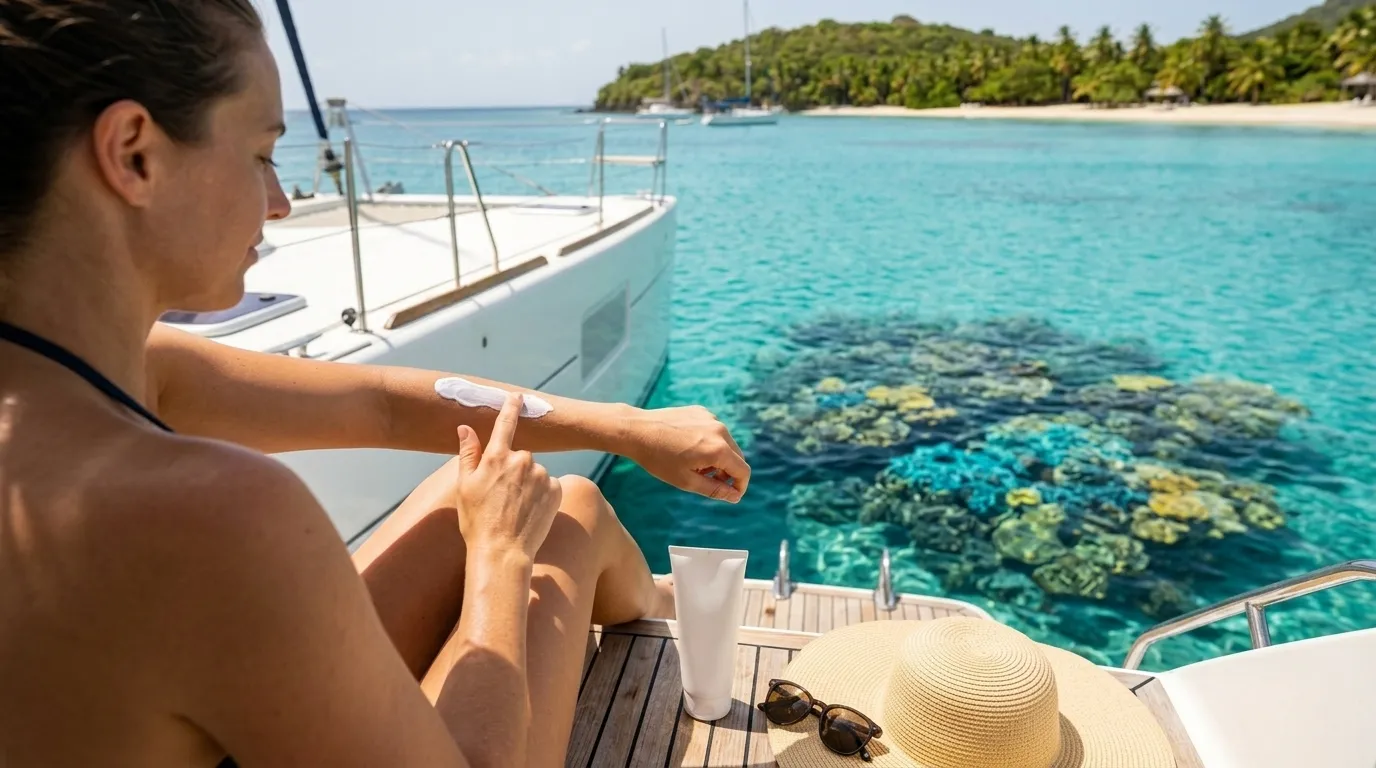
The U.S. Virgin Islands became the first U.S. jurisdiction to ban all three “Toxic O” sunscreen chemicals in 2020: oxybenzone, octinoxate, and octocrylene (USVI Government, 2020). Hawaii, Aruba, Bonaire, and Palau have their own bans, and the BVI strongly encourages reef-safe alternatives. A mineral sunscreen belongs at the top of any Caribbean yacht charter packing list.
Toiletries to bring:
- Reef-safe sunscreen (SPF 30+, mineral-based with zinc oxide or titanium dioxide)
- Aloe vera gel for inevitable sun exposure
- Motion sickness remedies (patches, wristbands, or meclizine, more on this below)
- Travel-size shampoo and conditioner (many crewed yachts provide these)
- Prescription medications in original packaging
- Insect repellent for shore excursions
Here’s a reality check on seasickness: approximately one-third of people are highly susceptible to motion sickness, and nearly anyone with a functioning vestibular system can experience it under enough stimulus (NCBI / StatPearls, 2024). Catamarans are significantly more stable than monohulls, but if you’re prone to motion sensitivity, bring remedies regardless. Scopolamine patches and over-the-counter meclizine are the most effective options.
How much sunscreen should you actually bring? More than you think. With 360-degree sun exposure on the water, reflected off the surface from every angle, you’ll reapply constantly. Plan on one full bottle per person for a week-long charter.
What Tech and Gear Should You Bring Aboard?
Airlines mishandled 33.4 million bags globally in 2024, costing the industry $5 billion, and only 25% were returned within 12 hours (SITA Baggage IT Insights, 2025). That’s reason enough to keep your valuables in a carry-on. On the yacht itself, the risk shifts to water damage, between dinghy rides, snorkeling trips, and constant sea spray, your electronics are exposed all week.
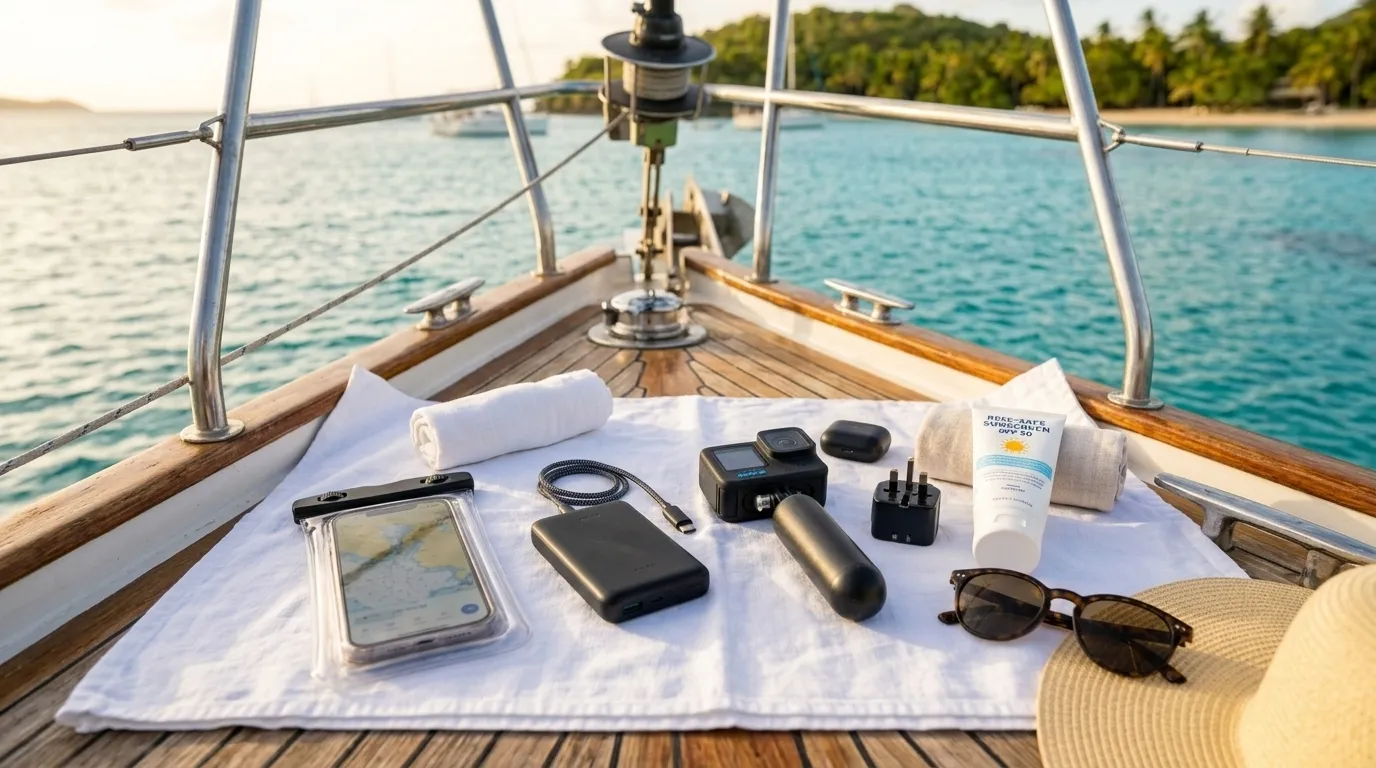
Tech essentials:
- Waterproof phone case or dry bag (non-negotiable)
- Portable charger / power bank: not all yacht cabins have USB outlets
- Universal adapter if you’re chartering internationally
- GoPro or waterproof camera for underwater shots
- E-reader or tablet for downtime (loading up shows beforehand helps since Wi-Fi is spotty in remote anchorages)
Among U.S. smartphone owners, 31% damaged a phone in the past year, about 78 million people, with water damage among the most common causes (Allstate Protection Plans, 2024). A week on the water raises that risk, so a waterproof phone case rated IP68 or higher is the single most important tech accessory for any sailing trip packing list.
Don’t bring a laptop unless you absolutely need to work. You won’t want screens once you’re anchored in crystal-clear water off Norman Island. But do bring a waterproof Bluetooth speaker if your charter doesn’t have a sound system. It transforms sunset cocktails on the flybridge.
Which Luxury Charter Essentials Do Guests Forget Most Often?
Extra swimsuits top the list of luxury charter essentials that guests wish they’d packed, followed by reef-safe sunscreen and motion sickness remedies, according to Vital Charters guest feedback collected over 2024–2025. The pattern is consistent enough that we now send a version of this list to every client before embarkation.

View data table
| Item | % of Guests Who Wished They’d Packed It |
|---|---|
| Extra swimsuits | 72% |
| Reef-safe sunscreen | 65% |
| Motion sickness remedies | 58% |
| Soft duffel bag | 51% |
| Light jacket for evenings | 44% |
| Waterproof phone case | 39% |
The top three surprises don’t cost much or take up space. They’re just easy to overlook when you’re packing for a beach vacation rather than a boat vacation. A yacht charter isn’t a hotel stay. You won’t have a gift shop downstairs or a pharmacy around the corner. Once you leave the marina, you have what you packed.
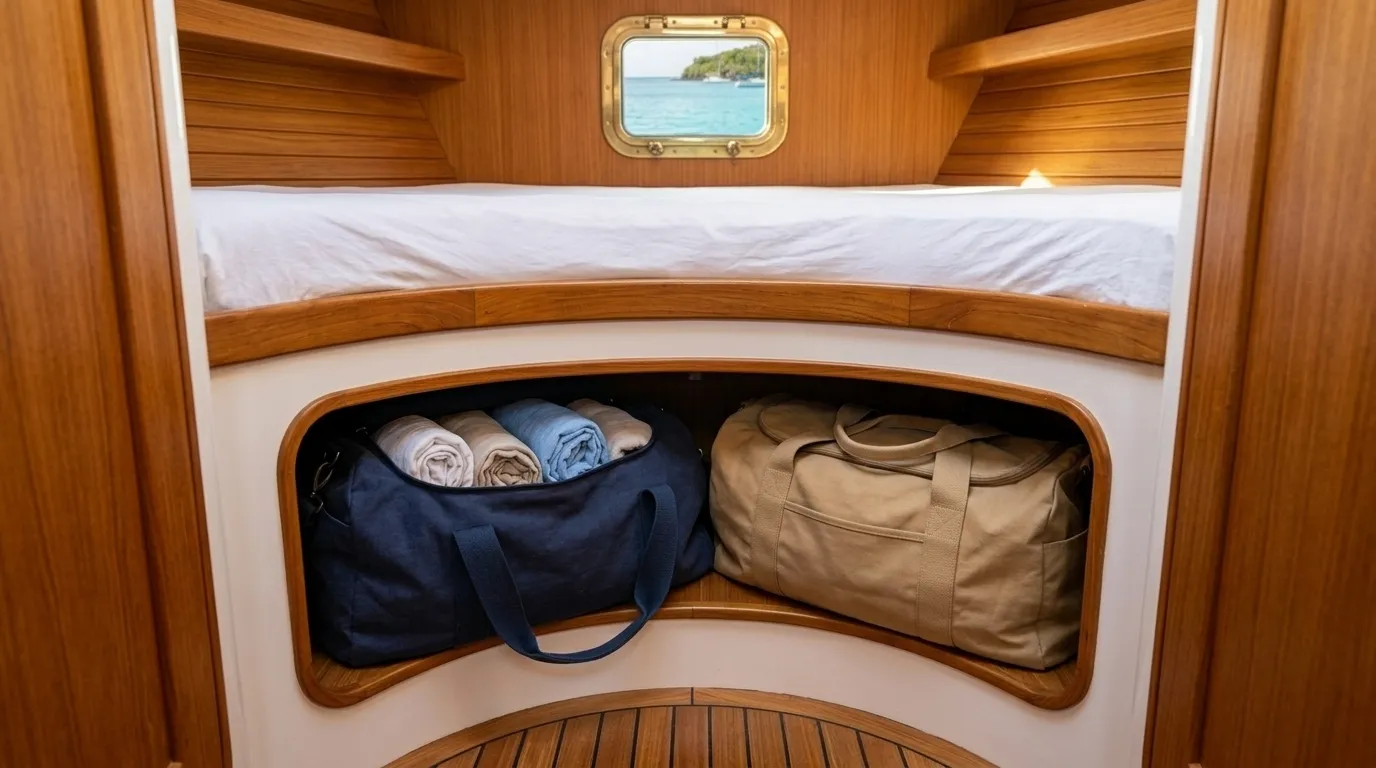
Soft duffel bags are the single most important luggage decision for a yacht charter. Hard-shell suitcases can’t fold into curved hull storage compartments, scratch teak interiors, and take up communal space in narrow companionways.
A few more items from the “wish I’d known” category:
- Dry bags in multiple sizes (one for your phone, one for a change of clothes during dinghy transfers)
- Rash guards or UV shirts: sunburn on day two ruins the remaining five days
- Ziplock bags for passports, cash, and anything that can’t get wet
- A compact first-aid kit with basics (bandaids, antibiotic cream, Ibuprofen)
- Snacks you love: all-inclusive charters provision before departure, but having your favorite snacks onboard feels like home
How Should You Pack for a Yacht?
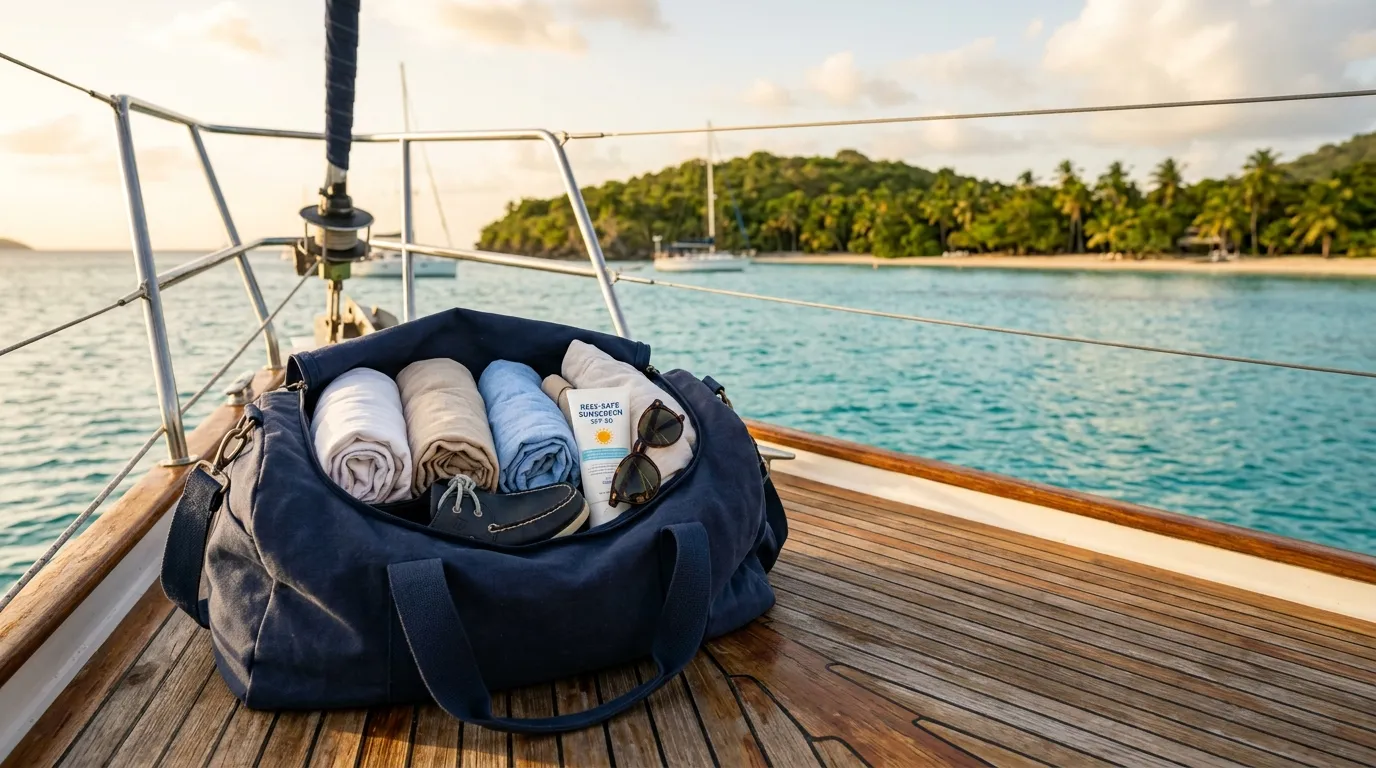
The golden rule is simple: soft bags only. Hard-shell suitcases are the single biggest packing mistake charter guests make. Yacht cabin storage is built around curved hull shapes, lockers, shelves, and under-berth compartments are designed for flexible bags that compress and fold, not rigid boxes that don’t.
Packing strategy:
- Soft duffel bags or backpacks: collapsible ones are ideal
- Roll, don’t fold: rolled clothes crease less
- Pack in layers: swimwear and daily clothes on top, evening and shore excursion wear beneath
- Fewer outfits than days: you’ll re-wear more than you think
- Separate wet bag: a waterproof stuff sack for damp swimsuits keeps everything else dry
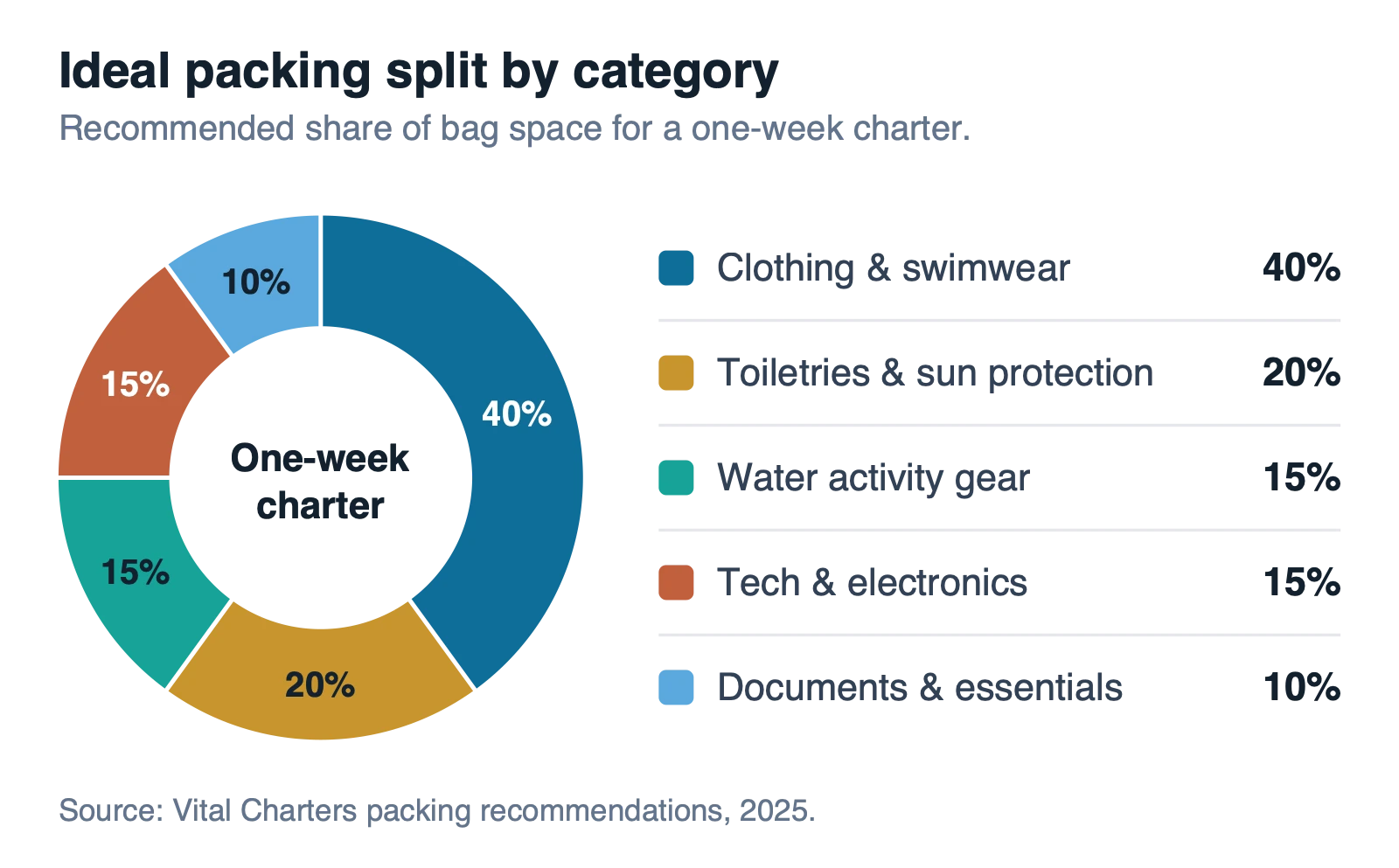
As a rule of thumb, this is how we suggest dividing the space in your bag for a one-week charter.
View data table
| Category | % of Bag Space |
|---|---|
| Clothing & swimwear | 40% |
| Toiletries & sun protection | 20% |
| Water activity gear | 15% |
| Tech & electronics | 15% |
| Documents & essentials | 10% |
Rolled clothes crease less, but rolling doesn’t save space. In a 2026 packing test across four bags, folding fit 129 garments to rolling’s 121, while rolled clothes came out with the fewest creases (Which?, 2026). For a week of linen and swimwear in a soft duffel, that’s the reason to roll.
When it comes to charter costs and APA, packing smart also saves money. Anything you forget, you’ll pay marina prices to replace, and marina convenience stores in the BVI aren’t cheap.
If you’re flying into the BVI, there’s another reason to pack light: inter-island prop planes between Tortola and neighboring islands have strict weight limits. Keeping your luggage under 40 pounds gives you flexibility for last-minute island hops. Before your trip, check out our first-timer’s guide to sailing the BVI for more arrival logistics.
Pack Light, Charter Right
The best yacht charter packing list isn’t the longest one. It’s the smartest one. Focus on reef-safe sun protection, versatile lightweight clothing, soft duffel bags, and a waterproof case for your phone. Skip anything rigid, formal, or heavy. You’re heading to the Caribbean, not a boardroom.
If you’re still figuring out the details of your trip, our guide on how to plan a Caribbean yacht charter covers everything from choosing a yacht to booking your crew. And when you’re ready, our team at Vital Charters is here to help you pack, figuratively, for the trip of a lifetime.
Frequently Asked Questions
Can I bring a hard suitcase on a yacht?
Technically yes, but you shouldn’t. Yacht cabin storage is curved and compact, designed for soft bags. Hard suitcases scratch interior woodwork, block passageways, and won’t fit under most berths. Every experienced charter captain will tell you the same thing. Bring a duffel.
Do charter yachts provide snorkel gear?
Most crewed yacht charters include basic snorkeling equipment, masks, snorkels, and fins in common sizes. However, if you wear prescription lenses, have a specific mask preference, or want gear that fits perfectly, bring your own. Ask your charter broker about included water toys before you pack.
What shoes should I wear on a yacht?
Bare feet are the norm aboard. Teak decks scratch easily, and black-soled shoes leave permanent marks. For going ashore, bring non-marking boat shoes or soft-soled sandals. Skip heels, dress shoes, and anything with hard rubber soles.
Should I bring my own reef-safe sunscreen?
Absolutely. While some crewed yachts provide basic toiletries, they rarely stock enough sunscreen for a full week of open-water sun exposure. Choose a mineral-based SPF 30+ formula with zinc oxide or titanium dioxide as the active ingredient.
Is there laundry service on a yacht charter?
Crewed charters usually offer basic laundry service. Your crew can wash and dry clothes for you during the trip. However, don’t rely on this for daily turnarounds. Pack enough swimwear and casual clothes to rotate comfortably for the full week. Quick-dry fabrics help enormously.
What should I NOT bring on a yacht?
Leave behind hard luggage, high heels, black-soled shoes, excessive electronics, heavy books (use an e-reader), spray-on aerosol sunscreen (it makes decks slippery and harms reefs), and too many formal outfits. Pack half what you think you’ll need for a BVI island-hopping itinerary. You’ll be glad you did.
You’re ready for the boat. Let’s find the right one.
Tell us your group size and dates and we’ll match you to a crewed Caribbean yacht where your crew handles the rest. You just bring the bag.