
All-Inclusive Yacht Charter Virgin Islands: 2026 Rates
An all-inclusive Virgin Islands charter week runs a $32,000 median across 282 crewed yachts, and the territory you pick barely moves it. BVI and USVI rates, passport rules and per-guest fees, measured in October 2026.
Last Updated: October 18, 2026
An all-inclusive yacht charter in the Virgin Islands lists at a median of $32,000 for the week in the 2026-2027 high season. That is measured across 282 crewed yachts holding a bookable rate in the British Virgin Islands, the US Virgin Islands or both (Vital Charters rate analysis, October 2026). The middle half of that market runs $26,000 to $44,000, and the median boat has four cabins. What almost nobody expects is the second number on this page: the territory you pick barely moves that median.
What does an all-inclusive Virgin Islands yacht charter cost in 2026?
A median of $32,000 for the week, with the middle half between $26,000 and $44,000 across 282 crewed yachts (Vital Charters rate analysis, October 2026). That figure is one high-season rate per yacht, read in October 2026 against the 2026-2027 season, for every boat whose cruising area includes the BVI, the USVI, or the two jointly.
Those are advertised rates published by each yacht’s central agent, not audited transaction prices, and on all-inclusive terms they’re close to what you actually pay. That’s the whole point of the contract: food, drink, fuel for normal cruising, water toys and the crew are inside the number. What sits outside it is government charges and the crew gratuity, and this page adds both back before the end.
Waiting for low season saves most people nothing. Of the 261 all-inclusive Virgin Islands catamarans that publish both a high and a low season rate, 193, or 74 percent, quote the identical number in both (Vital Charters rate analysis, September 2026). Sixty-four do come down, by a median of 5 percent, and four are actually dearer outside the winter season. High season here runs roughly December through April; the rest of the year is quieter and greener, but it is not, for three yachts in four, cheaper.
The comparison worth holding on to is the other half of the same fleet. The 81 Virgin Islands yachts quoting plus expenses instead list at a median of $85,000, middle half $52,000 to $116,000. That’s not the same boat priced differently. It’s a different boat: the plus-expenses fleet here is large motor yachts, and only 26 of those 81 are catamarans.
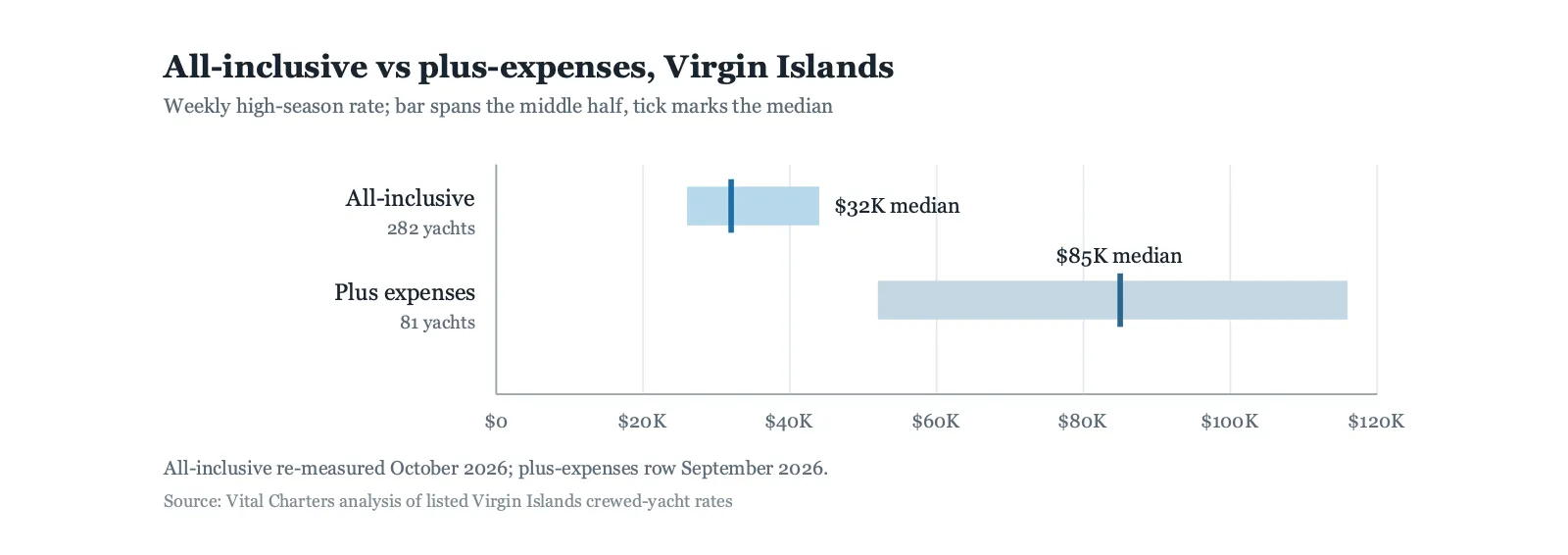
View data table
| Contract terms | Yachts | 25th percentile | Median week | 75th percentile |
|---|---|---|---|---|
| All-inclusive | 282 | $26,000 | $32,000 | $44,000 |
| Plus expenses | 81 | $52,000 | $85,000 | $116,000 |
Source: Vital Charters rate analysis of current Virgin Islands crewed charter rates: all-inclusive row October 2026, plus-expenses row September 2026. Advertised weekly rates, one high-season rate per yacht, excluding government charges and the crew gratuity.
Why is nearly every all-inclusive Virgin Islands yacht a catamaran?
277 of the 282 all-inclusive yachts are catamarans, 98 percent (Vital Charters rate analysis, October 2026). Five aren’t: a handful of motor yachts and monohulls that chose the same contract. If you’re shopping all-inclusive in the Virgin Islands, you’re shopping catamarans, and the exceptions are rare enough that you’ll probably never see one.
The geography explains it. Every island in the BVI sits inside a cluster roughly 30 miles across, with the Sir Francis Drake Channel running down the middle as a sheltered highway. Nothing about that rewards range or speed. What it rewards is deck space, shallow draft and stability at anchor, which is the catamaran’s entire case. The USVI adds St Thomas and St John at the western end of the same cruising ground. St Croix lies about 40 miles further south across open water and rarely features in a single charter week.
That’s also why the all-inclusive contract took hold here more than anywhere else in the region. Short hops mean predictable fuel, predictable provisioning and a week the crew can price up front without much risk. Where distances get long and unpredictable, as in the Bahamas, the fleet flips: 156 of the 206 yachts with a bookable Bahamas week are motor yachts, and 152 of those quote plus expenses (Vital Charters rate analysis, September 2026). The whole cost structure changes with it.
What does all-inclusive actually include?
On the standard Caribbean form, the rate covers the yacht, the crew, all meals aboard, a stocked bar within reason, fuel for normal cruising, water and the yacht’s watersports equipment. What it does not cover is the crew gratuity, government taxes and permits, and anything bought ashore: restaurant meals, bar tabs, dive courses, taxis and marina berths where you ask for one.
The contract underneath is usually the Caribbean Yacht Brokers Association Inclusive Agreement, and the gratuity band people quote comes straight out of it. Clause 2.B of the CYBA Inclusive Agreement describes 15 to 20 percent of the charter fee as the customary rate in the Caribbean crewed fleet, given to the captain at the end of the week and shared among the crew.
On the US side, the industry body is the Virgin Islands Professional Charter Association, VIPCA, which represents crew, vessels, brokers and marine vendors across the USVI and publishes compliance guidance and industry standards for the territory’s charter fleet. If you’re comparing a St Thomas-based yacht against a Tortola-based one, VIPCA membership is one of the trust signals worth checking, alongside the broker’s own association standing.
One line worth stating plainly, because it’s the most common misunderstanding we correct: an all-inclusive charter carries no advance provisioning allowance, the APA defined by the Mediterranean Yacht Brokers Association (MYBA) standard form. About 2 percent of all-inclusive rates state a small allowance of around 5 percent for premium extras, and the rest state none at all. If a quote described as all-inclusive arrives with a 30 percent APA attached, that quote is plus expenses wearing the wrong label, and it’s worth understanding what an APA is before you sign anything.
How much does each size of catamaran cost?
A 50 to 59 ft all-inclusive catamaran lists at a median of $31,000 for the week, and that band alone is 145 of the 277 boats (Vital Charters rate analysis, October 2026). It’s also the tightest market on the page: the middle half runs $26,500 to $34,000, a $7,500 spread on a $31,000 median. Step up one band and that spread widens to about $15,000.
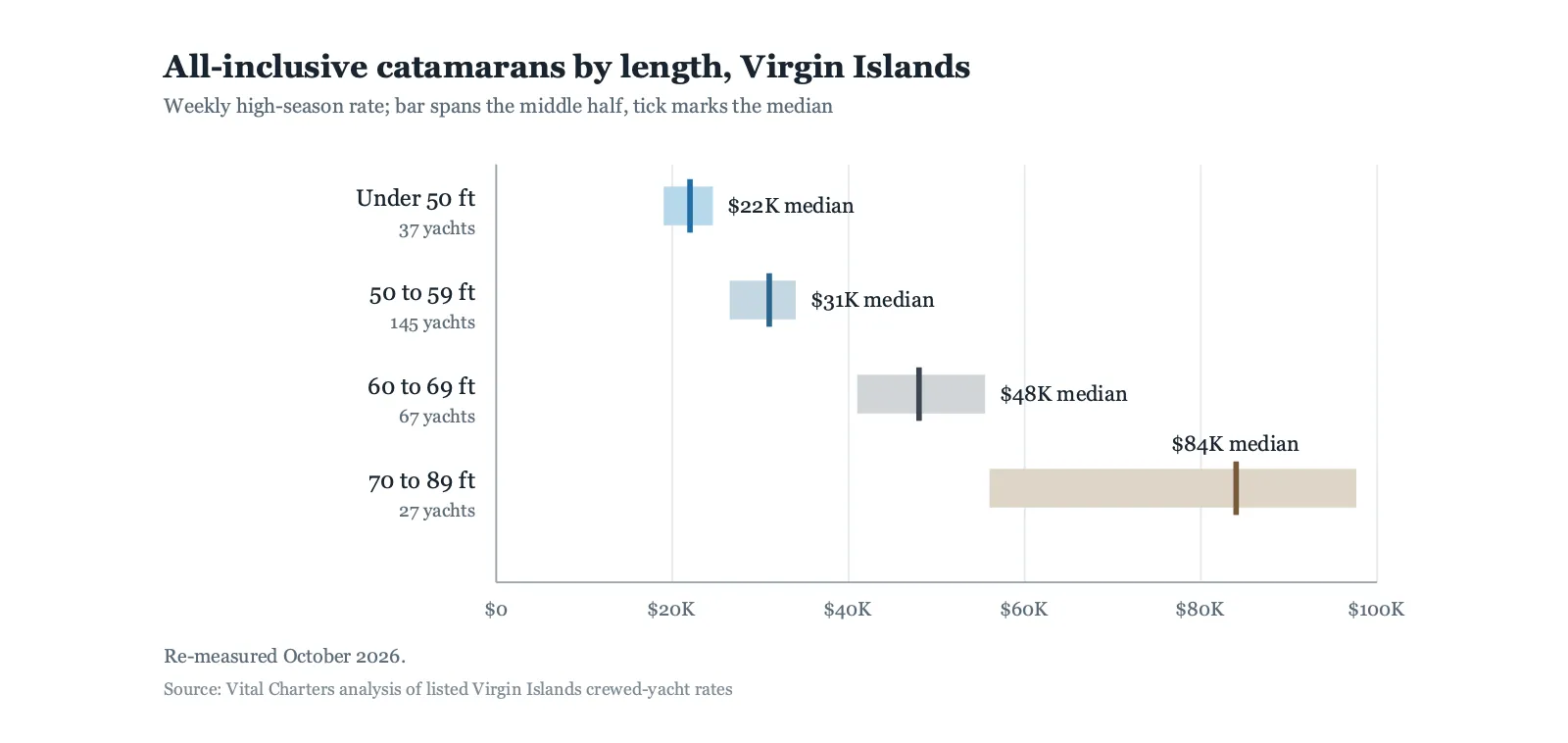
View data table
| Length band | Yachts | 25th percentile | Median week | 75th percentile |
|---|---|---|---|---|
| Under 50 ft | 37 | $19,000 | $22,000 | $24,600 |
| 50 to 59 ft | 145 | $26,500 | $31,000 | $34,000 |
| 60 to 69 ft | 67 | $41,000 | $48,000 | $55,500 |
| 70 to 89 ft | 27 | $56,000 | $84,000 | $97,650 |
| 90 ft and above | 1 | n/a | $67,900 (single yacht, not a market) | n/a |
Source: Vital Charters rate analysis of current Virgin Islands crewed charter rates, October 2026. All-inclusive sailing and power catamarans with a bookable 2026-2027 high-season rate.
Read the bands as guest capacity, not as luxury. Under 50 feet is typically three cabins and suits six guests who like each other. The 50 to 59 ft band is four cabins and is where most groups of eight land. Sixty to 69 feet buys noticeably more space per guest rather than more berths. Above 70 feet you’re into a crew of three or four and a different kind of week entirely. The BVI catamaran rate breakdown goes band by band on the BVI side of the same fleet.
Does the BVI or the USVI cost more?
Neither, to within $1,000. The all-inclusive median is $32,000 for yachts listing both territories and $33,000 for the BVI alone (Vital Charters rate analysis, October 2026). Yachts listing both territories, 178 of them, come in at a $32,000 median with the middle half at $26,000 to $42,875. Yachts listing the BVI alone, 103 of them, come in at $33,000, middle half $26,500 to $49,500. That is a remarkably flat result, and it’s the opposite of what most people assume when they hear that one territory is US soil and the other isn’t.
The reason is that these are mostly the same boats. A Tortola-based catamaran cruising the Sir Francis Drake Channel is a Tortola-based catamaran whether or not its listing also names St John, and the majority of the fleet names both because guests routinely want both. Territory is a paperwork boundary running through one cruising ground, not a market boundary, which the BVI versus USVI comparison works through itinerary by itinerary.
One number does need a caveat. A USVI-only all-inclusive yacht is a population of one, a single boat at $19,500, with three more on plus-expenses terms. Any figure you see quoted for “USVI all-inclusive rates” as if it were a market is being drawn from a sample too small to mean anything. The honest version is that the USVI is chartered from the same fleet as the BVI, and priced from it.
Do you need a passport for the BVI and the USVI?
US citizens need a passport for the British Virgin Islands and do not need one for the US Virgin Islands. The USVI is a US territory, so travel there from the mainland is domestic travel and a REAL ID-compliant driver’s license is enough for the flight (Visit USVI). The BVI is a British Overseas Territory and a separate country. Everyone needs a passport there, including children (Government of the Virgin Islands).
That single difference is the reason a lot of Virgin Islands weeks get planned the way they do. A group flying into St Thomas without passports can charter the USVI perfectly well and simply not cross into BVI waters. A group with passports can start in either territory and cross freely, which is what most crewed itineraries do, because the best-known anchorages sit on both sides of the line. Our guide to a yacht charter from St Thomas covers both versions of the week.
Bring the passport even if you think you won’t need it. Plans change mid-week when the weather does, and a yacht that can’t clear into Jost Van Dyke because one guest left a passport in a hotel safe loses a day. Your crew handles the clearance formalities themselves. What they can’t do is produce a document you didn’t bring. Our guide to passport and entry requirements for charter guests covers all three destinations, including the BVI arrival card that has been mandatory since January 2025.
What lands on the invoice, BVI and USVI compared
A week for eight guests costs about $976 in per-guest government charges in the BVI and nothing at all in the USVI. That is the clearest practical difference between the two territories. Here is each one, with the source for every figure.
What lands on a British Virgin Islands charter invoice in 2026
The BVI charges guests three things: a cruising permit of $16 per guest per day on foreign-based yachts or $4 on BVI-based ones, a $10 arrival levy, and small National Parks Trust fees. All-inclusive rates cover these in most cases, and the customary 15 to 20 percent crew gratuity is always yours. No mandatory APA.
| Line item | Typical amount | Who sets it | Source |
|---|---|---|---|
| APA (Advance Provisioning Allowance) | None mandatory on all-inclusive catamarans, except a small allowance, usually 5 percent, on about 1 rate in 50. Plus-expenses charters add an APA, typically 30 to 35 percent of the base rate, intended to cover every running fee except government taxes, refunded where unspent | Each yacht’s own charter terms; MYBA publishes the mechanics, not a percentage | Vital Charters APA listings analysis |
| Cruising permit (per guest, per day) | $16 per guest per day on foreign-based charter yachts, including USVI-based ones; $4 on BVI-based yachts (an amending Order took effect June 1, 2025 and its text is not published, so confirm the current rate when you book) | HM Customs, Government of the Virgin Islands | Cruising and Home Port Permit Act, 2021, Schedule 2 |
| Environmental and Tourism Levy | $10 per guest (age 3 and over), once per arrival, air or sea | Government of the Virgin Islands | GIS release, September 2017 (archived) |
| National Parks Trust fees | The Baths day pass $3 per adult, $2 per child. Park mooring permits are handled by your crew and are not billed to you | National Parks Trust of the Virgin Islands | NPT ticketing, The Baths National Park |
| Crew gratuity | Customarily 15 to 20 percent of the charter fee in the Caribbean crewed fleet, the band CYBA’s Inclusive Agreement (Clause 2.B) calls the customary rate; MYBA’s 2026 guidelines publish no percentage, and both leave it at your discretion | Custom, written into the CYBA form | CYBA Inclusive Agreement, Clause 2.B (2020) |
Fees verified September 2026.
What lands on a US Virgin Islands charter invoice in 2026
A USVI crewed charter adds little to your invoice: no cruising permit, no per-guest charter tax. The only government fee you meet directly is $5 per person at Trunk Bay; national park mooring fees are the yacht’s cost, not yours. Budget a customary 15 to 20 percent crew gratuity.
| Line item | Typical amount | Who sets it | Source |
|---|---|---|---|
| APA (Advance Provisioning Allowance) | None mandatory on all-inclusive catamarans, except a small allowance, usually 5 percent, on about 1 rate in 50. Plus-expenses charters add an APA, typically 30 to 35 percent of the base rate, intended to cover every running fee except government taxes, refunded where unspent | Each yacht’s own charter terms; MYBA publishes the mechanics, not a percentage | Vital Charters APA listings analysis |
| Cruising permit or charter tax (per guest) | None. There is no per-guest government charge in the US Virgin Islands | USVI Department of Planning and Natural Resources | DPNR, Anchoring and Mooring |
| National Park Service fees | $5 per person at Trunk Bay, ages 16 and up. Park mooring fees are paid by the yacht, not billed to you (a proposal to raise these has not been implemented) | National Park Service | Virgin Islands National Park, Fees and Passes |
| Crew gratuity | Customarily 15 to 20 percent of the charter fee in the Caribbean crewed fleet, the band CYBA’s Inclusive Agreement (Clause 2.B) calls the customary rate; MYBA’s 2026 guidelines publish no percentage, and both leave it at your discretion | Custom, written into the CYBA form | CYBA Inclusive Agreement, Clause 2.B (2020) |
Fees verified September 2026.
On a week for eight guests the gap is easy to size. In the BVI, a $16 daily cruising permit across eight guests for seven days is $896, plus $80 in arrival levies, so roughly $976 in per-guest government charges before anything else. In the USVI the same eight guests pay nothing per head, and the only government money in the week is the yacht’s own park mooring fees. On a $32,000 charter that’s about a 3 percent difference, which counts for less than most people expect and more than the brochures admit.
How does a Virgin Islands charter start from St Thomas?
Most guests fly into Cyril E. King Airport on St Thomas, which has the region’s widest choice of nonstop mainland flights, and join the yacht the same afternoon. The sequence is short:
- Land at Cyril E. King (STT) on St Thomas.
- If the yacht is USVI-based, take a taxi to the marina and board. You’re aboard within about half an hour of clearing baggage.
- If the yacht is Tortola-based, take a taxi to the Red Hook or Charlotte Amalie ferry terminal. Your crew will tell you which before you book flights.
- Cross to Tortola by ferry, clear BVI immigration with your passport, and meet the yacht.
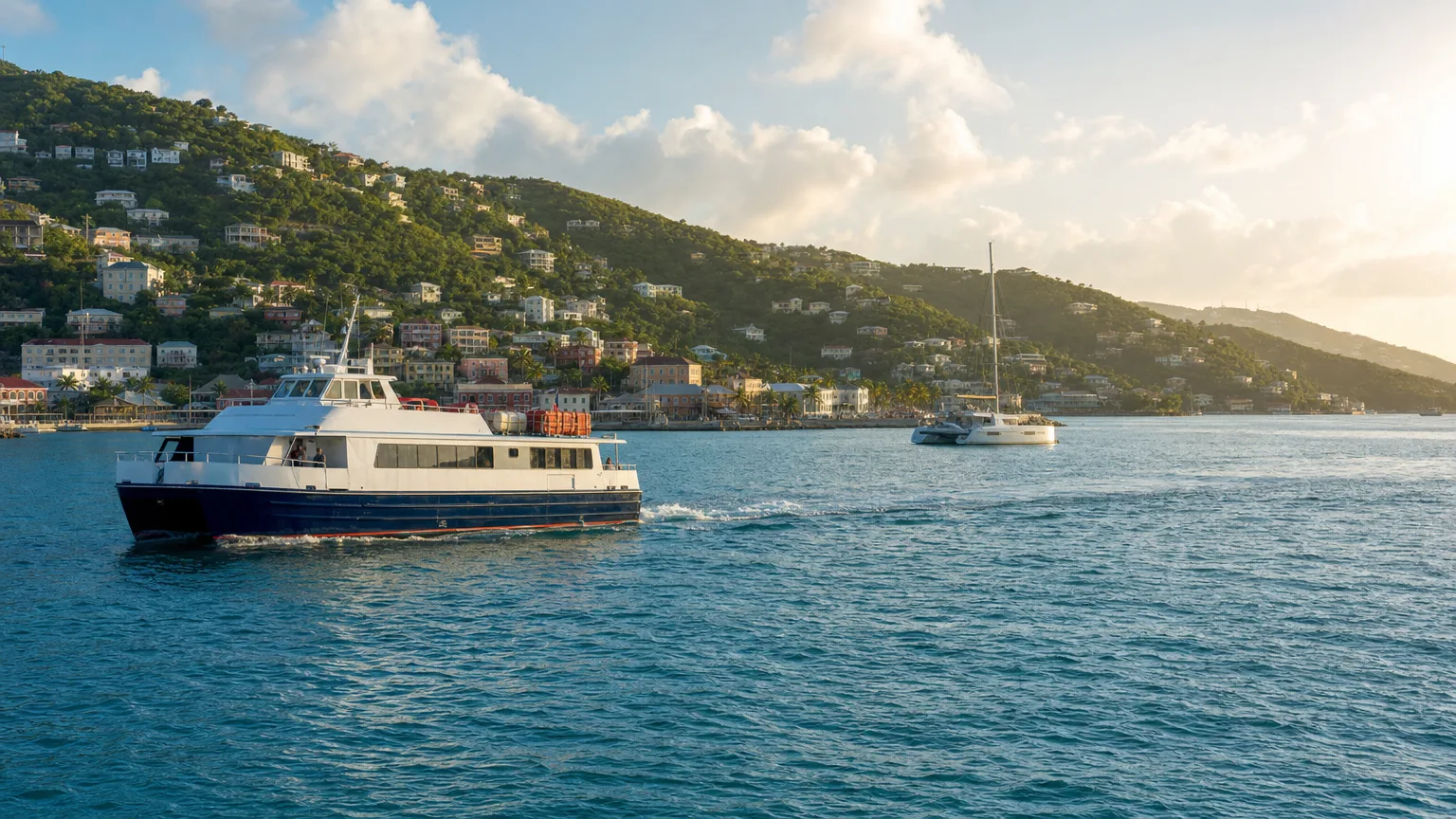
Give yourself the afternoon rather than the last flight of the day. Ferries stop running in the early evening, immigration lines at either end move at their own pace, and the difference between arriving at four and arriving at seven is the difference between a first night at anchor and a first night alongside. Crews plan the week backwards from your flight times, so send them early.
Departure at the other end is the same logic in reverse. Most Virgin Islands itineraries finish back where they started, and a Saturday morning disembarkation puts you at the airport with time to spare. If your flight is a tight one, say so at the start of the week rather than the end, and the captain will shape the last two days around it.
Getting a real Virgin Islands number
Everything above is the market, not a quote. The number you will actually pay depends on the week you want, the size of your group and how far in advance you’re asking, and the honest way to get it is to have someone price real boats against real dates. That is what we do: start a yacht search at Vital Charters and we’ll come back with a shortlist of available catamarans, the all-in landed cost for each, and the reason we picked them.
If you’re still deciding where to spend the week, the US Virgin Islands island guide covers what’s worth seeing on the American side, and the BVI crewed charter guide goes deeper on routes and anchorages than this page does.
Frequently Asked Questions
How much is an all-inclusive yacht charter in the Virgin Islands in 2026?
A median of $32,000 for the week, with the middle half between $26,000 and $44,000, across 282 crewed yachts holding a bookable 2026-2027 Virgin Islands high-season rate (Vital Charters rate analysis, October 2026). The median boat is a four-cabin catamaran. Add a customary 15 to 20 percent crew gratuity and, in the BVI only, per-guest cruising permit and levy charges.
Is the BVI or the USVI more expensive to charter?
Neither, to within $1,000 on the yacht itself. The all-inclusive median is $32,000 for yachts listing both territories and $33,000 for the BVI alone (Vital Charters rate analysis, October 2026). The difference is on the invoice, not the rate: the BVI charges a per-guest cruising permit and a $10 arrival levy, and the USVI charges guests no cruising permit and no charter tax at all.
Do you need a passport to charter in the US Virgin Islands?
No. The USVI is a US territory, so US citizens travel there domestically and a REAL ID-compliant license is enough. The British Virgin Islands is a separate country and everyone needs a passport, children included. Because most crewed itineraries cross between the two, we tell every guest to bring a passport regardless of which territory the charter starts in.
How much is the BVI cruising permit for charter guests in 2026?
$16 per person per day on foreign-based charter yachts, which includes USVI-based ones, and $4 on BVI-based yachts, under Schedule 2 of the Cruising and Home Port Permit Act, 2021. An amending Order took effect June 1, 2025 and its text is not published, so confirm the rate that applies to your yacht when you book. Your crew files the permit, and on all-inclusive terms the rate covers it in the vast majority of cases. A $10 environmental and tourism levy is also collected per guest on arrival.
Do charter guests pay a cruising permit or charter tax in the US Virgin Islands?
No. There is no USVI cruising permit charge for guests and no per-person charter tax. The only National Park Service charge you meet directly is $5 per person at Trunk Bay, for ages 16 and up. Park mooring fees are paid by the yacht rather than billed to you.
Does an all-inclusive Virgin Islands charter have an APA?
No. All-inclusive rates carry no mandatory advance provisioning allowance: about 2 percent of them state a small allowance of around 5 percent for premium extras, and the rest state none. A quote described as all-inclusive that also carries a 30 percent APA is a plus-expenses charter with the wrong label on it, and worth querying before you sign.
Is a Virgin Islands charter cheaper outside high season?
Usually not. Of the 261 all-inclusive Virgin Islands catamarans publishing both a high and a low season rate, 193 quote the identical number in both, which is 74 percent (Vital Charters rate analysis, September 2026). Sixty-four come down by a median of 5 percent and four are dearer outside winter. Pick your dates for weather and crowds rather than for a discount that mostly is not there.
What size catamaran do I need for eight guests?
A four-cabin catamaran in the 50 to 59 ft band, which is the largest single group in the Virgin Islands fleet at 145 of 277 all-inclusive catamarans and a $31,000 median week (Vital Charters rate analysis, October 2026). It is also the tightest-priced band on the market, running $26,500 to $34,000 across the middle half, so quotes should cluster closely.
A Virgin Islands number with the fees already in it.
Tell us your group size and dates and we’ll send available catamarans priced all in: the rate, the permits, the levy and the gratuity, on one line.