
Stargazing, Bioluminescence, and Night Diving: Noctourism Aboard a Caribbean Yacht
A bioluminescent bay charter Caribbean itinerary unlocks Bortle 2-3 anchorages, Mosquito Bay glow, and Perseid peaks. Plan your 2026 noctourism dates.
Last Updated: September 7, 2026
A Caribbean bioluminescent bay charter that strings together Mosquito Bay in Vieques, Laguna Grande in Fajardo, and Luminous Lagoon in Jamaica, paired with Bortle Class 2–3 anchorages for the Milky Way, is the cleanest way to experience the 2026 travel trend called noctourism. 62% of travelers across 33 countries are now considering trips with nighttime experiences, and American Express Travel’s 2026 Global Travel Trends Report names astrotourism among the four trends defining the year. This piece is the practical playbook on one trend from our 2026 travel trends pillar: why nighttime experiences are uniquely deliverable from an anchored yacht.
The rest of this guide covers what noctourism is, how a yacht’s dark-sky math beats a resort’s, where the bioluminescence is genuinely accessible, night diving logistics, what an astronomy-equipped charter actually carries, and a sample 7-day arc.
What Is Noctourism and Why Is It Surging?
Booking.com’s 2025 Travel Predictions surveyed 27,000+ travelers across 33 countries and found 62% considering trips with nighttime experiences. Wayfairer reported nocturnal excursion bookings up 25% in 2024; Flash Pack noted millennial demand for night experiences up 40%.
American Express Travel’s 2026 Global Travel Trends Report places astrotourism among the four key trends shaping 2026 travel, noting that 2026 begins a multi-year window with three major solar eclipses through 2027. Booking.com’s 2026 “Destined-ations” finding, 17% would reschedule a trip around astrological events like eclipses or full moons (n=29,733): adds the booking-window mechanic.
The structural driver: global light pollution is growing roughly 10% per year, and one-third of the world’s population can no longer see the Milky Way from where they live. Dark sky has become a destination: and you can’t reach it from a lit beach resort.
The Caribbean’s Dark-Sky Math: Yacht vs Resort vs City
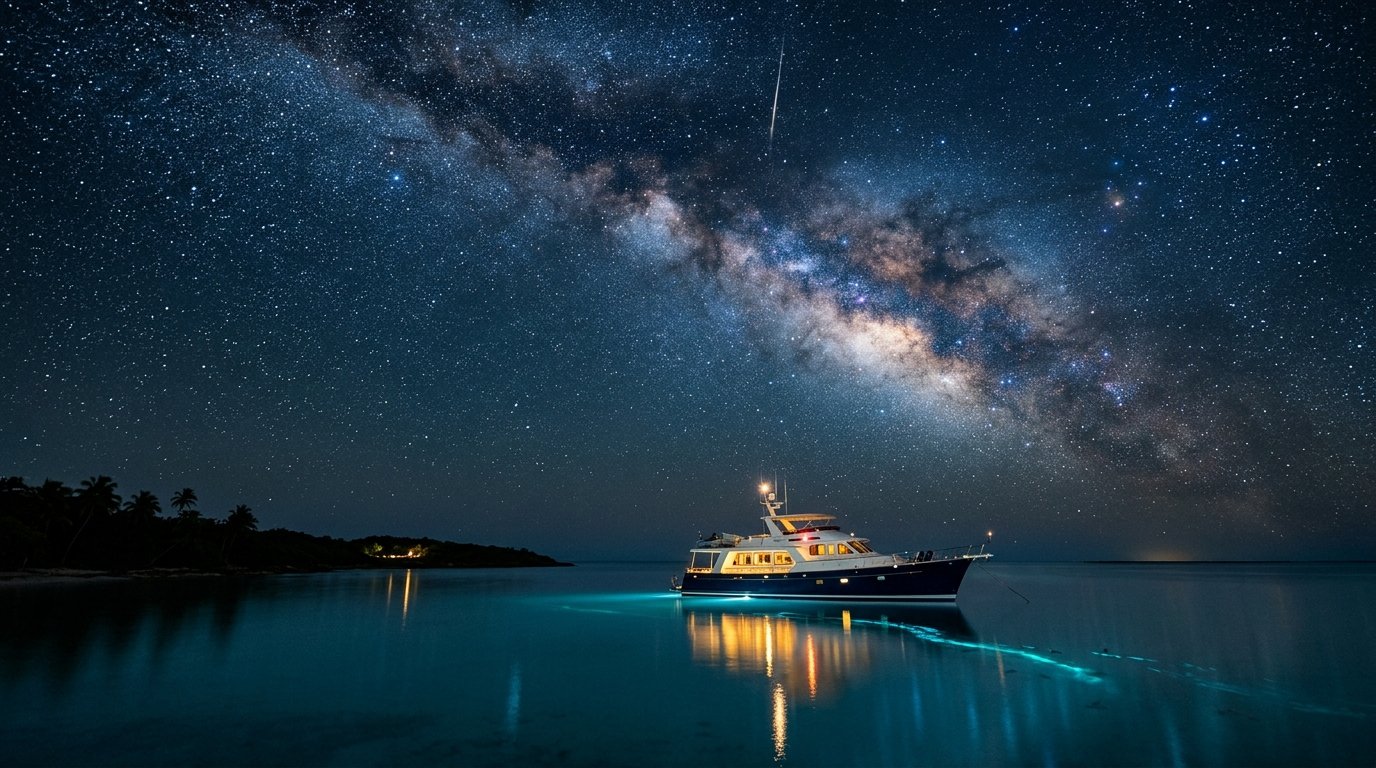
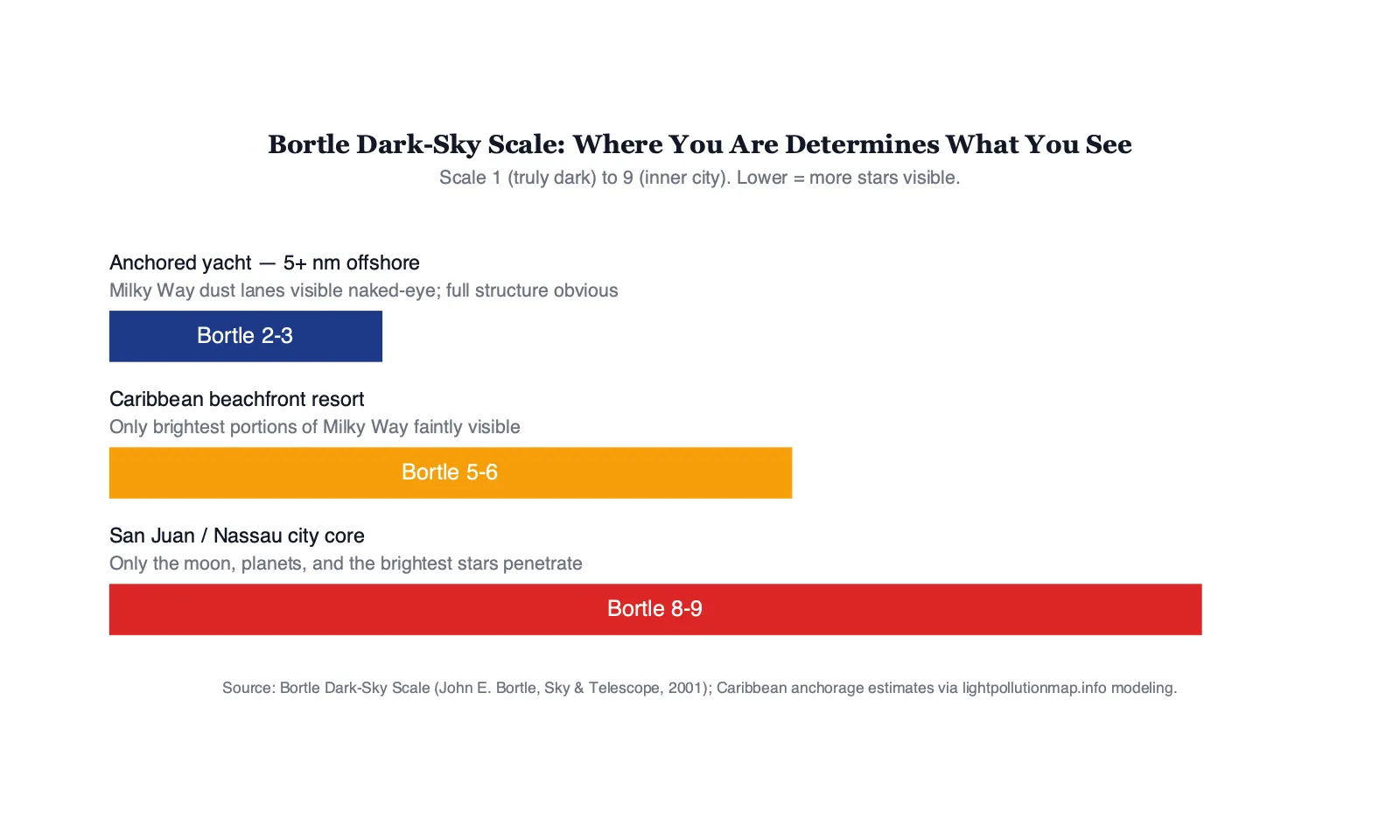
The Bortle Dark-Sky Scale: published by John Bortle in Sky & Telescope (2001): runs 1 (excellent dark site) to 9 (inner city). An anchored yacht 5+ nautical miles offshore in the Bahamas Exumas, the Tobago Cays, or outer BVI/USVI routinely lands in Bortle Class 2–3, where the Milky Way’s dust lanes are visible to the naked eye and structure becomes obvious (Sky & Telescope). The same charter guest at a lit beachfront resort sits in Bortle 5–6, where only the brightest part of the Milky Way is faintly visible. San Juan or Nassau hits Bortle 8–9: only the moon and brightest planets penetrate the dome.
View data table
| Location type | Bortle class | What you can see |
|---|---|---|
| Anchored yacht, 5+ nm offshore (Exumas, Tobago Cays, outer BVI/USVI) | 2–3 | Milky Way dust lanes visible naked-eye; full galactic structure obvious; M33 with direct vision |
| Caribbean beachfront resort property | 5–6 | Only the brightest portions of the Milky Way are faintly visible |
| San Juan or Nassau city core | 8–9 | Only the moon, brightest planets, and a handful of bright stars penetrate the light dome |
Source: Bortle Dark-Sky Scale (Bortle, Sky & Telescope, 2001); anchorage estimates via lightpollutionmap.info.
The yacht-specific cruising grounds that consistently deliver Bortle 2–3: the Exuma Cays Land and Sea Park in the Bahamas, Tobago Cays Marine Park in the Grenadines, Anegada’s North Shore in the BVI, and the Spanish Virgin Islands (Vieques and Culebra) east of Puerto Rico. Our hidden Caribbean anchorages spoke covers the regulatory specifics (vessel caps, anchoring rules, mooring counts) that explain why these places stayed dark.
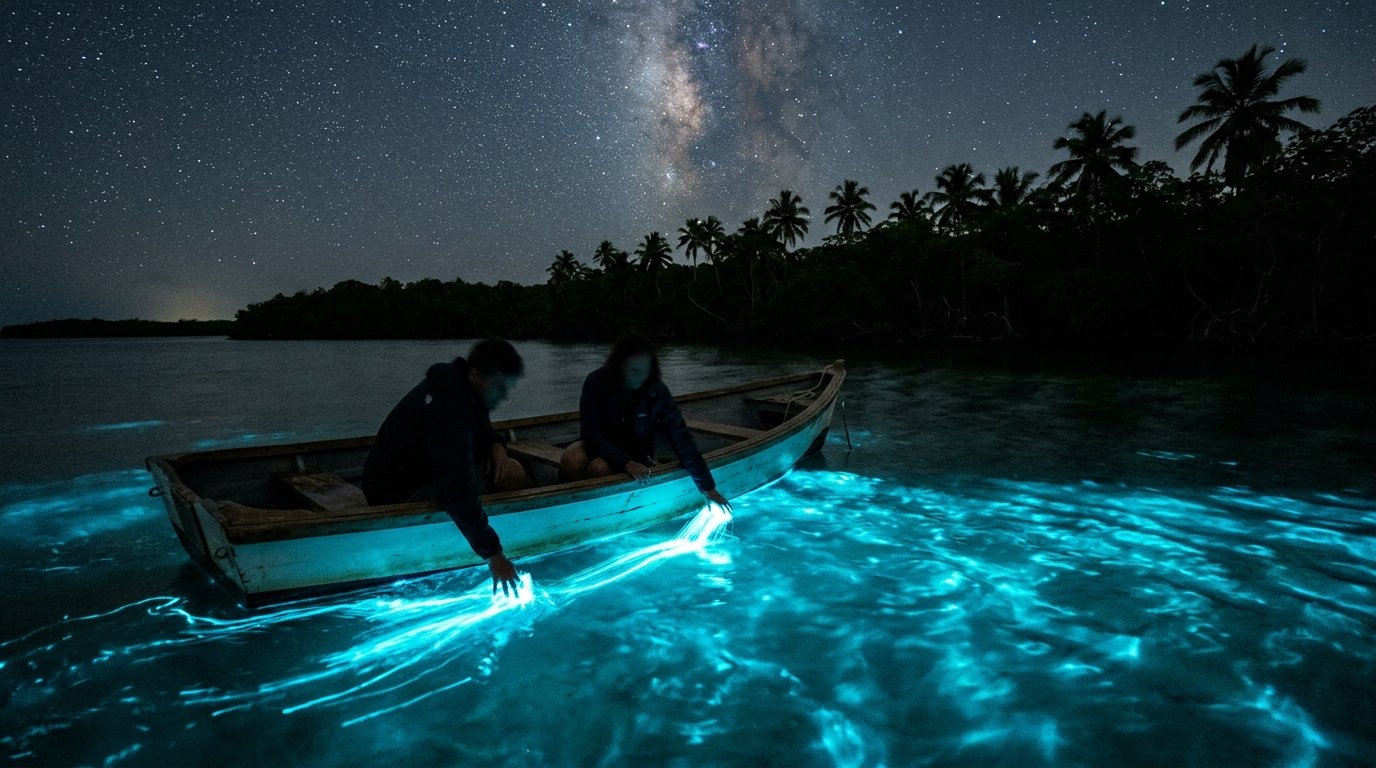
The Bioluminescent Bays of Puerto Rico, Jamaica, and Grand Cayman
Bioluminescent bays glow because of dinoflagellates, single-celled organisms (Pyrodinium bahamense, “whirling fire”) that emit a blue-green flash when agitated. Concentrations vary by site; Mosquito Bay in Vieques carries up to 700,000 dinoflagellates per gallon of water and holds the Guinness World Record for the brightest bioluminescent bay in the world (Guinness World Records).
The genuinely yacht-stageable bays in the Caribbean, with the rules that govern each:
- Mosquito Bay, Vieques (Puerto Rico). Stage at Vieques anchorage. Access only via DRNA-licensed electric-boat tours; swimming prohibited; tours close around the full moon (Discover Puerto Rico: Bio Bays). Guinness World Record holder.
- Laguna Grande, Fajardo (Puerto Rico). Kayak-only via DRNA-permitted operators. Stage at Fajardo.
- La Parguera, Lajas (Puerto Rico). The only PR bio bay where swimming is permitted, but plankton concentration is reported to have declined over the past two decades.
- Luminous Lagoon, Falmouth (Jamaica). Yacht-accessible from the Falmouth and Montego Bay area, and one of the few bioluminescent bays where swimming is permitted.
- Bioluminescent Bay, Grand Cayman (North Side). Yacht-accessible; snorkel and swim permitted via licensed operators. Best May–October on new-moon nights.
The yacht advantage is structural: a charter can anchor at Vieques, Fajardo, Falmouth, or the Cayman North Side and the broker coordinates the licensed-operator rendezvous on your behalf. A resort guest is two transfers away: taxi to the bay, tour operator boat, taxi back.
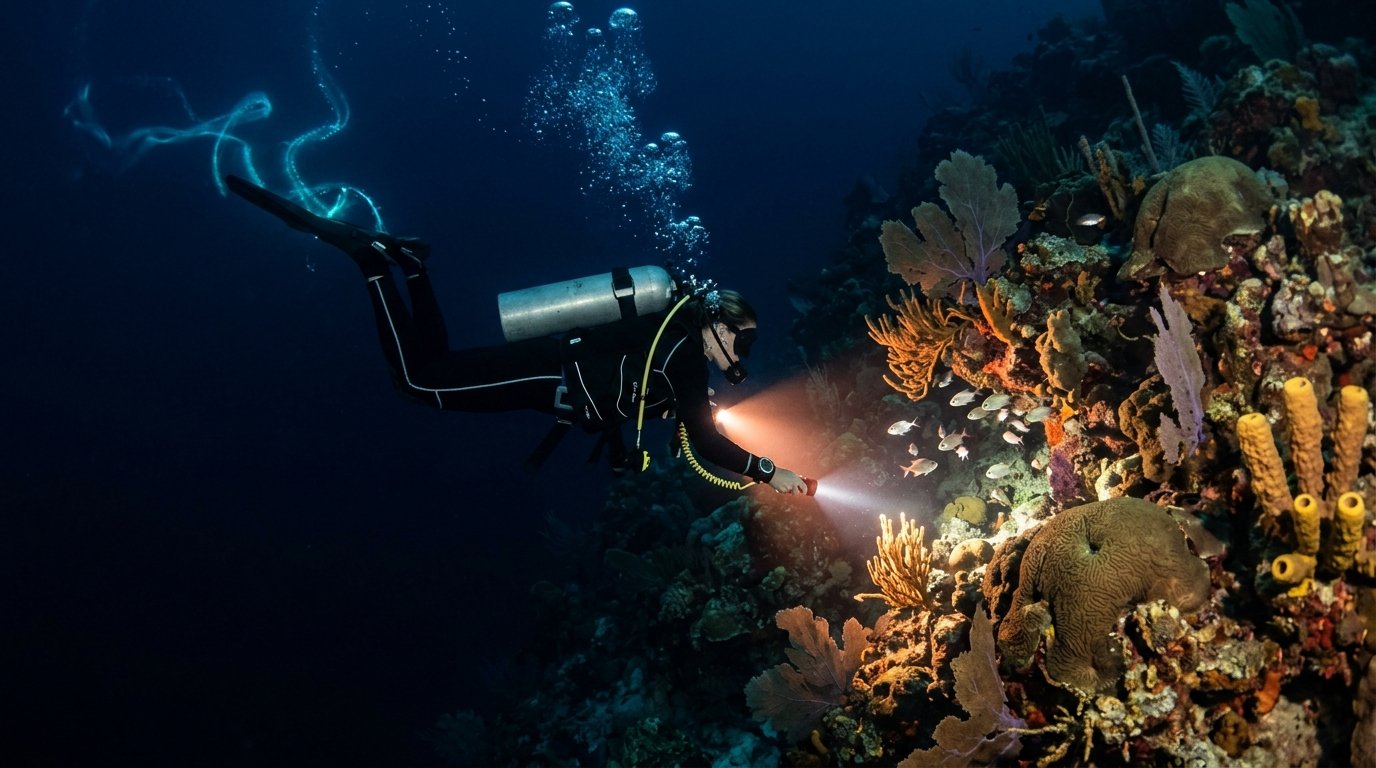
Night Diving and Night Snorkeling Onboard a Charter
PADI lists Grand Cayman, Bonaire, Cozumel, and the BVI/USVI among its top Caribbean Night Diver destinations (PADI). Yacht-arranged night dives work through licensed local operators, most Caribbean nations require operator rendezvous and a permit. The crew handles logistics; you bring the certification card. Frederiksted Pier doubles as one of the region’s standout dive sites in daylight too.
Our BVI crewed yacht charter insider guide covers BVI dive permit logistics and which operators yachts most commonly partner with.
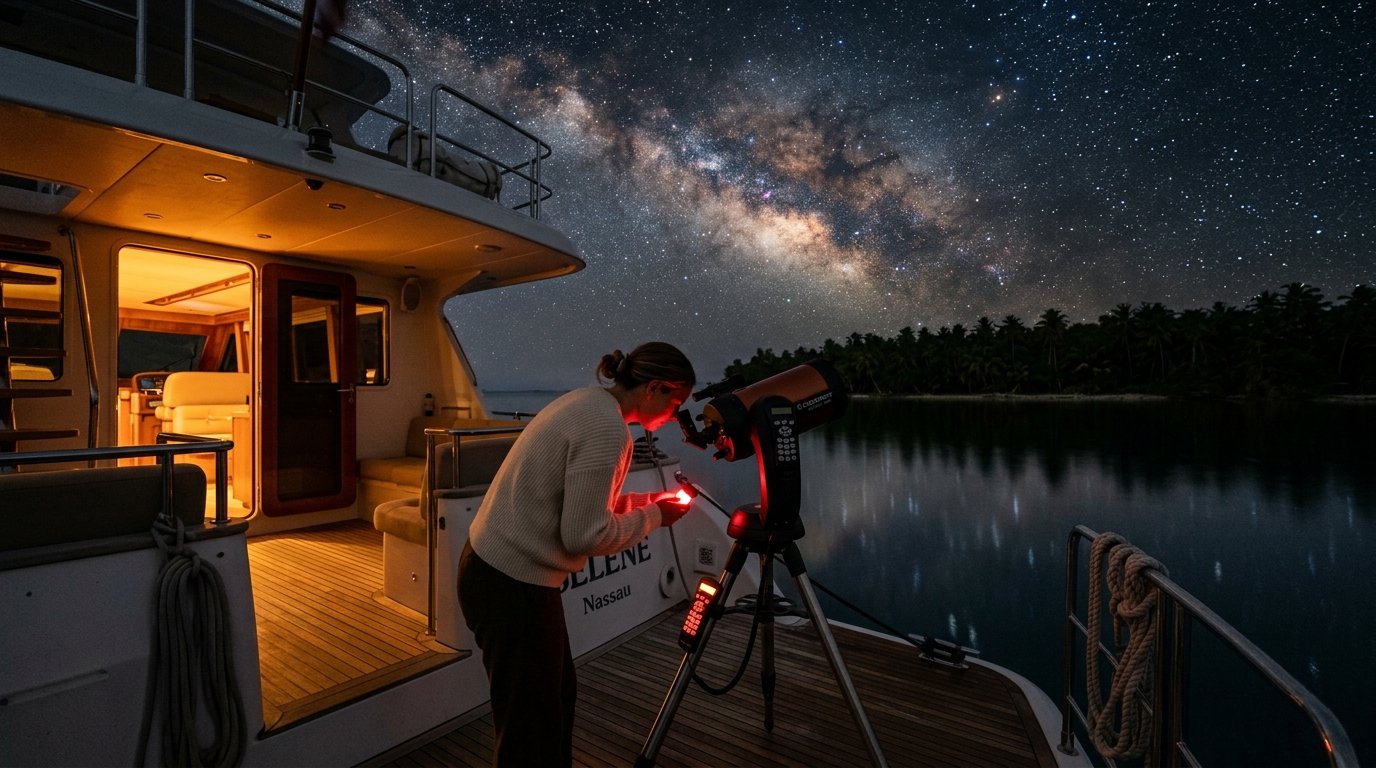
What an Astronomy-Equipped Charter Yacht Actually Carries
Most crewed charter yachts carry binoculars in the bridge inventory. The premium segment goes further: portable telescopes like the Celestron NexStar 4SE or 6SE on alt-azimuth GoTo mounts, plus astronomy apps on the bridge tablet. Some captains will reposition 2–3 nautical miles to escape downwind cloud cover, a routine adjustment a fixed resort can’t replicate.
Brief your broker by gear: “Telescope on board, dark-sky anchorages only, generator off by 9pm so deck lights die.” A wellness-style daily rhythm, covered in our wellness yacht charter spoke pairs naturally with noctourism.
Sample 7-Day Noctourism Charter: Puerto Rico → USVI → BVI
A realistic 7-day arc that hits two bioluminescent bays, a USVI night dive, and two Bortle 2–3 anchorages:
- Day 1: Embark Fajardo, Puerto Rico. Sunset anchor at Cayo Icacos. Evening DRNA-permitted kayak tour to Laguna Grande bio bay.
- Day 2: Sail to Vieques. Sunset anchor at Esperanza. Evening shore transfer to a DRNA-licensed Mosquito Bay tour (electric boat, no swimming).
- Day 3: Sail to Culebra. Anchor at Playa Tortuga or Ensenada Honda. First Bortle 2–3 night on deck.
- Day 4: Cross to St. Thomas / St. John (USVI). Night dive at a licensed operator’s USVI Marine Park site.
- Day 5: Sail into the BVI. Anchor in The Bight at Norman Island. Evening dinghy swim-around for dinoflagellate hand-streaming.
- Day 6: Reposition to Anegada. The BVI’s most offshore anchorage and its best dark sky. Deck astronomy with the crew telescope. If chartering August 12–13, the Perseids new-moon peak delivers an observed rate of up to 60 meteors per hour at Caribbean latitudes (AMS ZHR ~100 under ideal conditions; American Meteor Society).
- Day 7: Sail to Virgin Gorda / North Sound for disembarkation, with a final dawn watch on deck.
For a deeper geography of the cruising grounds where these dark anchorages live, our Bahamas yacht charter guide and set-jetting Caribbean spoke (which covers the same Thunderball Grotto and Exumas chain) both fill in detail.
The Bottom Line: The Caribbean’s Dark Skies Need a Yacht
The Caribbean has no formal DarkSky International-certified places yet, but the geography delivers Bortle 2–3 anyway, at anchorages that resorts physically can’t compete with. Noctourism is one of nine 2026 travel trends our pillar piece maps against crewed charter, and it’s the trend yachts win most decisively. The 2026 astronomy calendar, Perseids on the August 12–13 new moon and Geminids on December 13–14, is bookable now.
When you’re ready to brief dates, group size, and which bio bay anchors the week, start a yacht search at Vital Charters and we’ll match the brief to inventory. If you’d rather talk through the licensed-operator logistics first, our contact form routes directly to me.
Frequently Asked Questions
What is noctourism?
Noctourism is travel built around after-dark experiences, stargazing, bioluminescent bays, night diving, meteor showers, lunar tourism, eclipse chasing. 62% of travelers across 33 countries are considering trips with nighttime experiences per Booking.com’s 27,000-traveler 2025 survey (National Geographic, 2024), and American Express Travel names astrotourism among the four trends defining 2026 travel.
Can you actually see the Milky Way from a Caribbean yacht charter?
Yes: at remote anchorages 5+ nautical miles offshore in the Bahamas Exumas, Tobago Cays, outer BVI/USVI, or Spanish Virgin Islands, an anchored yacht typically sits in Bortle Class 2–3 dark sky, where the Milky Way’s dust lanes are visible to the naked eye. A lit beachfront resort sits in Bortle 5–6 by comparison. The Caribbean has no DarkSky International-certified places yet, but geography alone delivers the skies.
Which Caribbean bioluminescent bay is the brightest?
Mosquito Bay in Vieques, Puerto Rico holds the Guinness World Record for the brightest bioluminescent bay in the world, with up to 700,000 Pyrodinium bahamense dinoflagellates per gallon (Guinness World Records). Access is only via DRNA-licensed electric-boat tours; swimming is prohibited; tours close around the full moon. Luminous Lagoon in Falmouth, Jamaica and the Grand Cayman North Side bay both permit swimming.
What are the best 2026 astronomy dates for a Caribbean charter?
August 12–13, 2026 for the Perseid meteor shower peak (new moon = optimal, up to 60/hour) and December 13–14, 2026 for the Geminids (up to 120/hour: the year’s strongest). August 28, 2026 brings a deep partial lunar eclipse.
How does night diving work on a yacht charter?
Yacht-arranged night dives go through licensed local operators, most Caribbean nations require operator rendezvous and a permit. The crew handles logistics; you bring your PADI Night Diver certification. Top yacht-accessible sites: Grand Cayman, Bonaire, Cozumel, USVI, and BVI.
Do crewed charter yachts carry telescopes for stargazing?
Most carry quality binoculars. The premium segment carries portable telescopes (Celestron NexStar 4SE / 6SE class on equatorial mounts that compensate for anchored sway) and astronomy apps on the bridge tablet. Brief your broker by gear, and ask for generator-off hours after 9pm so the deck stays dark.
Bortle 2 skies and glowing bays, reserved for you.
Share your dates and group size and we’ll match you to a crewed yacht and itinerary that hits the bioluminescent bays and dark-sky anchorages at peak timing.