
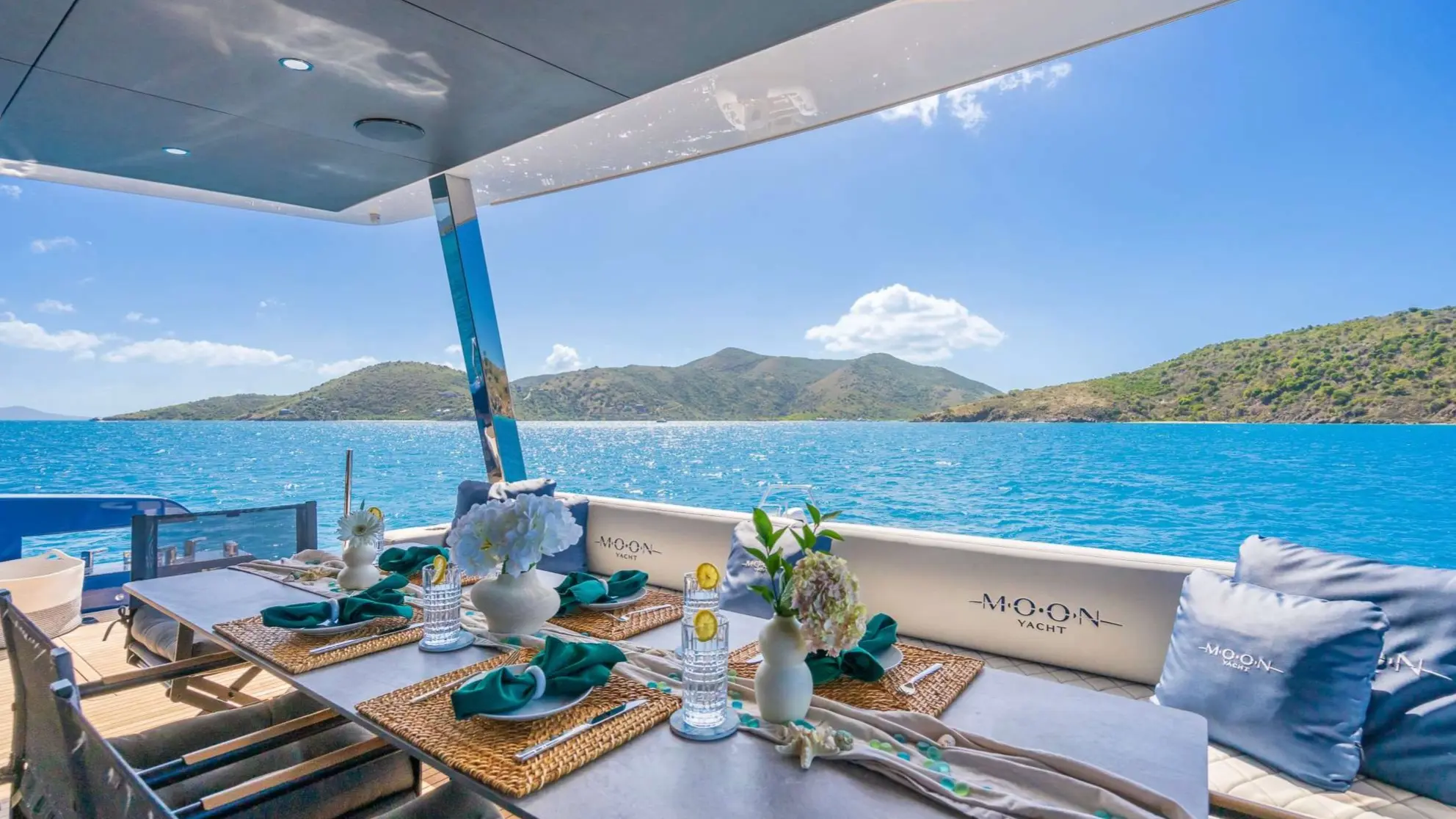
A private catamaran charter and a small ship luxury cruise both promise an escape from mega-ship chaos — but that’s where the similarities end. Small ship lines market themselves as the antidote to floating mega-resorts: fewer passengers, better food, more personal service. Compared to a 6,000-passenger behemoth, a 200-guest expedition vessel feels intimate. But “intimate” is relative. You’re still sharing a ship with strangers, eating on someone else’s schedule, and following a route somebody else planned months ago.
A private catamaran charter flips the entire equation. You aren’t one of 200 travelers. You’re the only guests. Your crew doesn’t rotate between dozens of cabins — they’re cooking your meals, adjusting your sails, and anchoring in coves that no cruise itinerary will ever list. If you’ve been weighing a crewed yacht vacation against a traditional luxury trip, the differences go far deeper than headcount.
This guide breaks down every experiential advantage of chartering a private catamaran over booking a small ship luxury cruise — from the sailing itself to the service, the freedom, and the cost.
TL;DR: A private catamaran charter typically carries 2–10 guests with a dedicated crew of 2–4, delivering crew-to-guest ratios of 1:3 or better. Small ship luxury cruises average 1:3 at best (CLIA, 2025). Combined with full itinerary freedom, authentic sailing, and all-inclusive pricing, a catamaran charter offers a fundamentally different and superior vacation experience.
What Makes a Private Catamaran Charter Fundamentally Different?
The global yacht charter market reached $8.39 billion in 2024 and is projected to hit $18.30 billion by 2034 — an 8.11% CAGR (Precedence Research, 2025). That growth isn’t coming from people who want bigger boats — it’s coming from travelers who want their own boat. And that distinction matters more than any brochure comparison can convey.
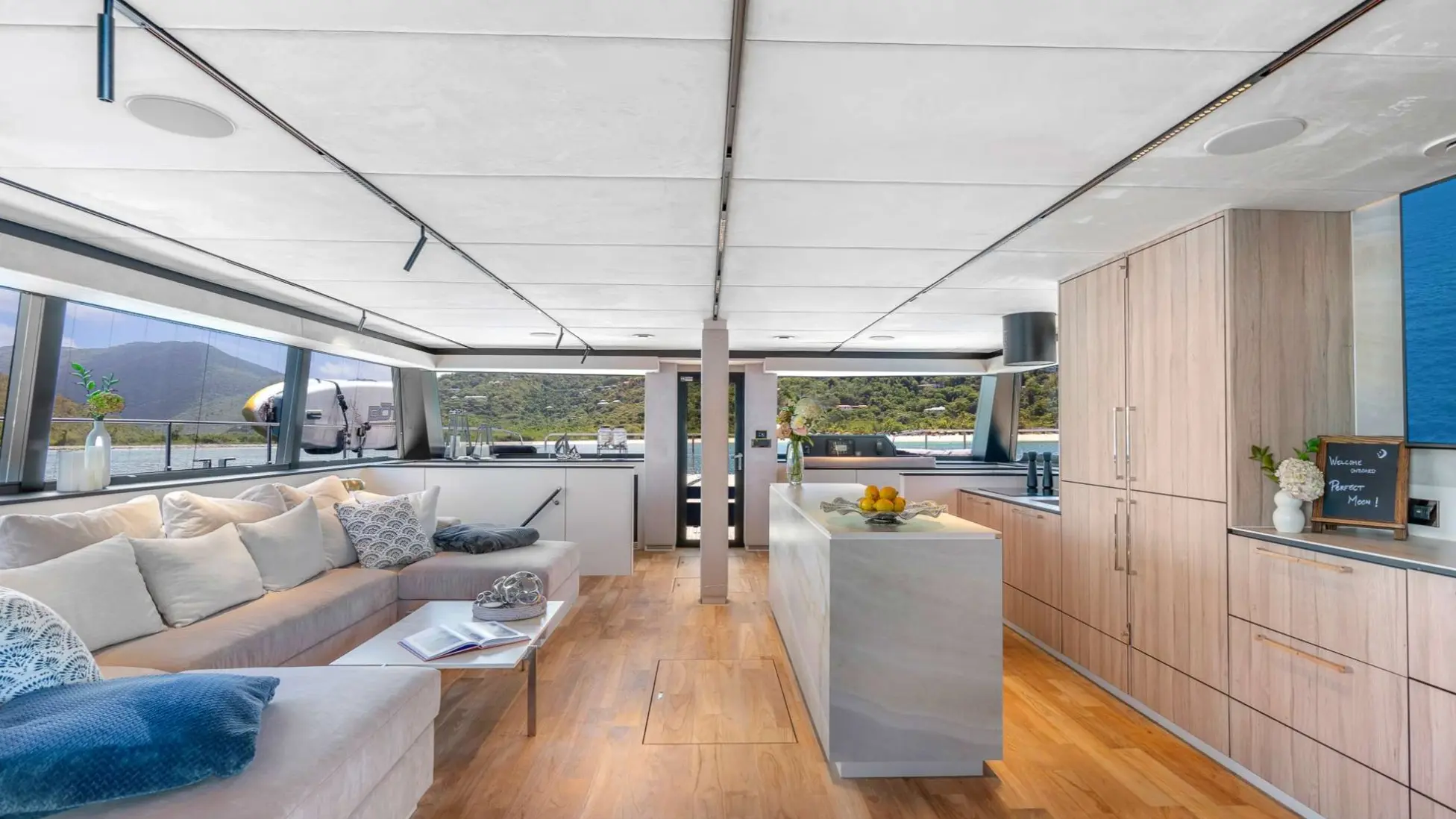
A private catamaran charter is a vacation where 2 to 10 guests book an entire 40- to 85-foot sailing catamaran with a dedicated crew of 2 to 5 for their exclusive use. Your captain, your chef, your itinerary. No other passengers. No compromises.
A small ship luxury liner — think Windstar, Ponant, or Seabourn Venture — typically carries 100 to 300 passengers. The marketing calls it “boutique.” But you’re still navigating shared dining rooms, pool decks, and shore excursion sign-up sheets. You’re still on a fixed route with fixed port times. The experience isn’t a smaller version of a cruise — it’s a completely different category of travel.
Our take: The cruise industry has spent decades training travelers to evaluate vacations by amenity count — pools, restaurants, entertainment venues. A private catamaran charter succeeds precisely because it subtracts all of that. The value isn’t in what’s onboard. It’s in what’s outside, and the fact that you can reach it on your own terms.
The Sailing Experience You Can’t Get on Any Cruise Ship

Roughly 72% of luxury travelers now prioritize unique experiences over material comforts when choosing vacations (Market.us, 2026). Sailing on a catamaran delivers exactly that — and it’s something no cruise ship, large or small, can replicate.
Here’s what most people don’t realize until they’ve done it: cruise ships don’t sail. They motor. Even “sailing” cruise lines like Windstar use their sails mostly for show — engines do the real work. On a chartered catamaran, when the captain cuts the engines and raises the sails, everything changes.
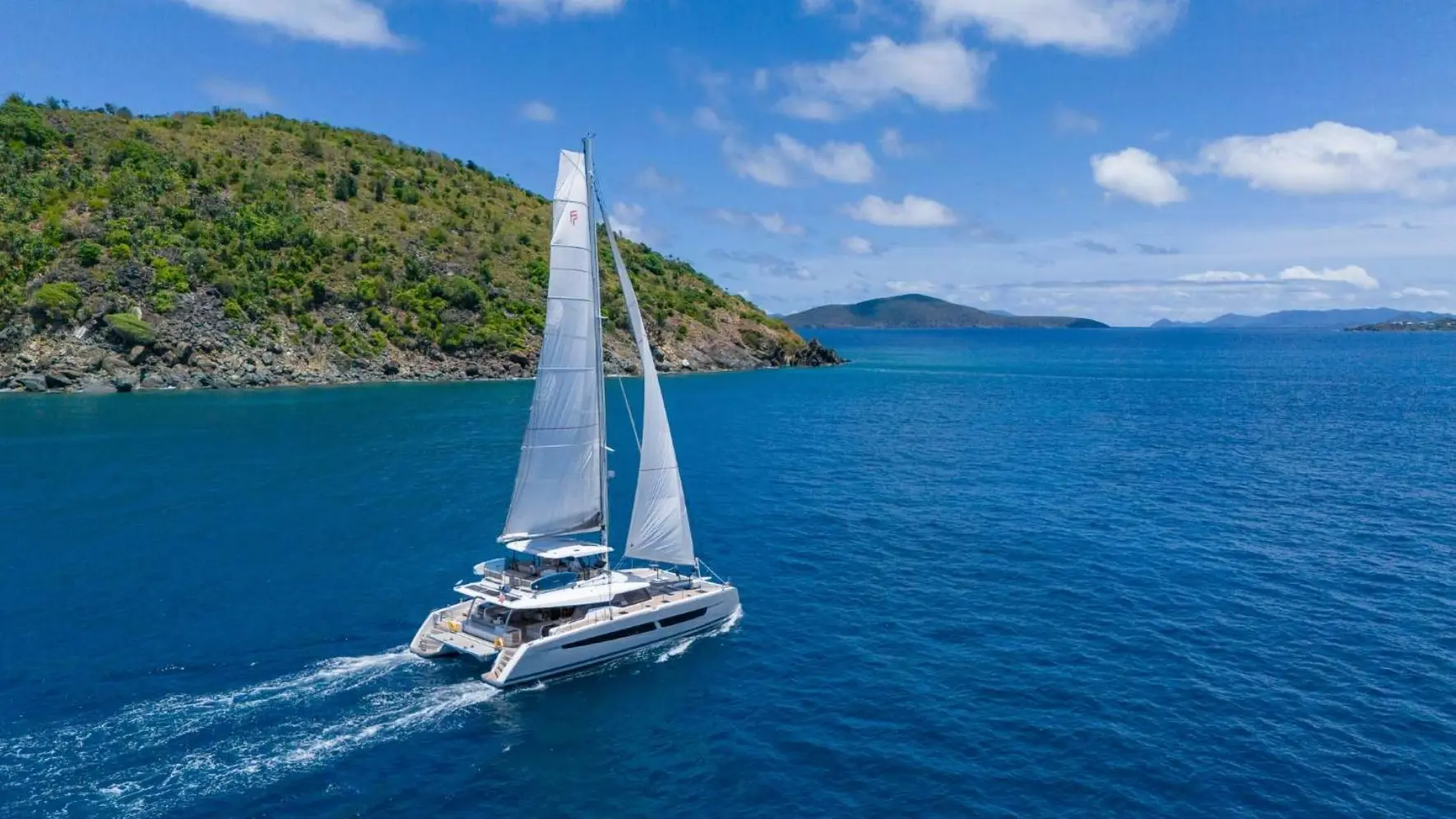
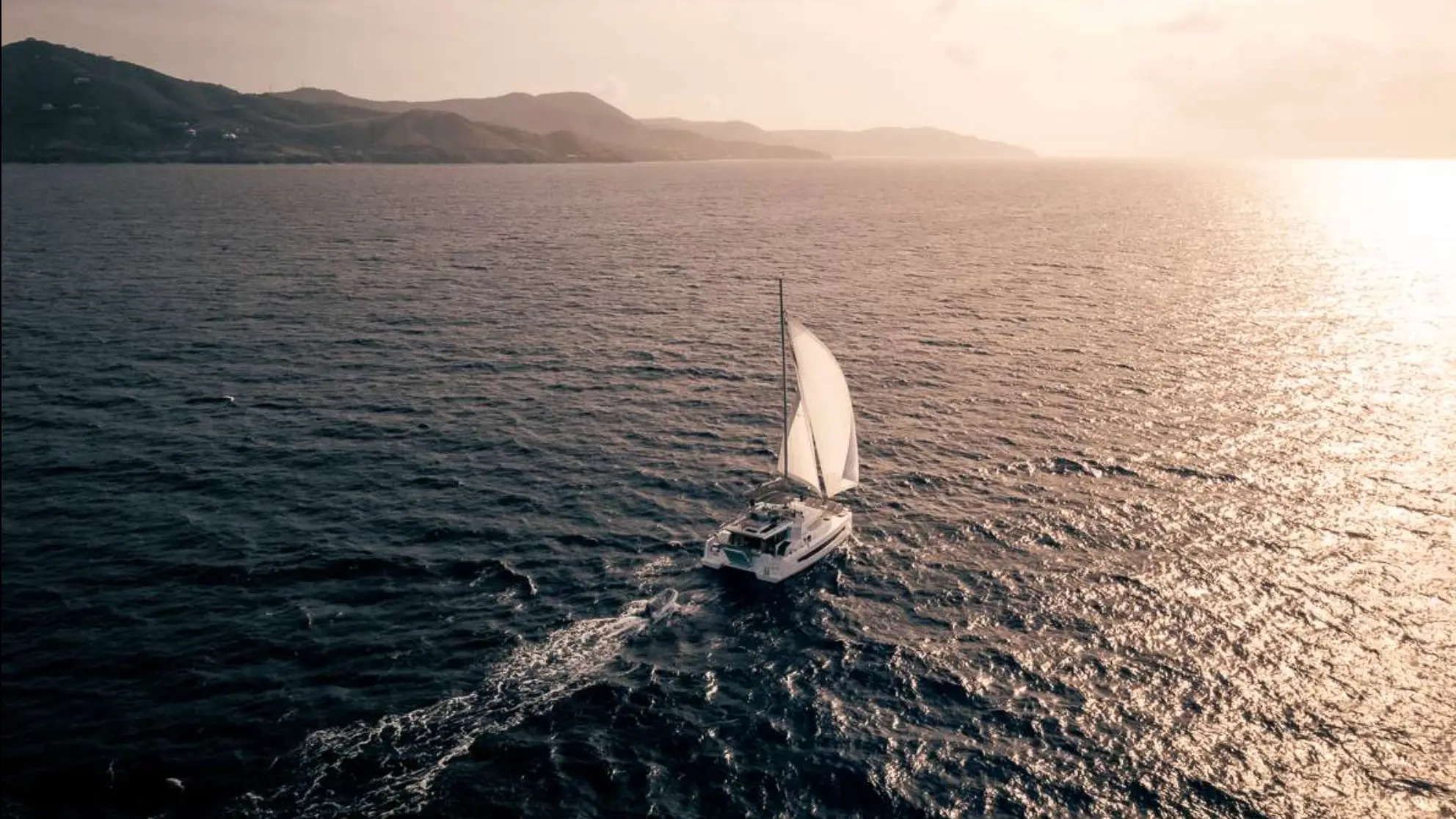
The diesel rumble disappears. You hear the wind filling canvas, water rushing along the twin hulls, maybe the snap of a jib sheet as the crew trims for a new heading. The boat heels gently. You’re actually moving with the wind, not fighting through waves with brute horsepower. It’s the difference between watching a nature documentary and standing in the jungle.
From experience: As an ASA 104 certified sailor, I can tell you that the moment the engines go silent and the sails take over is the single most underrated part of a charter vacation. Guests who’ve never sailed before consistently call it the highlight of their trip — not the snorkeling, not the beach bars, but the sailing itself. Once you’ve felt a catamaran glide at 8 knots under sail power alone, a motorized cruise ship feels like riding a bus.
Catamarans also ride differently. The dual-hull design provides remarkable stability — far less rolling than a monohull sailboat and dramatically less than a cruise ship in open water. For guests prone to seasickness, this alone can be the deciding factor.
How Much Itinerary Freedom Does a Catamaran Charter Actually Give You?
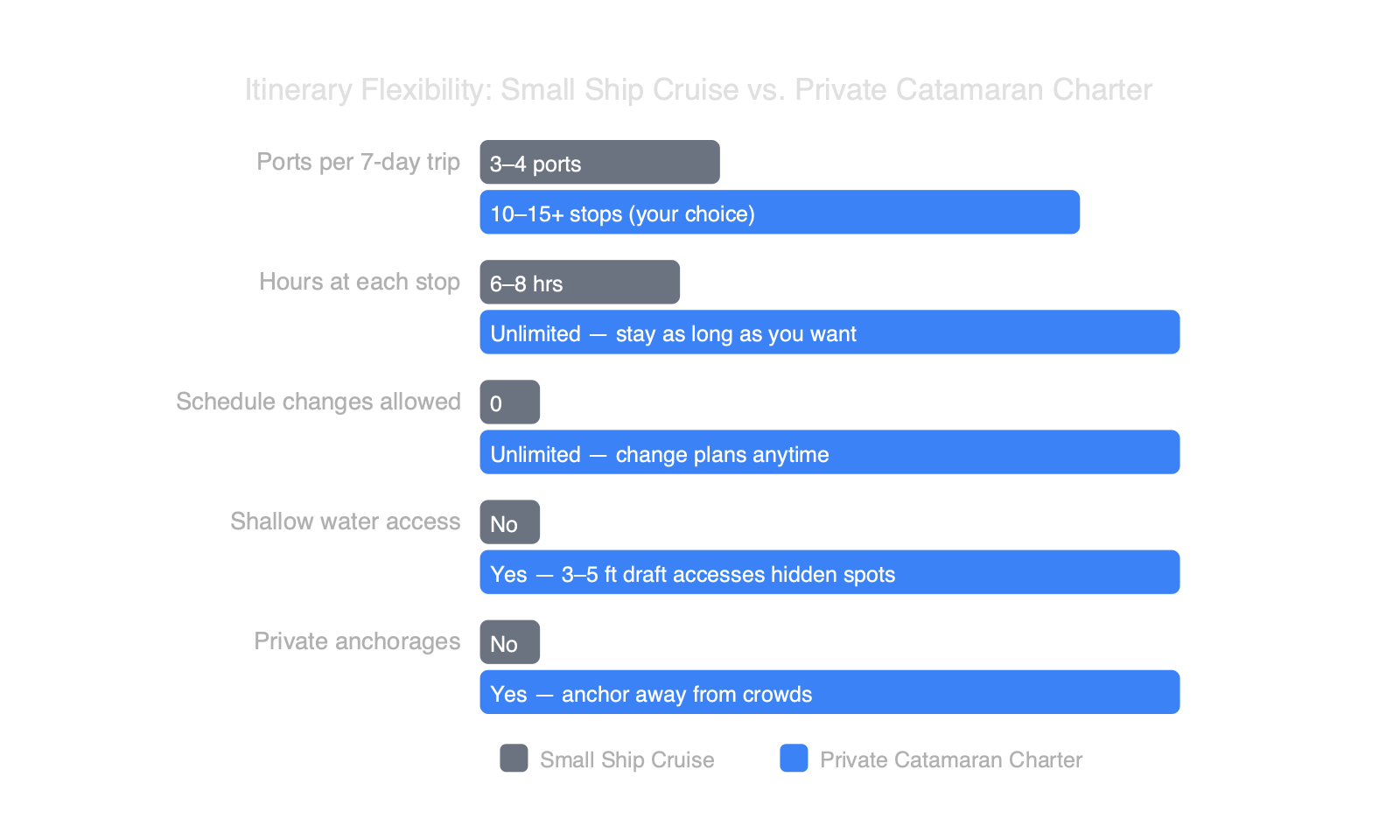
A typical 7-day Caribbean cruise visits 3 to 4 ports, spending an average of 6–8 hours at each one (CLIA State of the Cruise Industry Report, 2025). That means you’re docked by 8 AM and back onboard by 4 PM — with 2,000 other passengers flooding the same port town simultaneously. On a chartered catamaran, you wake up and ask your captain, “Where should we go today?”
That’s not a rhetorical question. It’s your actual morning routine. Maybe you spotted a quiet bay on the chart last night and want to anchor there for breakfast. Maybe the wind shifted and there’s a perfect beam reach to an island you hadn’t planned on visiting. Maybe you just want to stay put, swim off the stern, and go nowhere at all.
A catamaran’s shallow draft — typically 3 to 5 feet — means you can anchor in waters that would ground a cruise ship’s tender. Hidden sandbars, mangrove-lined creeks, uninhabited cays with beaches you’ll have entirely to yourself. When you’re exploring Caribbean charter destinations, this kind of access transforms a vacation into an adventure.
View data table
| Category | Small Ship Cruise | Private Catamaran Charter |
|---|---|---|
| Ports per 7-day trip | 3–4 | 10–15+ (your choice) |
| Hours at each stop | 6–8 hrs | Unlimited |
| Schedule changes allowed | 0 | Unlimited |
| Shallow water access | No | Yes (3–5 ft draft) |
| Private anchorages | No | Yes |
And unlike a cruise, there’s no tender situation. No waiting for a small boat to shuttle you to shore with 50 other passengers. Your catamaran is the tender. Pull up, drop anchor, swim to the beach. Want to snorkel that reef 200 yards off the bow? Jump in. Nobody’s checking a sign-up sheet or handing you a numbered wristband.
How Does Personalized Service on a Charter Compare to a Small Ship Cruise?
Even the most exclusive small ship cruises — Silversea, Regent Seven Seas, Seabourn — top out at roughly a 1:1.3 crew-to-guest ratio (CLIA, 2025). That sounds impressive until you realize those crew members are split across housekeeping, engine room, bridge, kitchen, entertainment, and administration. The number of staff actually focused on your experience is far smaller than the ratio suggests.
On a crewed catamaran voyage with 6 travelers and a crew of 3 (captain, chef, and first mate), you’re looking at a 1:2 ratio — and every single crew member is dedicated entirely to your group. Nobody else. Your chef doesn’t cook for a dining room of 150. She cooks for you. By day two, she knows your daughter won’t eat cilantro, your partner prefers her eggs scrambled, and you want your coffee before 7 AM.
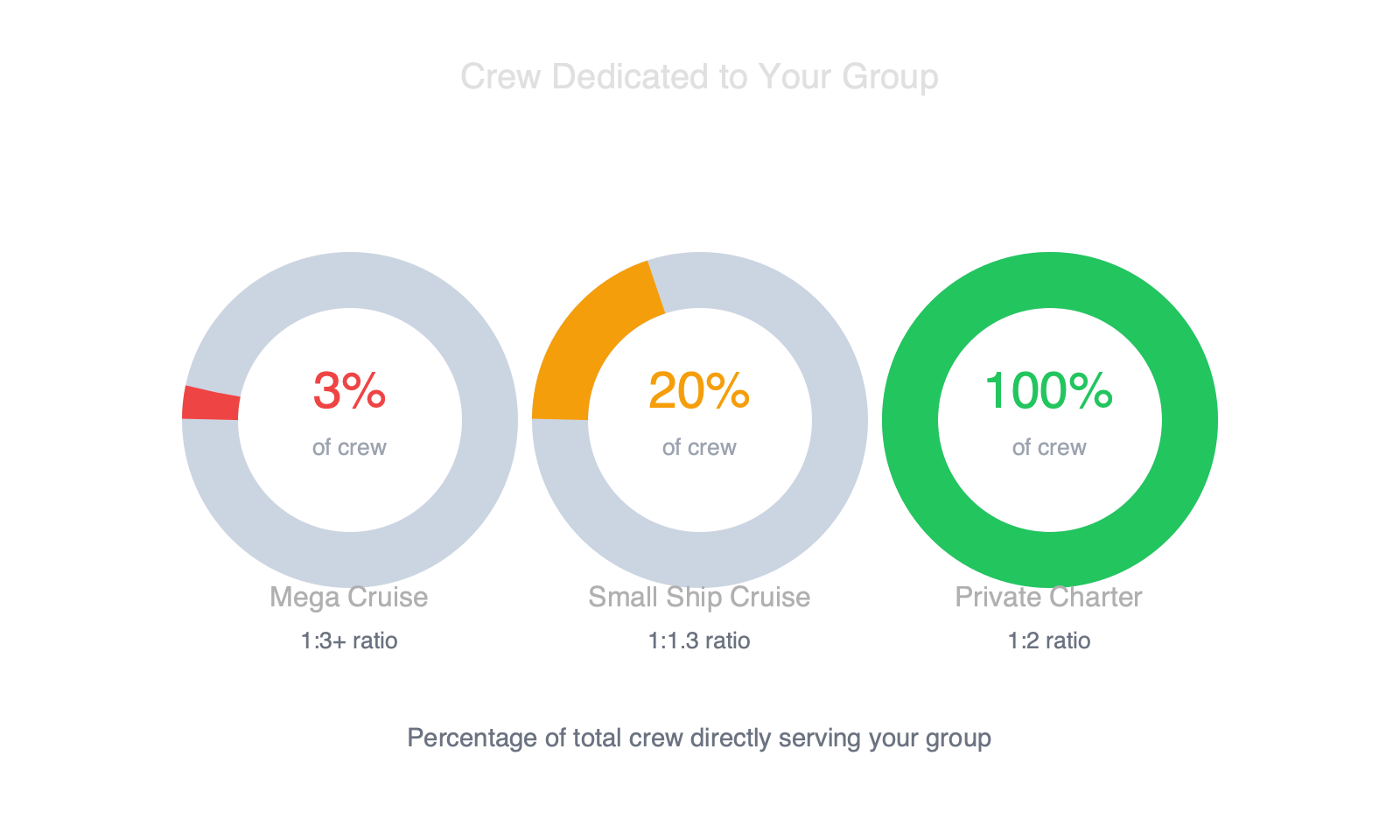
View data table
| Vessel Type | Crew-to-Guest Ratio | % of Crew Dedicated to Your Group |
|---|---|---|
| Mega Cruise Ship (3,000+ guests) | 1:3+ | ~3% |
| Small Ship Luxury Cruise (100–300 guests) | 1:1.3 | ~20% |
| Private Catamaran Charter (2–10 guests) | 1:2 | 100% |
That level of personalization compounds over the course of a week. By mid-charter, your crew doesn’t just know your preferences — they anticipate them. The sundowner cocktails appear at the right time. The snorkel gear is set out before you mention wanting to dive. The boat repositions for the best sunset view without anyone asking. It’s not luxury in the five-star-hotel sense. It’s something closer to having a close friend who happens to be an expert sailor, a professional chef, and a local guide — all at once.
Cruise ship crew members rotate shifts and serve hundreds of guests. They can be excellent at their jobs and still never learn your name. That’s not a criticism of the crew — it’s a structural limitation of the format. The math simply doesn’t work at scale. When you understand how all-inclusive yacht charters operate, the service gap becomes obvious.
What Does Daily Life Look Like on a Catamaran vs. a Small Ship?
Experiential travel now accounts for roughly half of the luxury travel market (Market.us, 2026). Travelers don’t want a curated program — they want to shape their own experience. A crewed sailing vacation is the purest expression of that trend.
Want breakfast at 10 AM instead of 7? Done. Feel like grilling lobster on the stern for lunch instead of sitting in a dining room? Your chef handles it. Want to skip dinner entirely and eat cheese and wine on the trampoline nets while watching stars? Nobody’s stopping you.
Compare that to even the most upscale small ship cruise. Windstar’s “Open Bridge” policy and Ponant’s butler service are genuinely good — but you’re still eating in a shared restaurant, at tables arranged by the maître d’, at times set by the galley schedule. The food may be excellent. The flexibility is not.
Activities follow the same pattern. On a cruise, shore excursions run on bus schedules. Snorkeling happens at designated sites during designated windows. On a catamaran charter, your captain drops anchor at a reef he knows from 15 years of sailing these waters — one that’s never appeared on a cruise excursion list. You snorkel until you’re done. Nobody blows a whistle.
Key distinction: A crewed catamaran charter in the Caribbean typically includes all meals, premium bar, water toys (paddleboards, kayaks, snorkel gear, fishing equipment), fuel, and crew service in the charter fee (MYBA charter terms). Cruise passengers pay base fare plus excursions, premium dining, drinks packages, Wi-Fi, and gratuities separately — adding 30–50% to the advertised price.
Is a Private Catamaran Charter Actually Worth the Cost?
A week aboard a small ship luxury cruise like Silversea or Ponant runs $700–$1,200+ per person per day, depending on cabin category and itinerary (CLIA, 2025). That’s before excursions, premium drinks, and spa treatments — extras that routinely add 30–50% to the total.
A crewed catamaran charter in the Caribbean runs roughly $2,500–$5,000 per day total for the entire vessel — typically for 2 to 8 guests. Split among 6 guests, that’s $415–$835 per person per day, all-inclusive: meals, open bar, water toys, fuel, and a crew that’s exclusively yours. For a detailed breakdown, take a look at how yacht charter pricing works in 2026.
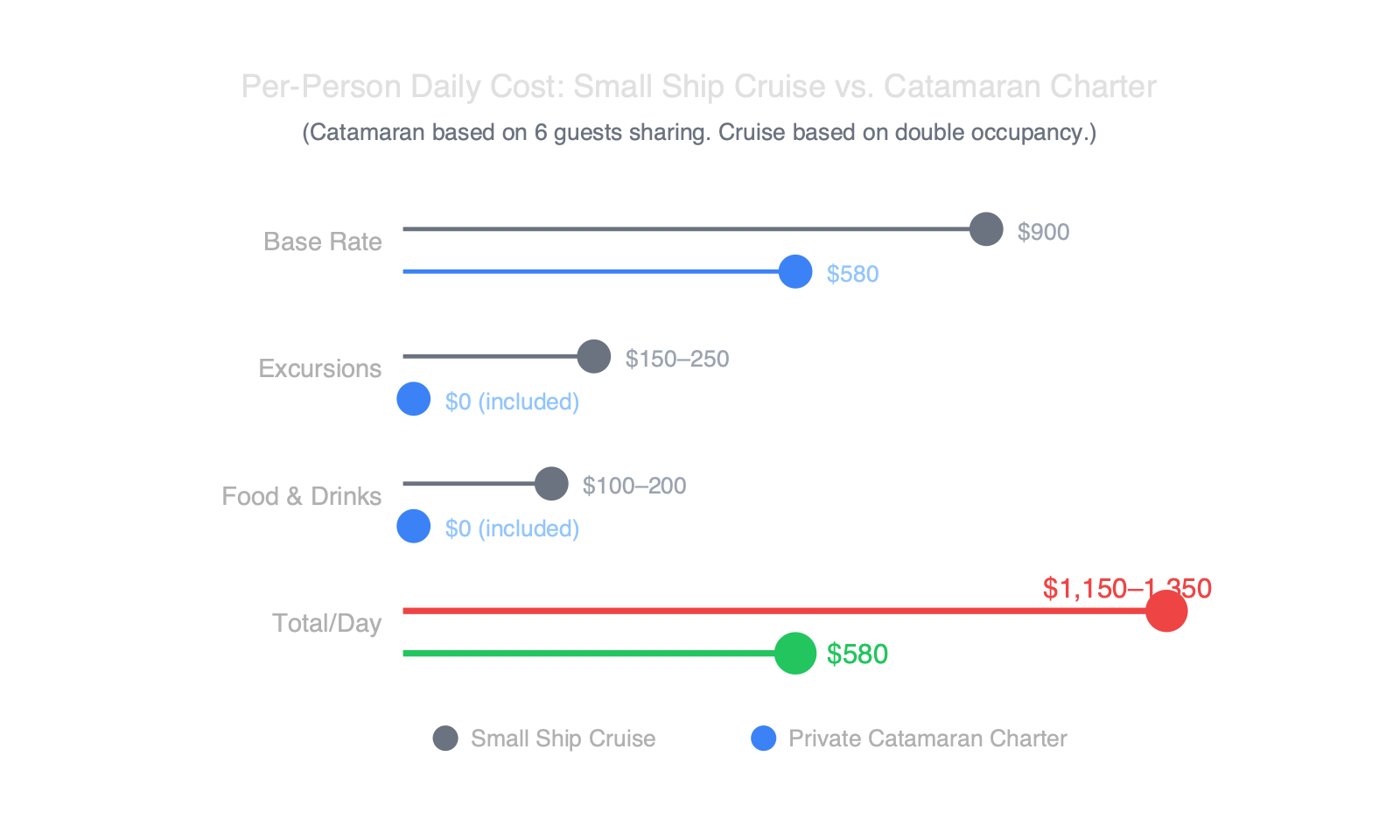
View data table
| Cost Category | Small Ship Cruise (per person/day) | Catamaran Charter (per person/day, 6 guests) |
|---|---|---|
| Base Rate | $900 | $580 |
| Excursions | $150–250 | $0 (included) |
| Food & Drinks Extras | $100–200 | $0 (included) |
| Total per Day | $1,150–1,350 | $580 |
The math isn’t even close. For the same money as one person’s small ship cruise cabin, you can charter an entire catamaran for your group — with better food, more privacy, and dramatically more flexibility. And unlike cruise pricing, there are no surprise add-ons. When you compare all-inclusive charter pricing to à la carte models, the transparency of a crewed charter stands out.
What we see with clients: Families and friend groups who switch from cruise vacations to crewed sailing charters get a more personalized experience. The perception that chartering is only for the ultra-wealthy is the single biggest misconception in the industry.
How Does a Catamaran Compare to a Cruise Ship for Comfort and Space?
The average interior cruise cabin measures 160–185 square feet, and even a suite on a small luxury ship typically runs 300–400 square feet (BoatBookings, 2025). On a 50-foot catamaran, each guest cabin is roughly 100–120 square feet — smaller on paper, but the comparison misses the point entirely.
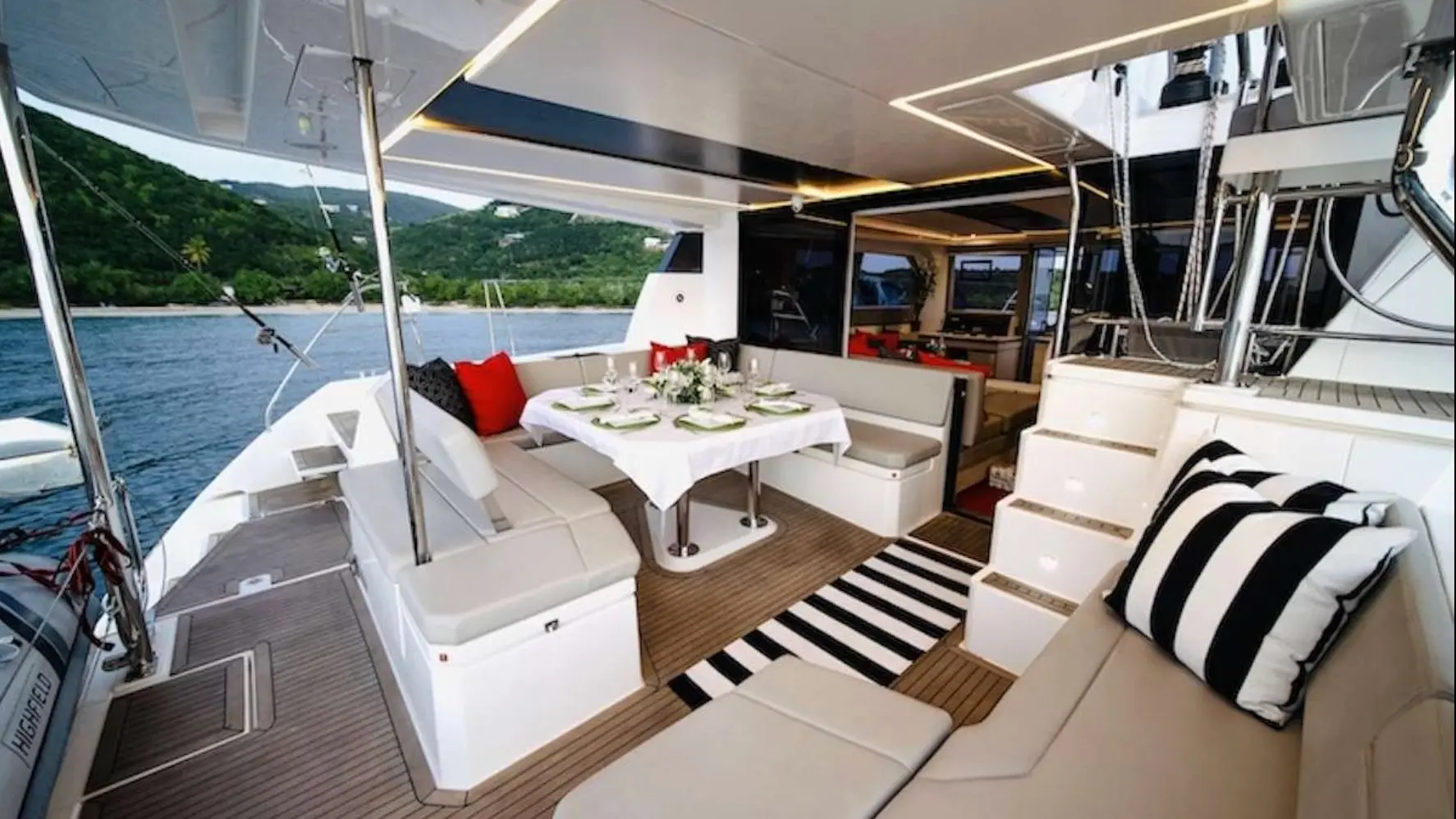
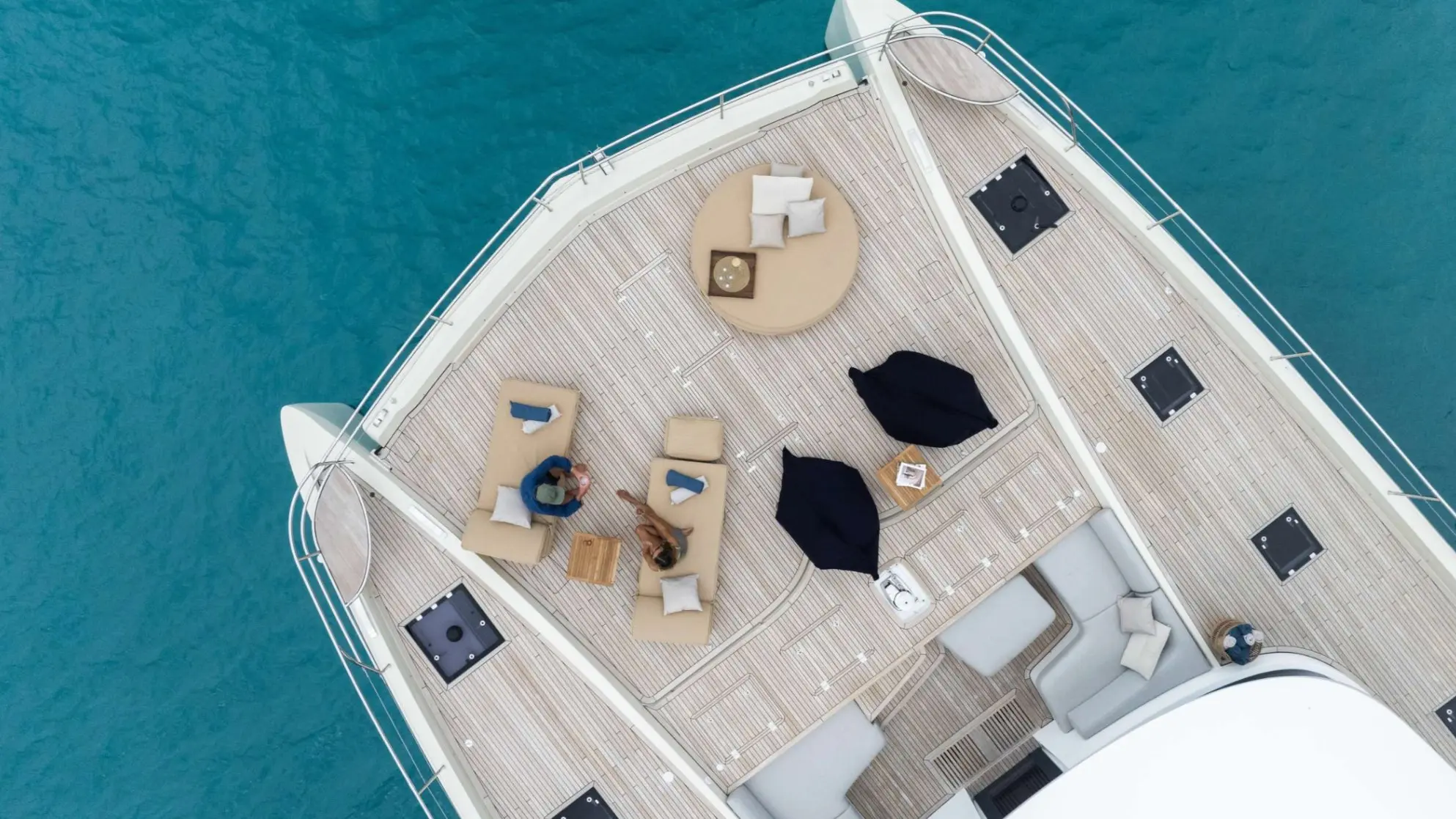
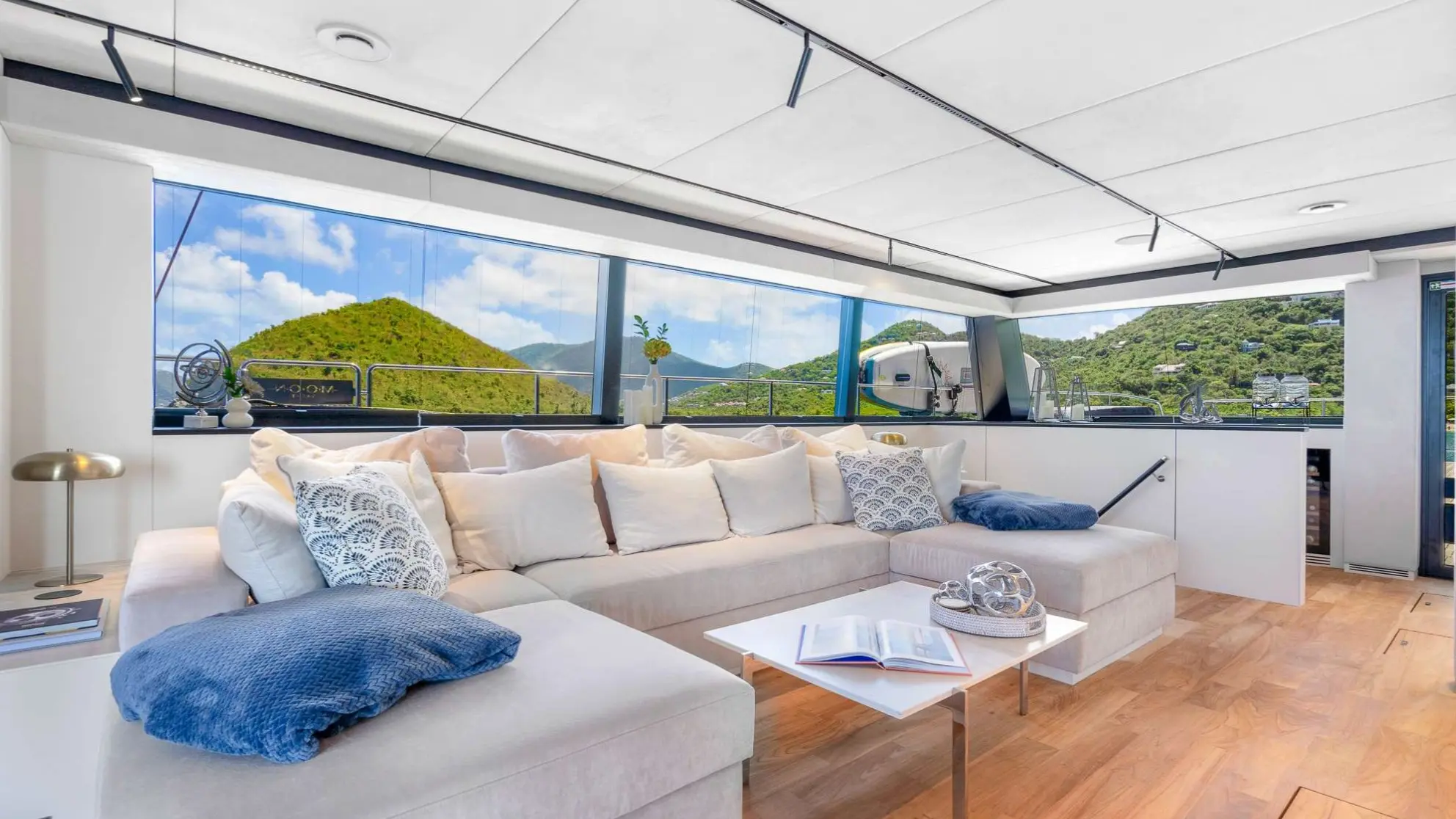
On a cruise ship, your cabin is where you retreat from shared spaces. On a catamaran, the entire boat is your space. The 400-square-foot cockpit and salon area? Yours. The forward trampoline nets, perfect for napping in the sun? Yours. The aft deck where your chef preps lunch while you watch dolphins? Also yours. Your total usable living area per guest on a charter catamaran often exceeds what you’d get in a cruise suite — and none of it is shared with strangers.
Then there’s the stability question. Catamarans don’t roll the way monohull sailboats or cruise ships do. The wide beam and twin hulls create a platform that stays remarkably level, even in choppy conditions. If anyone in your group is concerned about seasickness, a catamaran charter is the safest bet on the water. Some of the most popular Lagoon catamaran models are specifically engineered for this kind of comfort — wide, stable, and designed for living aboard rather than just sleeping aboard.
Why does this matter for a vacation? Because comfort isn’t just about thread count and pillow menus. It’s about whether you can actually relax. On a stable catamaran, anchored in a quiet bay with no engine noise and no wake from passing ships, the relaxation is physical. Your body stops bracing. You sleep deeper. You wake up calmer. A small ship cruise offers nice amenities — but it can’t offer silence.
Who Should Choose a Private Catamaran Charter Over a Small Ship Cruise?
Not every traveler should charter a catamaran. But the people who are the best fit often don’t realize it until they’ve compared the two options side by side. CLIA reports that 37.7 million passengers cruised globally in 2025, a 9% increase over 2024 (CLIA, 2025). Many of them would’ve had a better time on a charter — they just didn’t know it was an option.
A private catamaran charter is the stronger choice if you value flexibility over predictability, quiet over entertainment, and depth of experience over breadth of amenities. It’s ideal for:
- Families with kids who want to swim, snorkel, and explore without fighting crowds or waiting for organized activities
- Couples looking for genuine seclusion — not a “private balcony” that faces another ship’s balcony
- Friend groups of 4–10 who want to split costs and have an adventure together
- Repeat cruisers who’ve done the cruise thing and want something fundamentally different
- Active travelers who want to dive, fish, paddleboard, and sail — not watch a show after dinner
A small ship cruise still makes sense if you want a wide range of onboard entertainment, structured social events, or if you prefer having hundreds of destination choices without planning anything yourself. But if you’re the kind of traveler who wants to feel the ocean, not just look at it from a deck chair, a charter is the answer.
Frequently Asked Questions
How many people can a private catamaran charter accommodate?
Most charter catamarans carry 2 to 10 guests comfortably, with 3 to 5 private cabins depending on the vessel size. A 45-foot catamaran typically has 3 cabins for 6 guests, while 50- to 65-foot models offer 4 to 5 cabins for 8 to 10 guests (BoatBookings, 2025). Crew quarters are separate, so you’ll never share bathroom schedules.
Do you need sailing experience to charter a catamaran?
Not on a crewed charter — your captain and crew handle everything. The captain navigates, the chef cooks, and the first mate manages sails, lines, and water toys. No experience required. If you want to learn, most captains are happy to teach basic sailing skills during the trip. For details on what a crewed charter includes, see what’s covered under a MYBA charter contract.
Is a catamaran charter more expensive than a small ship cruise?
Per person per day, a crewed catamaran charter is typically fairly comparable to small ship luxury cruise. A group of 6 on a Caribbean catamaran pays roughly $415–$1200 per person per day, all-inclusive. Silversea or Ponant runs $700–$1,200+ per person per day before extras (CLIA, 2025). The charter price includes food, drinks, water toys, and crew.
What destinations are best for a private catamaran charter?
The Caribbean is the most popular region, with the British Virgin Islands, Bahamas, St. Martin, and Grenadines offering ideal conditions: protected waters, short island-to-island distances, reliable trade winds, and hundreds of anchorages. The Mediterranean (Greece, Croatia, Italy) is equally popular during summer months. Caribbean cruise tourism spending alone hit a record $4.27 billion in 2023–24 across 29.4 million passenger visits (Seatrade Cruise, 2024), underscoring why the region is the world’s top chartering ground.
What happens if the weather is bad during a catamaran charter?
Your captain monitors weather continuously and adjusts the route to avoid rough conditions — a major advantage over fixed cruise itineraries. Catamarans can duck into protected harbors, anchor in the lee of islands, or simply change direction. Caribbean charter seasons benefit from predictable trade winds and rarely see severe weather disruptions. The dual-hull design also provides far more stability than monohull vessels in choppy seas.
Should You Choose a Private Catamaran Charter Over a Small Ship Cruise?
A small ship luxury cruise is a better vacation than a mega-ship cruise. But a private catamaran charter is a better vacation than either of them — for the right traveler. The advantages aren’t incremental. They’re structural:
- Real sailing — wind, water, silence — versus motorized transport between ports
- Total itinerary freedom — 10–15 stops versus 3–4 fixed ports, with the ability to change plans on a whim
- 100% dedicated crew — 1:2 ratio with your own captain, chef, and mate versus shared staff across hundreds of guests
- True all-inclusive pricing — meals, drinks, toys, and experiences included versus base fare plus stacking add-ons
- Access to hidden spots — shallow-draft anchorages, private coves, and beaches no cruise ship can reach
If you’ve been looking at small ship cruises because you want something more personal than a floating resort, a private catamaran charter is where that logic leads when you follow it all the way to the end. The ocean is better when you’re the only ones on board.
Jason Acosta is the co-founder and principal broker of Vital Charters. He is an avid sailor and yacht charterer. Jason is also a Master Diver and certified ASA 104 sailor.