
Bali Catamarans is the fastest-growing catamaran brand in the world — and they’ve earned that title in just over a decade. Since launching their first model in 2014, the brand has delivered more than 1,500 boats and ramped production from 15 hulls per year to roughly 350 (Barche Magazine, 2024). If you’ve been browsing popular charter yacht brands in the Caribbean, you’ve probably noticed these French-built multihulls showing up everywhere.
What actually makes a Bali catamaran different from a Lagoon or a Fountaine Pajot? And should you book one for your next charter vacation? This FAQ breaks it down into four sections:
- About the Bali Brand — Who builds them, how they started, and how fast they’ve grown
- Design & Innovation — The Bali Door, solid foredeck, and open-space concept
- Bali in the Charter Market — Where to find them, from the BVI to the Mediterranean
- Your Bali Vacation — Costs, Lagoon comparison, and why they’re built for entertaining
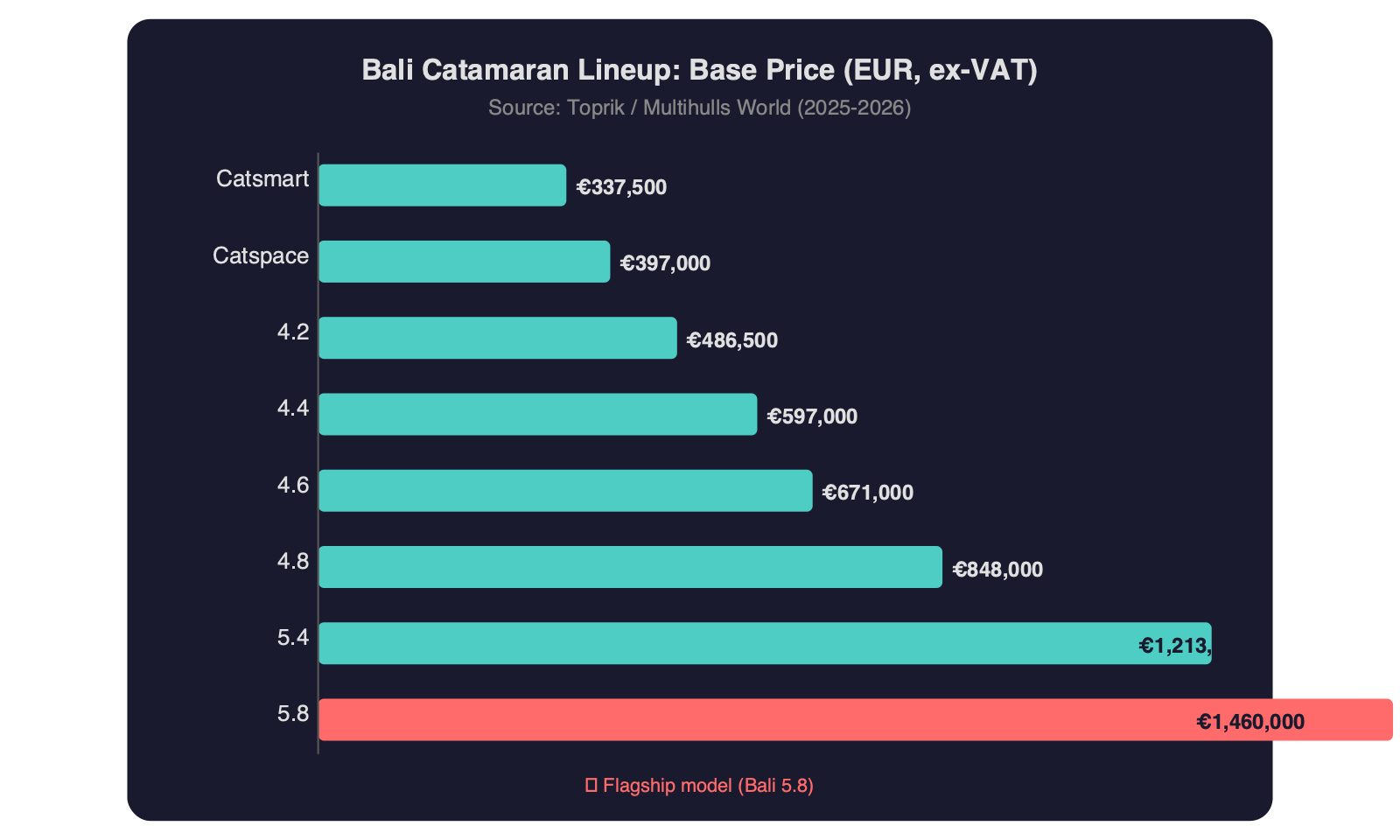
TL;DR: Bali Catamarans, made by Catana Group, has built over 1,500 boats since 2014 with prices from EUR 337,500 to EUR 1,460,000. Their signature solid foredeck and Bali Door create more usable outdoor space than any competitor. Charter fleets in the Caribbean and Mediterranean are adding them fast — and charterers love the open-plan layout for group vacations.
Last updated: .
About the Bali Brand
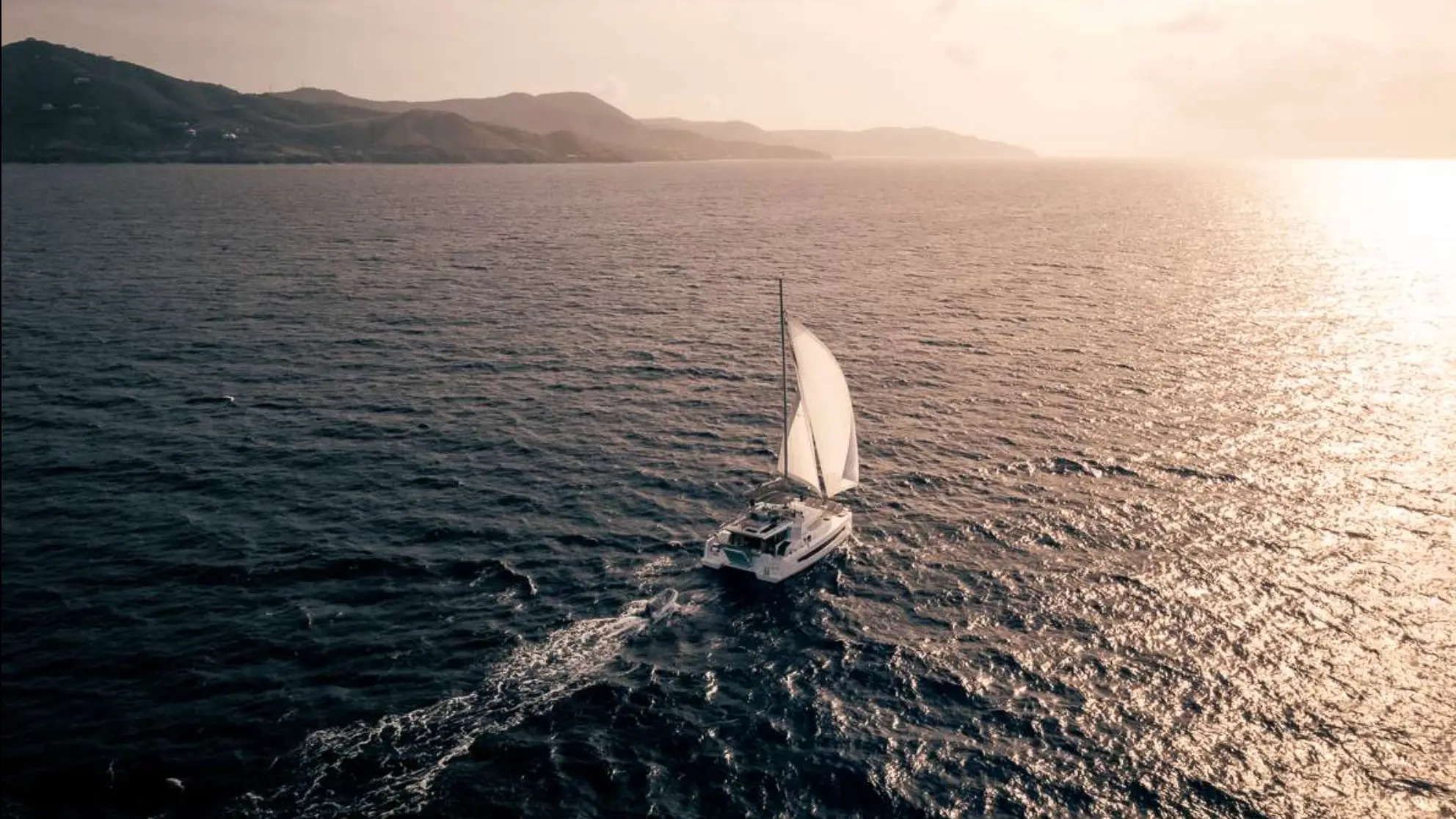
Bali Catamarans is built by Catana Group, a publicly traded French marine company (EPA: ALCAT) that generated EUR 229.5 million in revenue during fiscal year 2024 (Stock Analysis, 2026). The group employs 1,400 people across four production sites in France, Tunisia, and Portugal (Katamarans, 2025).
Catana Group also builds performance-oriented Catana catamarans and the newer YOT powercat line. Bali is the volume brand — it accounts for the lion’s share of output and has been the main growth engine since its 2014 launch.
When were Bali catamarans first built?
The Bali brand launched in September 2014 with the Bali 4.5, its first model. Catana Group itself was founded in 1984 by Jean-Pierre Prade and Thierry Goyard in Cogolin, France. Olivier Poncin acquired the struggling company in 2003 and turned it around by creating the Bali line for the cruising and charter market (Barche Magazine, 2024).
Poncin’s vision was straightforward: take the best ideas from the charter world — easy boarding, open living spaces, minimal maintenance — and build them into a production catamaran from the ground up. He started fresh rather than iterating on an old design.
From the helm: I remember the first time I saw a Bali 5.4 at a boat show. The solid foredeck looked wrong to me — where’s the trampoline? Then I walked up there and realized it was the biggest, flattest sunbathing and entertaining area I’d ever stood on aboard a cat. That was the moment I understood what Poncin was doing.
Olivier Poncin passed away in May 2023 at age 69. His son Aurelien now leads the design team and has continued pushing the brand forward with newer models like the Bali 5.2 (Giornale della Vela, 2023).
How many Bali catamarans have been built?
Over 1,500 Bali catamarans have rolled off the production line since 2014, with 14 distinct models launched in that span. Catana Group delivered approximately 330 boats worldwide in 2024 alone — their highest output ever (Toprik, 2024). Production scaled from just 15 boats in 2015 to roughly 350 per year today.
Lagoon has built over 7,000 catamarans, but they’ve had a 40-year head start. Bali’s pace of roughly 150 boats per year on average is closing the gap faster than anyone expected.
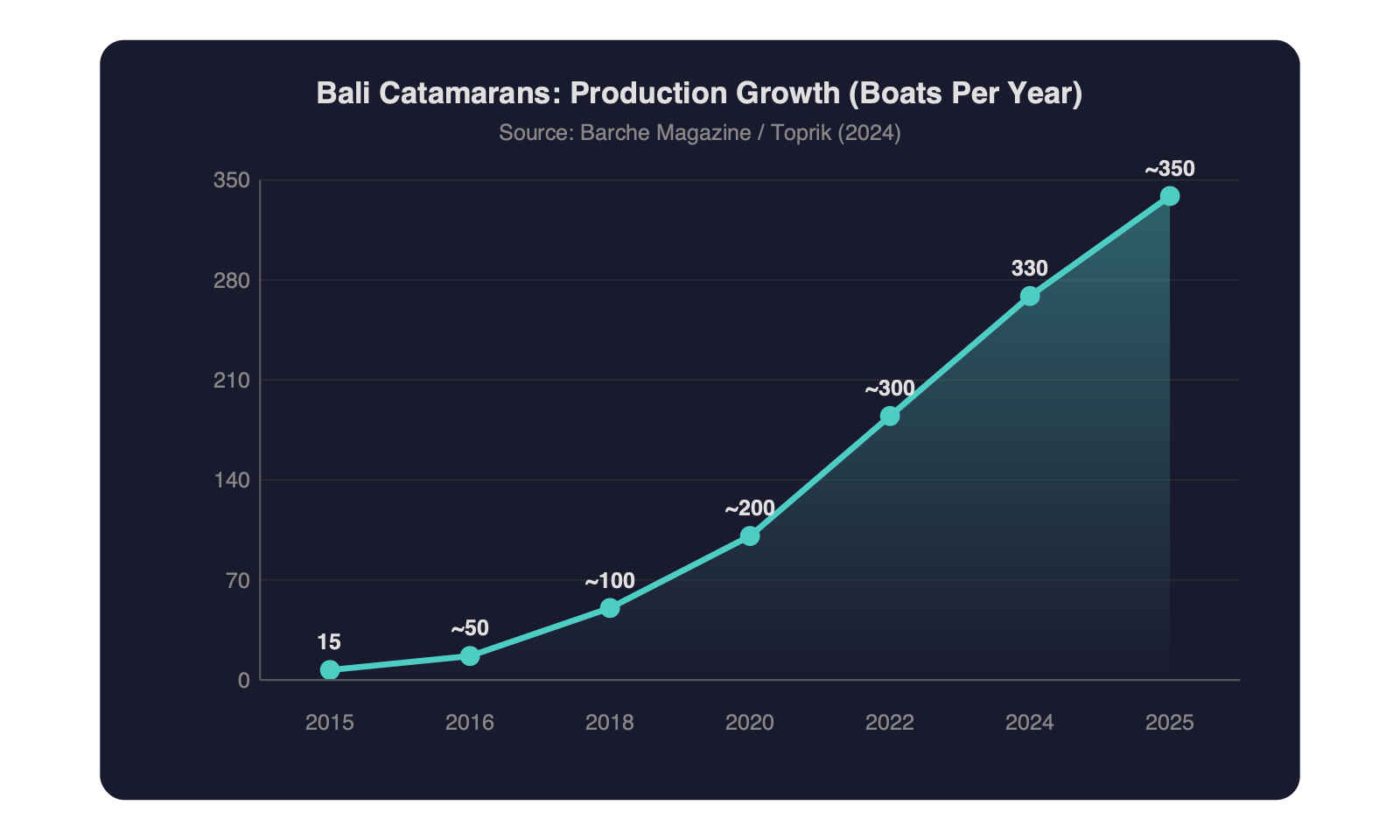
View data table
| Year | Boats Per Year |
|---|---|
| 2015 | 15 |
| 2016 | ~50 |
| 2018 | ~100 |
| 2020 | ~200 |
| 2022 | ~300 |
| 2024 | 330 |
| 2025 | ~350 |
Design & Innovation
What is the Bali Door on a catamaran?
The Bali Door is a full-width tilting panel between the cockpit and salon that folds down to create a single, uninterrupted living space. When open, it eliminates the traditional threshold between indoor and outdoor areas — turning two separate rooms into one massive entertaining zone. No other production catamaran brand offers anything like it at this scale.
Here’s why it matters for a charter vacation: on a conventional catamaran, the galley and salon are sealed behind sliding glass doors. You’re either inside or outside. On a Bali, the cook is part of the party. Guests flow freely between the cockpit table, the salon settee, and the galley counter without ducking through a doorway.
What makes Bali catamarans different from other brands?
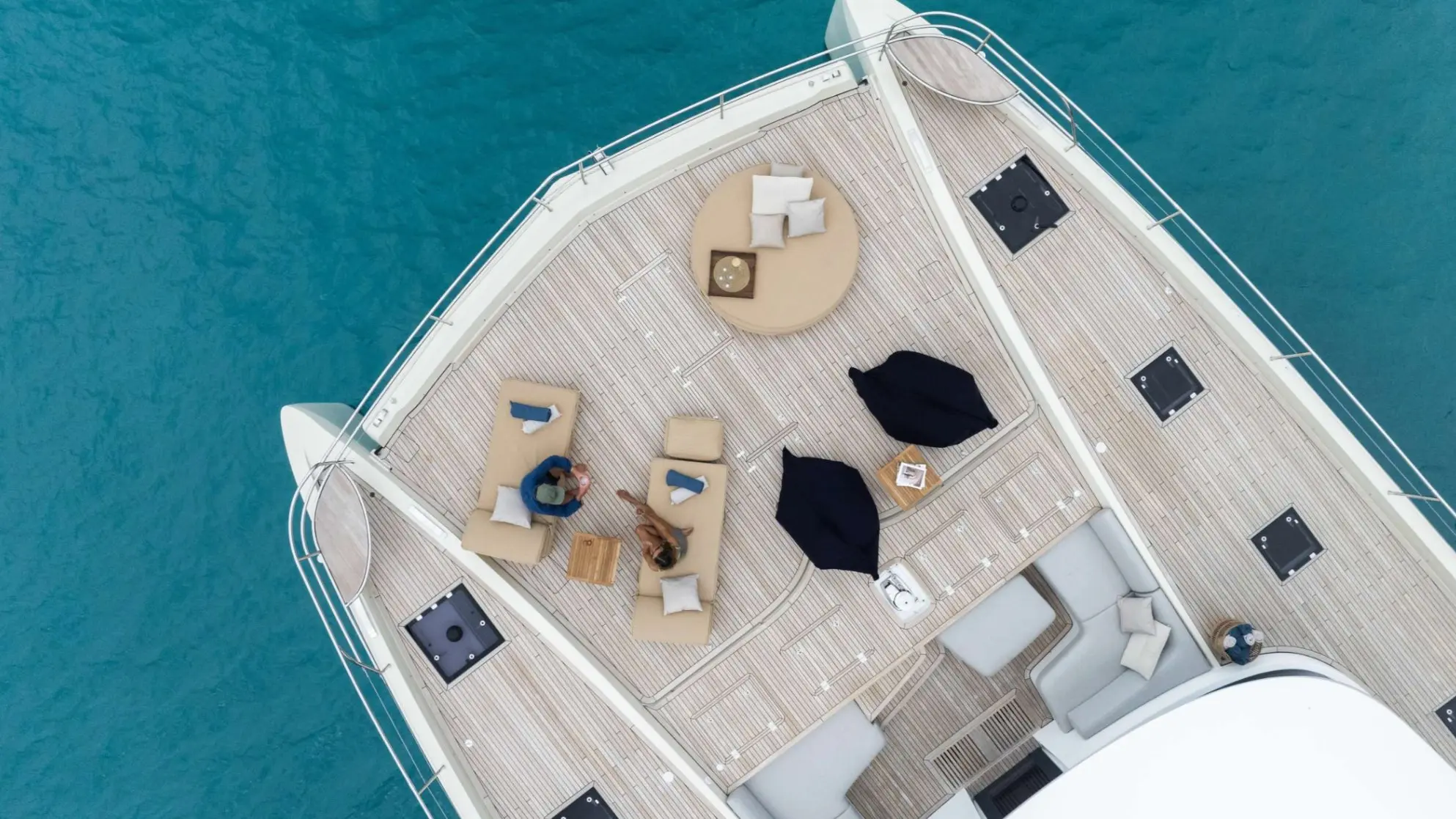
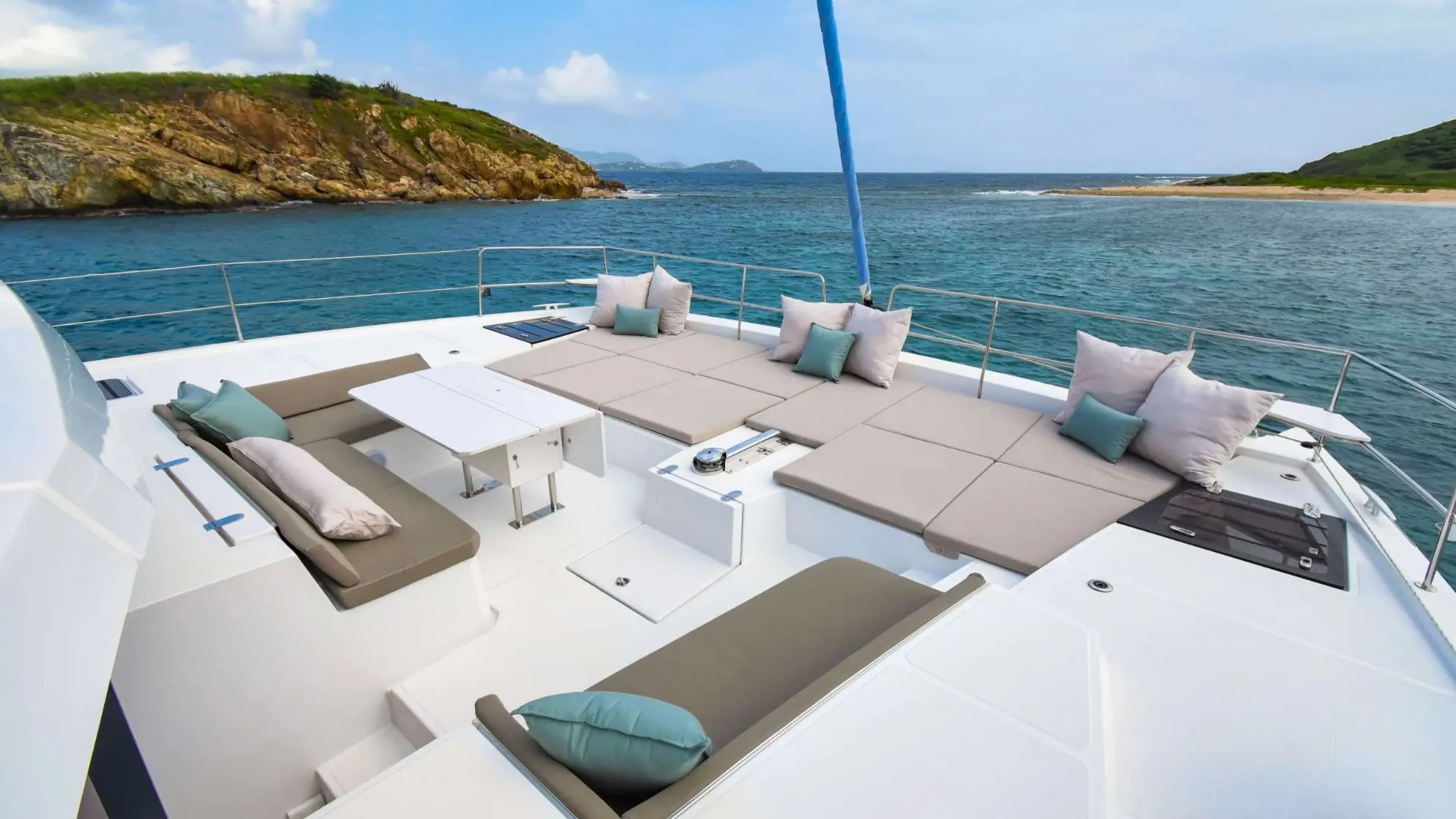
Three design choices separate every Bali yacht from the rest of the charter fleet. First, the solid foredeck replaces the traditional trampoline netting with a rigid, flat platform — giving you a forward cockpit, sunbathing area, and second entertaining zone that no other brand replicates at this price point. Second, the Bali Door merges indoor and outdoor living. Third, Bali uses a closed-cell foam hull core instead of the balsa wood core found in Lagoons and Fountaine Pajots (Catamaran Gurus, 2024).
The foam core matters because balsa can absorb moisture if the fiberglass skin is breached. Closed-cell foam doesn’t. That translates to lower long-term maintenance — a real factor for charter companies deciding which brand to buy.
Design insight: The solid foredeck is polarizing among sailors. Traditionalists miss the trampoline netting that lets spray pass through. Here’s what most reviews don’t mention: that foredeck creates a second cockpit with seating, a table, and a sunpad. On a week-long charter with 8-10 guests, having two separate outdoor gathering spots completely changes group dynamics. People naturally split into two groups without feeling crowded.
Are Bali catamarans good?
Yes — and the market agrees. The Bali 5.4 won Multihull of the Year in the 40-55 foot category in 2019 with over 11,000 votes (Bali 5.4 Charter, 2019). The Bali Catsmart was nominated for British Yachting Awards Multihull of the Year in 2023 (MedCat Yachts, 2023). Charter companies keep buying them because guests rate the living space highly.
They’re not for everyone, though. Bali catamarans prioritize comfort and living space over sailing performance. If you want to race or point high upwind, a Catana or an HH Catamaran will outperform a Bali. For 95% of charter vacationers who want a floating villa with sails? They’re excellent.
Why are Bali catamarans so affordable?
Bali Catamarans recently lowered prices across their range after raw material costs stabilized, passing the savings directly to buyers (Croatia Yachting, 2025). Catana Group’s EUR 130 million strategic investment through 2030 includes expanding production capacity in Portugal and Tunisia, where manufacturing costs are lower than mainland France (Katamarans, 2025).
A Bali Catsmart starts at EUR 337,500 — roughly 15-20% less than a comparably-sized Lagoon or Fountaine Pajot. That price advantage makes them attractive to charter fleet operators who need to maximize return on investment. When charter companies buy in volume, they negotiate even steeper discounts.
Bali in the Charter Market
Can you charter a Bali catamaran in the Caribbean?
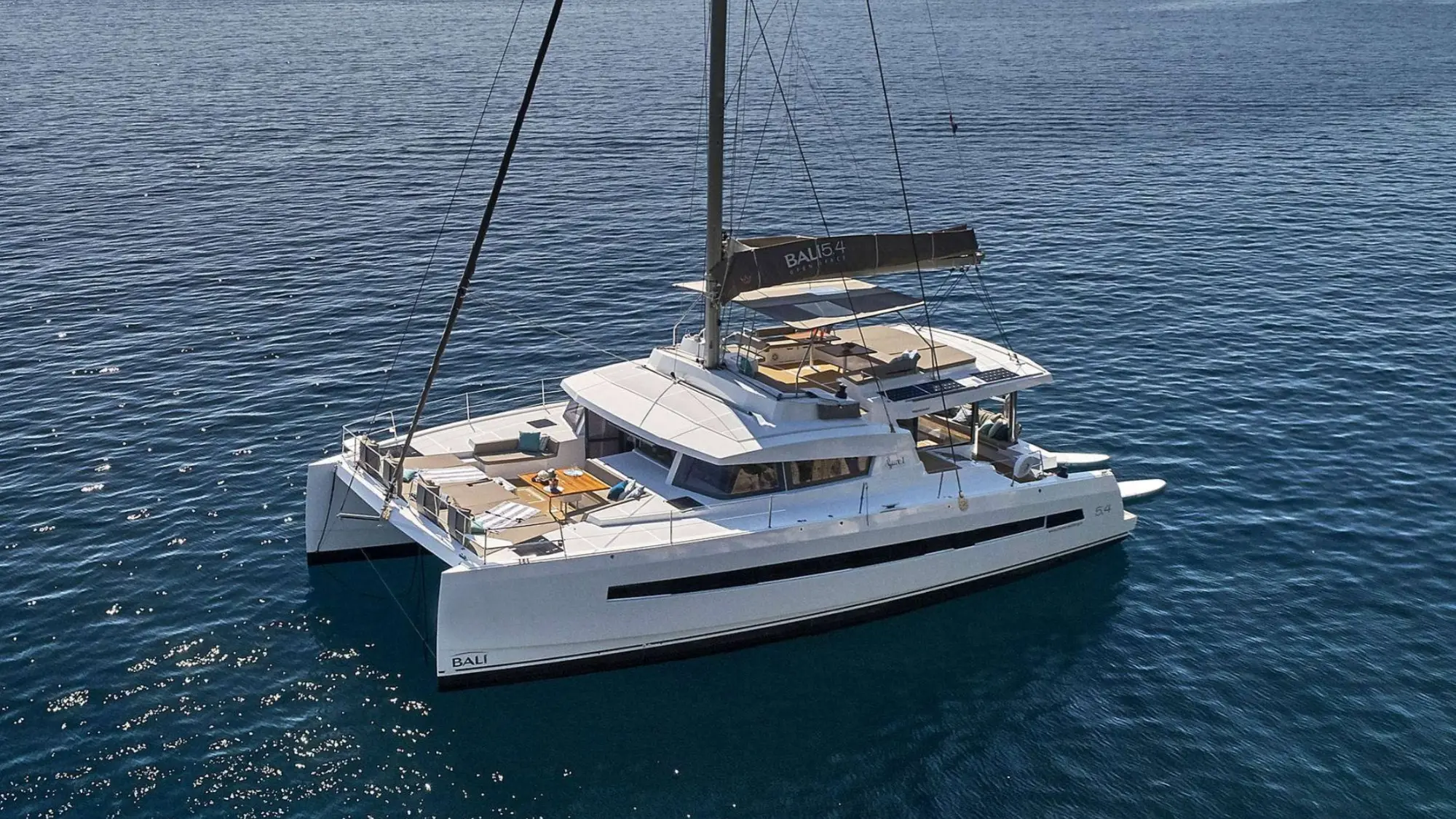
Absolutely. Bali catamarans are one of the fastest-growing segments of the Caribbean charter fleet. Dream Caribbean Blue alone added 10 Bali catamarans to their BVI fleet in 2022, bringing their total to 17 Bali sailing cats (Catamaran Gurus, 2022). You’ll find them available for both bareboat and crewed charters across the British Virgin Islands, the USVI, the Bahamas, Antigua, and Martinique.
The global yacht charter market hit USD 8.98 billion in 2025 and is projected to reach USD 18.20 billion by 2034, growing at 8.19% CAGR (Fortune Business Insights, 2025). Catamarans in the 40-55 foot range — where Bali dominates — are driving a significant share of that growth. Caribbean destinations remain the largest single market.
Where can you charter Bali catamarans worldwide?
Beyond the Caribbean, Bali yachts are available for charter across the world’s top sailing destinations. Croatia leads the Mediterranean market with dozens of Bali cats in Split, Dubrovnik, and Trogir. Greece, particularly the Cyclades and Ionian Islands, has seen rapid adoption. Thailand’s Phuket and the Andaman Sea round out the Asia-Pacific options.
The global catamaran market is valued at USD 2.23 billion in 2025 and projected to reach USD 2.92 billion by 2030 at a 5.51% CAGR (Mordor Intelligence, 2025). Catana Group plans to double North American sales by 2030 — so expect even more Bali cats in charter fleets soon.
What Bali catamaran models are available for charter?
The current Bali lineup spans eight sailing models, from the entry-level Catsmart at 38 feet to the flagship 5.8 at 58 feet. Charter fleets most commonly stock the Catspace (40 ft), the 4.6 (46 ft), and the 5.4 (54 ft) — these hit the sweet spot for group size, charter pricing, and handling ease.
The Catspace and 4.4 are popular bareboat options, typically configured with 3-4 cabins and 2-4 heads. They handle well under sail and offer enough space for 6-8 guests without feeling cramped. The 4.6 steps up to 4-5 cabins and is the most requested Bali yacht for crewed charters in the Caribbean. For larger groups or luxury crewed experiences, the 4.8, 5.4, and 5.8 deliver the full Bali experience: vast cockpits, a forward lounge, and living space that makes guests forget they’re on a boat.
View data table
| Model | LOA (ft) | Base Price (EUR, ex-VAT) |
|---|---|---|
| Catsmart | 38 | €337,500 |
| Catspace | 40 | €397,000 |
| 4.2 | 42 | €486,500 |
| 4.4 | 44 | €597,000 |
| 4.6 | 46 | €671,000 |
| 4.8 | 48 | €848,000 |
| 5.4 | 54 | €1,213,876 |
| 5.8 | 58 | €1,460,000 |
Your Bali Vacation
How much does a Bali catamaran charter cost?
Bareboat charter rates for a Bali Catspace or 4.2 start around $4,000-6,000 per week in the Caribbean during shoulder season. Peak season (December through April) pushes that to $6,000-9,000/week for the same boats. Crewed charters on larger models like the 4.8 or 5.4 range from $15,000 to $35,000+ per week, all-inclusive.
Bali charter rates tend to run 5-15% below comparable Lagoon models in the same fleet, reflecting the lower acquisition cost for charter companies. For a deeper breakdown of what goes into charter pricing — APA, crew gratuity, provisioning — check our yacht charter costs guide.
What’s the difference between Bali and Lagoon catamarans?
This is the question every charterer asks. We’ve sailed both brands extensively and they serve different priorities. Lagoon is the world’s largest catamaran builder with over 7,000 hulls since 1984 (Wikipedia, 2025). Bali is the fast-growing challenger with 1,500+ since 2014. For our detailed Lagoon breakdown, see our Charter Kings: Lagoon Catamarans FAQ.
| Feature | Bali | Lagoon |
|---|---|---|
| Foredeck | Solid platform with forward cockpit | Traditional trampoline netting |
| Indoor/outdoor flow | Bali Door (full-width tilting panel) | Sliding glass doors |
| Hull core | Closed-cell foam | Balsa wood |
| Sailing performance | Good; comfort-oriented | Good; slightly better upwind |
| Global fleet size | 1,500+ boats | 7,000+ boats |
| Service network | Growing (tied to Catana Group) | 233+ service centers worldwide |
| Price (comparable 46-ft) | ~EUR 671,000 | ~EUR 790,000 |
| Best for | Entertainers, families, open-plan lovers | All-rounders, first-time charterers |
Our observation: After placing dozens of clients on both Bali and Lagoon charters, the feedback pattern is consistent. Families with teenagers and couples traveling together prefer Bali for the forward lounge and indoor-outdoor flow. First-time charterers and bareboat sailors gravitate toward Lagoon for the larger service network and crew familiarity.
Why are Bali catamarans great for yacht vacations?
Three words: space, flow, and flexibility. A Bali 4.6 gives you two full cockpits (aft and forward), a salon that opens completely to the outdoors via the Bali Door, and cabin layouts that sleep 8-12 guests comfortably. There’s simply more usable living area per foot of boat length than on any competitor.
That layout solves a real vacation problem. On a week-long charter with 8 people, privacy and personal space become critical by day three. A forward lounge where two people can read while six others grill in the aft cockpit? That’s the difference between a good trip and a great one. Compared to a luxury resort at the same price point, a Bali yacht gives you a new anchorage every morning and none of the resort crowds.
Related Resources
Explore these guides to plan your catamaran charter vacation:
- Charter Kings: Popular Charter Yacht Brands — Our complete guide to every major catamaran brand in the Caribbean fleet
- Charter Kings: Lagoon Catamarans — The full FAQ on the world’s most popular charter catamaran brand
- Caribbean Charter Destinations Guide — Which island is right for your group in 2026
- Bali Catamarans Official Model Range — Specs, layouts, and configurator for every current model
- Catana Group — Corporate info, investor relations, and brand portfolio
Still Have Questions?
Didn’t find the answer you need? Reach out to our charter team — we’ve helped hundreds of guests match the right catamaran to their vacation. Whether you want a bareboat Bali Catspace in the BVI or a crewed Bali 5.4 in Greece, we’ll walk you through the options.
Jason Acosta is the co-founder and principal broker of Vital Charters. He is an avid sailor and yacht charterer. Jason is also a Master Diver and certified ASA 104 sailor.