
If you have ever tried to plan a group yacht charter and hit a hard ceiling at 12 guests, you have run into what people casually call the “12 Person Yacht Rule.” It is one of the most common points of confusion in private yachting because it feels like an arbitrary hospitality policy.
In reality, it is mostly a maritime safety and vessel classification rule. In much of the world, once you carry more than 12 passengers, the yacht is no longer treated as a “yacht” for regulatory purposes, it becomes a passenger ship, with a much higher safety standard and inspection regime.
Below is what the rule means, why the number is 12, the history behind it, where and when it can be exceeded, and what to do if your vacation group is larger.
TL;DR
- The “12 Person Yacht Rule” limits 12 passengers (guests), not 12 people total. Crew are counted separately.
- The threshold comes from international maritime law (SOLAS), which classifies vessels with more than 12 passengers as passenger ships.
- Exceeding 12 guests requires a differently certified vessel with stricter safety standards.
- For groups of 13+, options include certified passenger yachts or chartering two yachts together.
What the “12 Person Yacht Rule” actually means (and what it does not)
First, the wording matters:
- The rule is typically 12 passengers (guests), not “12 humans total.”
- Crew do not count as passengers in the international definitions used for safety rules.
- The rule is not about whether you are in the British Virgin Islands, the Mediterranean, or anywhere else. It is mainly about how the vessel is certified and regulated.
On most private charters, you will see language like “12 guests + crew”. That is the practical outcome of international passenger-ship definitions.
Passenger vs. crew: the key legal distinction
Internationally, the definition of passenger used for safety conventions generally excludes:
- The master and crew
- People employed or engaged in any capacity on board (for example, yacht staff)
That means a yacht might legally carry 12 guests plus 4 to 20 crew, depending on its size and service style.
Why 12? The maritime law behind the limitation
The “12” is not a random charter-industry tradition. It traces to the most influential global safety treaty for ships:
- The International Convention for the Safety of Life at Sea (SOLAS), overseen by the International Maritime Organization (IMO).
Under SOLAS, a “passenger ship” is broadly defined as a ship that carries more than 12 passengers. Once a vessel is a passenger ship, it typically must comply with extensive requirements covering construction, stability, fire safety, lifesaving appliances, radio, operational procedures, and more.
You can see SOLAS referenced directly on the IMO’s official page here: International Convention for the Safety of Life at Sea (SOLAS), 1974 (IMO),-1974.aspx).
How countries apply SOLAS to yacht charters
SOLAS is an international convention, but it is implemented through:
- The yacht’s flag state rules (where the yacht is registered)
- Port state control (the country whose waters/ports the yacht is visiting)
Most charter yachts are structured to stay on the “commercial yacht” side of the line (12 passengers or fewer) because moving into “passenger ship” compliance is a major leap in:
- Design and build requirements
- Certification and inspections
- Crewing and training standards
- Operating cost
The history: why maritime regulators got strict about passenger safety
SOLAS exists because maritime travel, especially with passengers, has historically carried serious risk. Major incidents in the early 20th century pushed governments toward shared, enforceable safety standards.
- The sinking of the Titanic (1912) is widely recognized as a catalyst for the first SOLAS convention.
Over time, SOLAS was updated to reflect new technology, new risks, and new lessons. The modern SOLAS framework (1974, with ongoing amendments) is the backbone of today’s global passenger safety standards.
The takeaway for charterers: the 12-passenger threshold is a regulatory tripwire. Cross it, and the yacht is treated like a different category of ship.
What changes if you want 13+ guests on one yacht
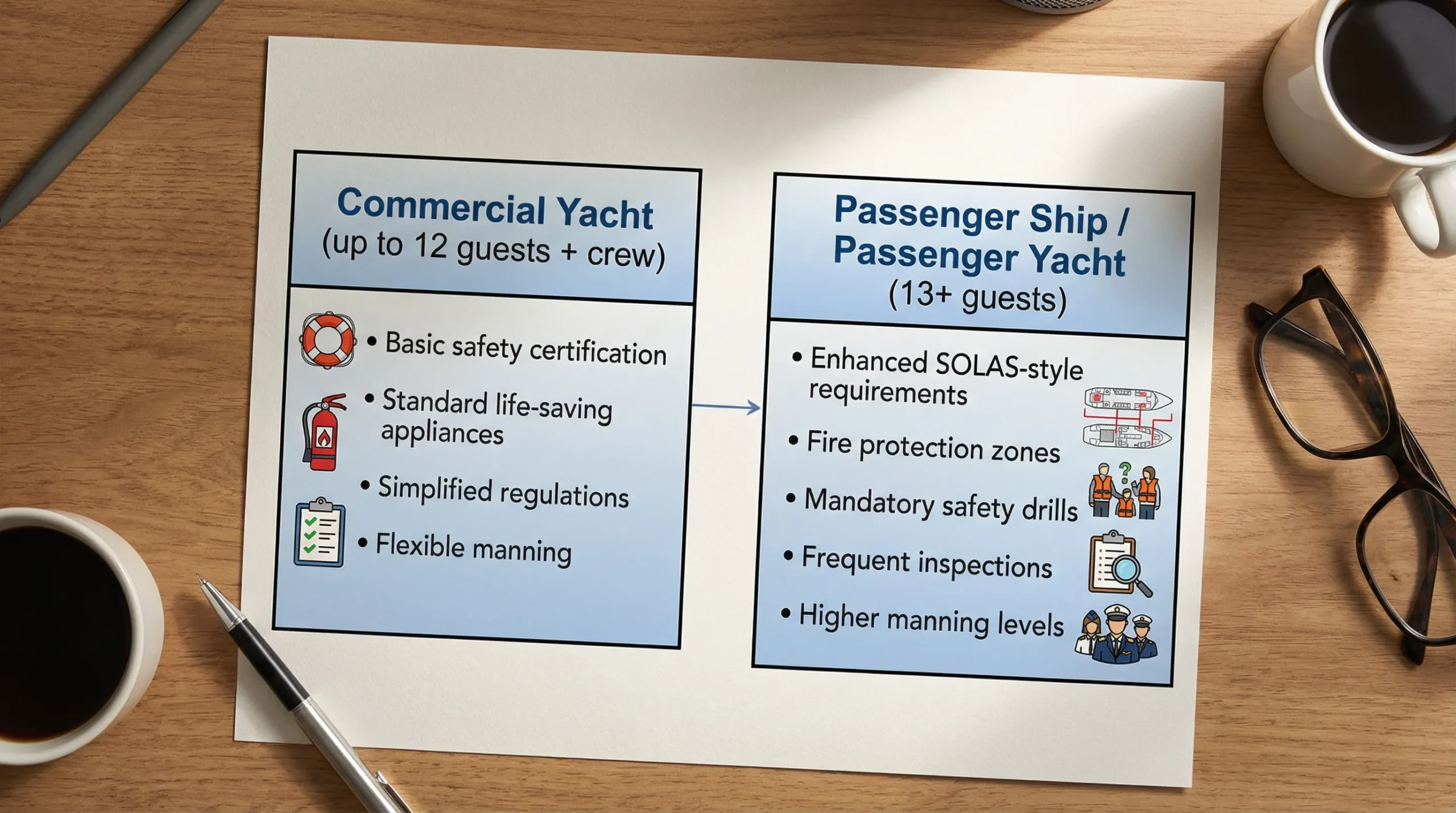
When a yacht carries more than 12 passengers, it generally must meet passenger vessel requirements. Those often include stricter standards for:
- Fire protection (materials, detection, suppression, subdivision)
- Lifesaving appliances (liferafts, lifejackets, rescue craft capacity)
- Damage stability and survivability criteria
- Safety management systems, drills, and documented procedures
- Crew qualifications and manning levels
This is why most “luxury yacht charter” options top out at 12 guests. The global fleet of true passenger-certified yachts is much smaller.
A U.S. example: the rule shows up differently, but the concept is the same
In the United States, there are clear legal definitions and categories for passenger vessels.
- Federal law defines terms around passenger vessels in 46 U.S. Code § 2101: 46 U.S. Code § 2101 (Definitions).
In practice, many U.S. operators distinguish between:
- Uninspected passenger vessels (commonly capped at 6 passengers, depending on the operation)
- Inspected passenger vessels that can legally carry more than 12, but only after meeting inspection and certification requirements under U.S. Coast Guard rules
This illustrates the universal pattern: if you want more guests, you can do it, but the boat must be built and operated to a higher standard.
Places where the 12 Person Yacht Rule does not apply (in the way most people mean)
Most travelers ask this because they want to charter in a specific destination and bring 13, 15, or 20 guests on one yacht.
The most accurate answer is:
It is not the destination that “turns off” the rule. It is the yacht’s certification and flag-state framework.
That said, there are a few well-known pathways where you will see yachts legally carrying more than 12 guests.
1) The United States (on properly inspected passenger vessels)
In U.S. waters, the “12 guest max” is not universal. You can charter boats with more than 12 passengers if the vessel is:
- Inspected and certified for that passenger count, and
- Operated within the terms of its certification
If you are planning a corporate event, large day charter, or celebration in U.S. waters, this is one of the most common scenarios where groups exceed 12 on a single vessel.
2) SOLAS passenger ships worldwide (large yachts that are truly passenger-ship compliant)
Some very large vessels (including cruise ships, but also a small subset of large “yacht-like” vessels) operate as SOLAS passenger ships.
In these cases, carrying more than 12 passengers is not an exception, it is the whole point of the vessel’s certification.
3) “Passenger yacht” frameworks under certain flag states (purpose-built 13 to 36 guest yachts)
A limited number of yachts are built and certified under passenger yacht codes designed to bridge part of the gap between:
- 12-guest commercial yachts, and
- full passenger ships
These yachts are sometimes marketed as “pax yachts” and may carry up to 36 passengers (depending on the specific code, vessel, and certification).
Because this area is technical and flag-specific, the safest planning approach is to ask your broker to confirm, in writing:
- The yacht’s flag
- The yacht’s certified passenger count
- Any operating limitations relevant to your itinerary
Why brokers and operators rarely “bend” this rule
Beyond legal compliance, there are practical reasons reputable operators stay strict:
- Safety and evacuation math changes dramatically with more guests.
- Insurance and liability depend on operating within certification.
- Port clearance and inspections can expose non-compliance quickly.
If you are traveling internationally, it is also smart to align your personal coverage (medical, trip interruption, liability) with the realities of remote cruising. If you live in or are traveling through the UAE, a comparison platform like InsuranceHub.ae for buying insurance online can be a convenient place to review travel and health insurance options before you depart.
So what do you do if you have more than 12 people in your group?
You have three realistic options.
Option A: Split into two yachts (often the best luxury outcome)
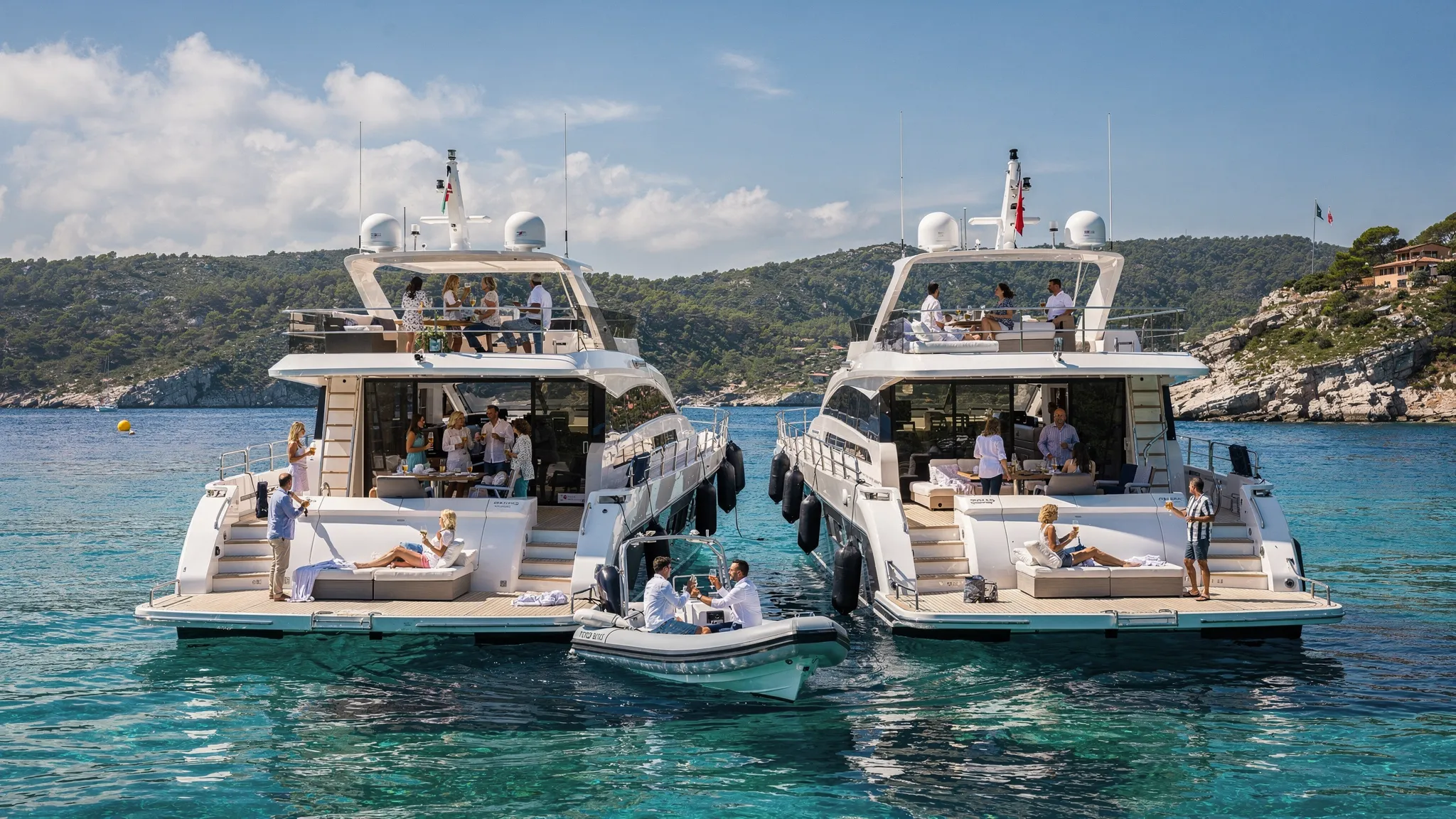
For many groups, the most seamless solution is to charter two yachts traveling together, sometimes called a tandem charter. You keep the experience private and premium, while making logistics (cabins, dining, activities) easier rather than harder.
This approach is especially popular for Caribbean yacht charter itineraries with short cruising distances, like the British Virgin Islands.
If that sounds like your group, you may find this helpful: Why BVI tandem charters are ideal for groups.
Option B: Choose a certified passenger yacht (13+ guests on one vessel)
This is the “single yacht, larger group” solution, but availability is limited and pricing can be different because the vessel is in a different regulatory class.
This option can be a great fit for:
- Corporate groups that want everyone together
- Multi-family trips that prioritize shared dining and events
- Hosted retreats with a structured program
Option C: Reframe the trip: 12 guests onboard, others join for day experiences
In some destinations, you can combine:
- A 12-guest private yacht charter for the core group, with
- Additional friends or colleagues joining for a day boat, beach club meet-up, or shoreside event
This can work well in areas like St. Barts, the U.S. Virgin Islands, and parts of the Mediterranean where shoreside logistics are straightforward.
Quick reference: what “12 guests” changes in charter planning
| Topic | Up to 12 guests (typical charter yacht) | 13+ guests (passenger yacht / passenger ship) |
|---|---|---|
| Regulatory category | Generally treated as a yacht (commercial yacht codes) | Generally treated as a passenger vessel category |
| Availability | Very high (most of the charter fleet) | Limited (specialized vessels) |
| Cost drivers | Charter fee, provisioning, fuel, crew gratuity | Higher compliance costs and certification overhead often reflected in pricing |
| Best for | Family trips, friends’ vacations, most group charters | Larger corporate groups, hosted events, certain big family reunions |
Common misconceptions about the 12 Person Yacht Rule
“It’s a Caribbean rule”
Not exactly. The Caribbean (including the BVI) is simply a place where many yachts operate under common commercial yacht codes that align with the SOLAS passenger-ship threshold.
“If we pay more, the captain can allow 14”
A reputable captain cannot override vessel certification with a preference. If a yacht is certified for 12 passengers, carrying 13 is not a luxury upgrade, it is a compliance problem.
“Kids don’t count”
In passenger-count rules, a child is still a passenger.
“Crew counts toward the 12”
In most commonly used international definitions, crew do not count as passengers. That is why you see “12 guests + crew.”
Frequently Asked Questions
Is the 12 Person Yacht Rule the same as “12 guests plus crew”? Yes. In normal charter language, the rule limits passengers (guests) to 12, while crew are counted separately.
Why is the number 12 specifically used in yacht charters? Because international safety frameworks (notably SOLAS) treat a vessel carrying more than 12 passengers as a passenger ship, which triggers significantly stricter requirements.
Can I charter a yacht with 20 guests in the British Virgin Islands? Possibly, but only if the vessel is certified to carry that many passengers (for example, a passenger ship or passenger yacht). Most classic luxury crewed yachts in the BVI are limited to 12 guests.
Are there destinations where the 12-person rule is ignored? Reputable operators should not “ignore” it. What changes is whether the yacht is inspected/certified to carry more than 12 passengers under the applicable flag-state and local rules.
What is the best solution for a group of 14 to 24 people? Most groups get the best experience by booking two yachts with coordinated itineraries, especially in island-hopping destinations like the BVI.
Does a day charter follow the same 12-person limit? Not always. In some places (notably the U.S.), inspected passenger vessels can legally carry more than 12 for day charters, depending on certification.
Plan the right yacht (or yachts) for your group
If your trip is bumping up against the 12-guest limit, the goal is not to force-fit the group onto the wrong boat. The goal is to match your guest count, itinerary, and comfort expectations to a yacht that is properly certified and genuinely enjoyable.
Vital Charters can help you evaluate options like two-yacht itineraries for groups, or sourcing a vessel that can legally accommodate a larger party, then tailor the destination and pacing around your group’s priorities. Start exploring at Vital Charters.