
How to Tip Yacht Crew: The 2026 Guide for Charterers
You’ve just spent a week aboard a crewed yacht. The chef nailed every meal. The captain found secluded anchorages you’d never discover on your own. Now comes the part nobody talks about until it’s awkward: the tip. How much is enough? Is cash still expected? And who actually gets the money?
Crew gratuities are the single most misunderstood line item in chartering. MYBA (the Mediterranean Yacht Brokers Association), the global standard-setting body for crewed charter contracts, recommends 5–15% of the base charter fee. However, in practice American clients typically tip 15–20%, while European guests tend toward 10–15% (Dockwalk, 2026). That gap creates real confusion, especially for first-time charterers who want to do the right thing without overpaying. If you’re still wrapping your head around what your charter fee actually covers, tipping is the one expense that sits entirely in your hands.
This guide breaks down exactly how much to tip yacht crew in 2026, when to go above or below the standard, and how to handle the handoff — whether you’re paying cash, wiring funds, or splitting the bill digitally.
TL;DR: Tip your yacht crew 10–20% of the base charter fee, calculated before APA or taxes. MYBA’s standard is 5–15%, but U.S. clients average 15–20% (Dockwalk, 2026). Hand cash directly to the captain on the last evening, or wire through your broker.

How Much Should You Tip Yacht Crew in 2026?
The global yacht charter market hit $9.30 billion in 2025 and is projected to reach $9.80 billion in 2026 (Mordor Intelligence, 2025). As a result, more first-time charterers are asking this exact question. The short answer: tip 10–20% of the base charter fee. But the right number depends on where you’re sailing and what kind of service you received.
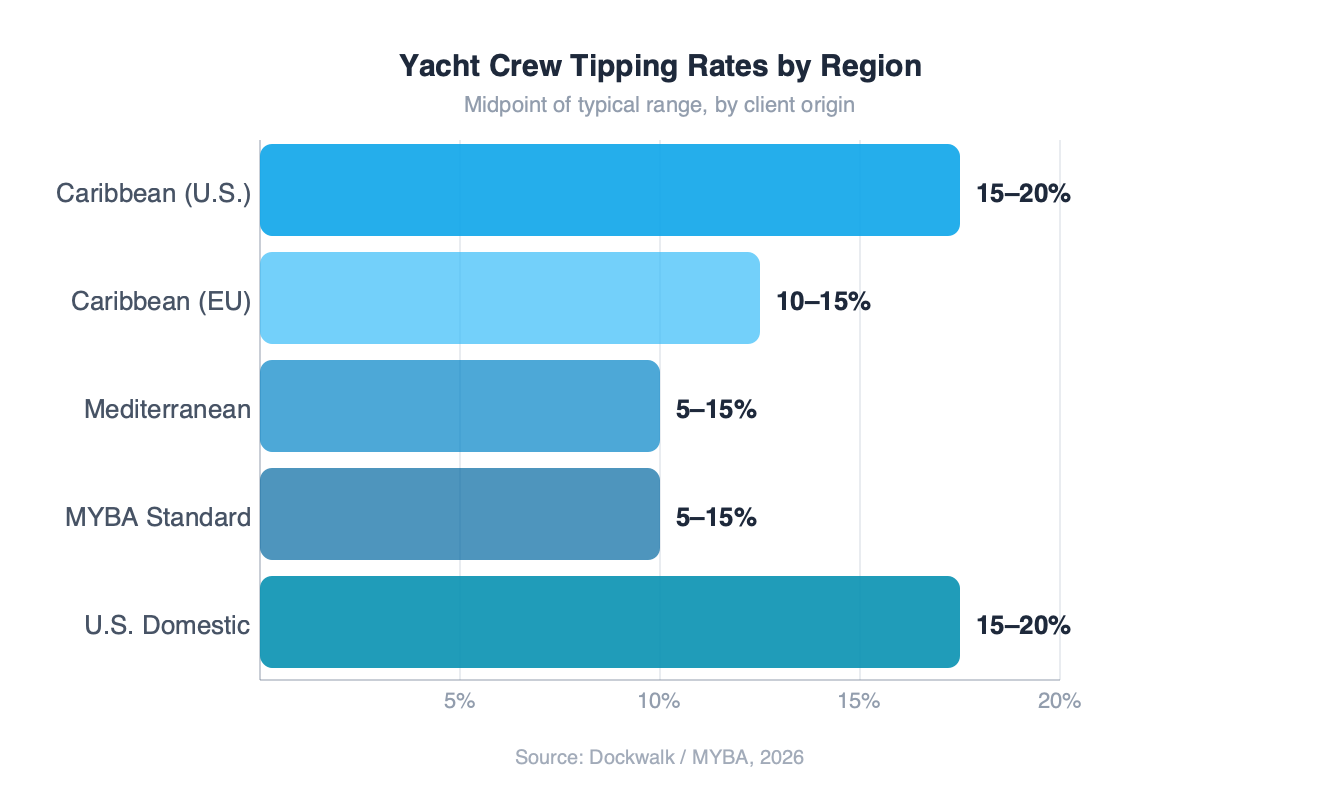
Here’s how gratuity expectations break down by region:
- Caribbean (U.S. clients): 15–20% is standard, because American tipping culture carries over to the water.
- Caribbean (European clients): 10–15% is typical — still generous by continental standards.
- Mediterranean: 5–15%, with 10% as the comfortable middle. Europeans book the Med more than anyone, and expectations reflect that.
- MYBA guideline (global): 5–15% of the contracted gross charter fee, with 10% as the baseline for a satisfactory week (Dockwalk, 2026).
- U.S. domestic voyages: 15–20%, consistent with restaurant and hospitality norms stateside.
An important distinction: you calculate tips on the base charter fee only. Don’t include the APA (Advance Provisioning Allowance), VAT, delivery fees, or insurance. If your charter costs $50,000 per week with a $15,000 APA, your tip range is based on $50,000 — not $65,000. For more details, see our guide on hidden fees in yacht charters:. For a detailed breakdown of these costs, here’s what’s included in a MYBA charter contract.
What Is the 10% Rule for Yachts?
You’ll hear “just tip 10%” tossed around in forums like it’s gospel. That number comes directly from MYBA, which recommends 5–15% of the gross charter fee with 10% as the standard for a week-long voyage (Dockwalk, 2026). It’s a safe middle ground — not stingy, not lavish.
That said, 10% is really the European baseline. If you’re sailing in the Caribbean or anywhere in the U.S., the crew will likely expect closer to 15–20%. This doesn’t mean 10% is wrong. Rather, it means 10% signals “the service was fine” while 15%+ signals “the crew went above and beyond.” As a rule of thumb, consider 10% your floor, not your target, whenever the crew delivered a memorable week.
Our finding: After brokering dozens of crewed charters across the Caribbean, we’ve noticed that clients who plan their tip amount before boarding — rather than deciding on the last night — consistently tip closer to the 15–20% range. Removing the decision pressure lets you focus on the experience.
Do Yacht Crew Get Paid on Top of Tips?
Yes — but base salaries alone don’t tell the whole story. Entry-level crew (deckhands, stewardesses) earn €2,000–€3,500 per month in 2026, while skippers on 80m+ vessels earn $16,000–$19,000 per month. These are livable wages, but consequently, gratuities on busy charter vessels can nearly double a junior crew member’s monthly income.

What makes this even more striking: entry-level crew compensation has barely moved in 15 years. A deckhand earned €2,000–€2,500 per month in 2008, and they’re earning roughly the same today, while skipper salaries grew from €7,000–€10,000 to €7,000–€15,000 over the same period (Boat International, 2026). Because of this wage stagnation, gratuities aren’t just a nice bonus for junior crew — they’re a meaningful part of take-home pay.
In addition, charter crew commonly work 16–18 hour days from dawn to midnight during guest weeks. When you divide your gratuity by hours worked, the math puts things in perspective. These aren’t people clocking in for a casual shift — they’re running a floating hotel for your family around the clock.
According to Dockwalk’s annual compensation survey, gratuities averaging 10% of the charter fee can add $20,000–$50,000 per year for senior crew members. For entry-level crew on busy vessels, tips during peak season can nearly double their monthly income.
How Are Tips Split Among the Crew?
Tips are distributed equally among all crew members, regardless of role or how much face time they had with guests. The captain receives the tip and divides it evenly. This means the engineer who kept the air conditioning running at 2 a.m. gets the same share as the stewardess who served your cocktails at sunset. Fair? Most crew members think so.
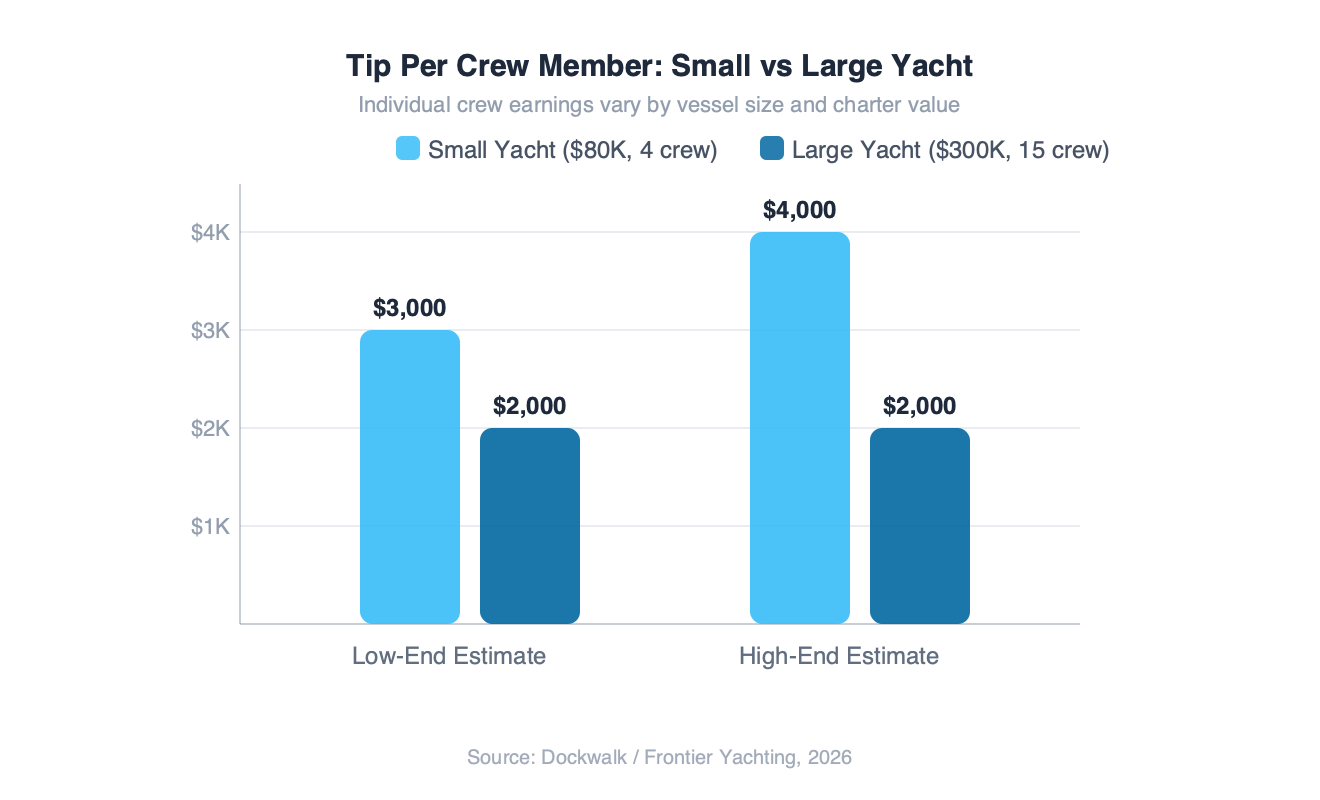
To illustrate, consider a practical example. On an $80,000 Caribbean booking with a 4-person crew, a 15–20% gratuity ($12,000–$16,000) works out to $3,000–$4,000 per crew member. Compare that to a $300,000 superyacht with a 15-person crew — a 10% tip ($30,000) breaks down to just $2,000 per person (Dockwalk, 2026). In other words, a bigger vessel doesn’t always mean bigger individual earnings for the crew.
Should you ever tip individual crew members separately? Generally, no. The captain distributes tips for a reason — it prevents favoritism and ensures behind-the-scenes crew aren’t penalized for working out of sight. The one exception: if a single crew member provided truly extraordinary personal service (a surprise birthday setup, a diving lesson for your kids), a small personal gift or separate cash tip is appropriate on top of the group gratuity.
When Should You Tip More Than the Standard?
Tipping above 15% is warranted when the crew resolves a crisis, customizes the itinerary spontaneously, or delivers exceptional personalization throughout the week. Not every sailing vacation is equal, and some crews turn a good trip into an unforgettable one. Specifically, here’s when going above the standard makes sense:
- The crew handled a crisis. Weather reroutes, mechanical issues, a medical situation — and they kept your family comfortable and safe without missing a beat.
- They customized the itinerary on the fly. You mentioned wanting to see dolphins, and the captain found a pod the next morning. That kind of responsiveness isn’t in the job description.
- The chef accommodated complex dietary needs. Gluten-free, vegan, a picky six-year-old, and a shellfish allergy — and every meal was still exceptional.
- They went beyond service into hospitality. There’s a difference. Service is refilling your glass. Hospitality is remembering you prefer rosé with lunch and white Burgundy at dinner without being told twice.
Our finding: We’ve seen the strongest tip correlations not with yacht size or destination, but with how well the crew personalizes the experience. Charterers who receive a pre-arrival questionnaire and see those preferences reflected onboard tip 20%+ almost every time.

Conversely, 5–10% is appropriate if service was merely adequate — meals were fine but uninspired, the crew was professional but disengaged, or there were recurring issues that weren’t addressed. Tipping below 5% sends a strong message and should be reserved for genuinely poor experiences. If you’re considering that range, it’s worth flagging the issues with your broker first so they can address it directly with the management company.
How Do You Actually Hand Over the Tip?
Cash is still king on charter vessels, but it’s not your only option anymore. Below is how each method works in practice:
Cash (Still the Most Common)
Hand an envelope directly to the captain on the last evening of your charter. Not the last morning — that feels rushed. Use the local currency of the charter region, or U.S. dollars, which are accepted virtually everywhere. Avoid personal checks (they’re impractical for crew banking) and coins (nobody wants to carry $3,000 in quarters off a boat).
Wire Transfer Through Your Broker
Increasingly popular for higher-end charters. Your broker holds the tip in escrow and transfers it to the captain’s account after disembarkation (Boat International, 2026). This avoids the awkwardness of carrying large amounts of cash and creates a paper trail for both parties. Ask your broker about this option when you book — most major brokerages offer it.
Digital Payment
Some charter management companies now accept tips via bank transfer or payment apps. This is still the exception rather than the rule, and it depends entirely on the management company’s setup. Don’t assume digital is available — always confirm with your broker before the charter.
Unique insight: The shift toward cashless tipping is accelerating, but it hasn’t reached a tipping point (pun intended). Based on Vital Charters’ brokerage data from 2023–2026, approximately 70% of Caribbean charter guests still tip in cash. The wire-through-broker method accounts for most of the rest. Direct digital payments to crew remain rare as of early 2026.

Does Tipping Differ on Bareboat vs. Crewed Charters?
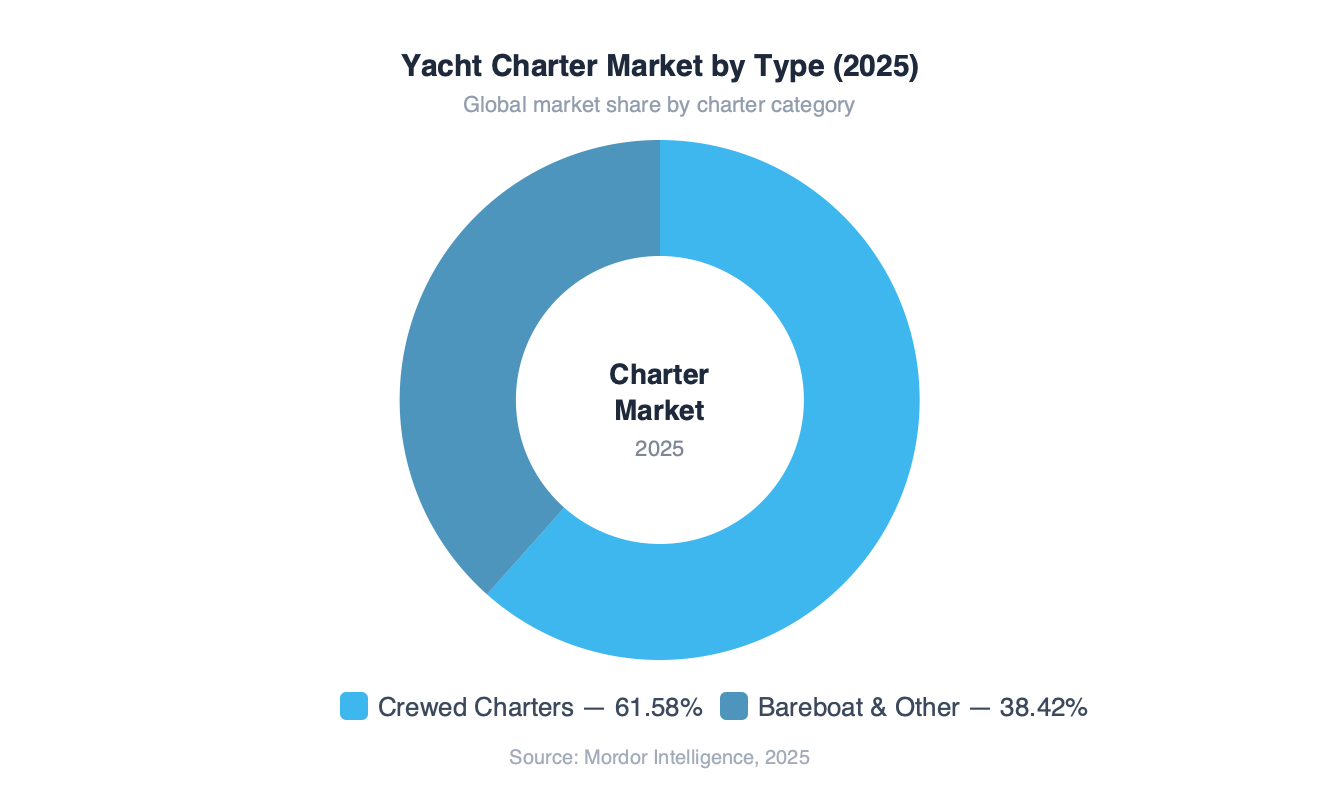
Crewed charters account for 61.58% of the global yacht charter market (Mordor Intelligence, 2025). But what about the other 38%? Tipping on a bareboat is fundamentally different because you’re typically the skipper — meaning there’s no crew to tip.
The exceptions:
- Bareboat with a hired captain: Tip the captain 10–15% of their fee, not the charter fee. A captain-only hire is a different arrangement than a full crew.
- Bareboat with a cook or hostess add-on: Tip them directly, $100–$200 per day is typical for day-hire crew.
- Marina staff and dockside assistance: A $20–$50 handshake tip for help tying up or carrying provisions is always appreciated but not expected.
If you’re exploring Caribbean charter destinations and trying to decide between bareboat and crewed, tipping logistics are one more factor. On a crewed charter, the tip is built into your planning. On a bareboat, you’re managing everything yourself — including whether to tip the marina attendant who helped you dock for the third time.
Quick Yacht Crew Tip Calculator
Don’t want to do the math? Here’s a quick reference based on a one-week charter:
| Charter Fee | 10% (Minimum) | 15% (Standard U.S.) | 20% (Exceptional) |
|---|---|---|---|
| $20,000 | $2,000 | $3,000 | $4,000 |
| $50,000 | $5,000 | $7,500 | $10,000 |
| $80,000 | $8,000 | $12,000 | $16,000 |
| $150,000 | $15,000 | $22,500 | $30,000 |
| $300,000 | $30,000 | $45,000 | $60,000 |
Remember: these amounts cover the entire crew. The captain handles distribution. You don’t need to calculate individual tips for each crew member.
For a full picture of how these fees break down beyond the base rate — including APA, delivery charges, and insurance — here’s a detailed look at what’s included in a MYBA contract.
What About Tipping Etiquette in Different Cultures?
Charter tipping norms vary more by client origin than by destination. Nevertheless, there are a few cultural specifics worth knowing:
- Japan: Tipping can be considered offensive. If you’re a Japanese charterer (or hosting Japanese guests), a thoughtful gift for the crew may be more appropriate than cash.
- Middle East: Gratuities are expected and tend to be generous — often 15–20% regardless of region.
- Australia/New Zealand: Tipping isn’t culturally embedded, so 10% is typical for Aussie and Kiwi charterers.
- U.K.: British guests generally follow the Mediterranean norm of 10–15%.
It’s also important to note that MYBA explicitly states skippers should never solicit gratuities — not verbally, not in writing, not through hints. If a crew member pressures you for a tip, that’s a red flag worth reporting to your broker.
Whether you’re comparing a crewed yacht to a luxury resort or planning your first BVI crewed charter, understanding tipping norms upfront eliminates the last-night scramble.
Frequently Asked Questions
How much do you tip a yacht crew for a day charter?
For day charters (4–8 hours), tip 15–20% of the day rate. On a $5,000 day charter, that’s $750–$1,000 split among the crew. MYBA guidelines don’t specifically address day charters, but U.S. hospitality norms apply (Dockwalk, 2026). Hand cash to the captain at the end of the outing.
Can you tip yacht crew with a credit card?
Most charter yachts don’t accept credit card tips directly. Cash and wire transfers through your broker are the standard methods (Boat International, 2026). Some management companies are adopting digital payment options, but always confirm with your broker before assuming a card is accepted.
Should you tip the captain separately from the rest of the crew?
No. Hand the full amount to the captain, who distributes it equally among all crew. Equal distribution is the industry standard on virtually all charter vessels (Dockwalk, 2026). The skipper doesn’t take a larger share — everyone splits evenly.
Do you tip on a fishing charter?
Yes — 15–20% of the cost is standard for fishing charters in the U.S., consistent with broader U.S. hospitality norms (Dockwalk, 2026). On a $2,000 half-day outing, expect to tip $300–$400 total. If the mate handled bait, tackle, and fish cleaning, they typically receive the majority while the skipper gets the rest.
Is it rude to not tip yacht crew?
It’s not technically required — MYBA guidelines call gratuities “discretionary.” But zero tip sends a clear negative signal. Crew members factor tips into their expected compensation, especially in the Caribbean where 15–20% is the norm (Dockwalk, 2026). If service was poor, tip 5% and explain the issues to your broker.
What to Remember Before You Board
Tipping your crew doesn’t need to be complicated. Here’s a quick summary:
- Calculate on the base charter fee — not APA, VAT, or extras
- Use 10% as your baseline, 15–20% for great service in the Caribbean or U.S.
- Hand cash to the captain on the last evening, or wire through your broker
- Tips are split equally among all crew — you don’t need to calculate individual amounts
- Plan your tip amount before you board — it removes the pressure and lets you focus on the experience
The crew on your vessel is working 16–18 hour days to make your vacation seamless. A fair gratuity isn’t just etiquette — it’s recognition of the work that goes into making a week on the water feel effortless. If you’re still in the planning stages, comparing Caribbean destinations is a great next step — and now you’ll know exactly how to handle the tip when you arrive.
Jason Acosta is the co-founder and principal broker of Vital Charters. He is an avid sailor and yacht charterer. Jason is also a Master Diver and certified ASA 104 sailor.